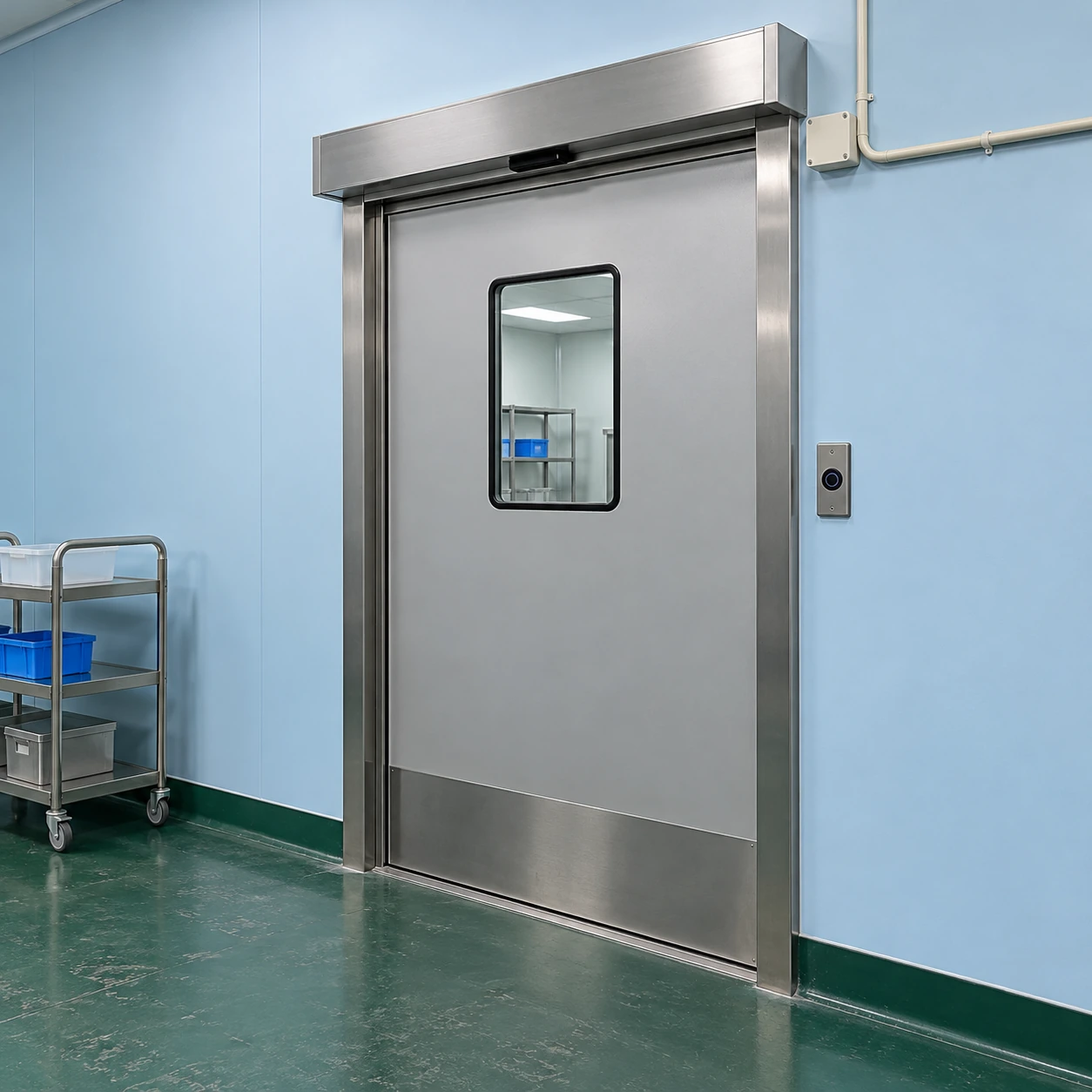
Hermetic Doors
automatic hermetic doors
| Inside-frame opening W × H (mm) | 1000 × 2100; 1200 × 2100; 1500 × 2100 |
|---|---|
| Leaf construction | 50 or 60 mm panel assembly |
| Drive arrangement | Powered sliding travel with coordinated sealing movement |
| Activation | Touchless, push-button, elbow or access-control request |
| Protective functions | Selected presence detection and obstacle response |
| Interfaces | Status contacts, lock control and interlock where specified |
| Electrical supply | Voltage and frequency matched to the selected operator and destination |
| Abnormal operation | Manual release, alarm response and optional backup function |
Controls, locks and detection are selected as a complete operating arrangement. Published size options are not operator load ratings or leakage test results.
Automatic hermetic door dimensions, activation, controls and operating modes can be customized for the process and the surrounding access system.
Automatic hermetic doors combine powered access with a defined closing and sealing action. Their value comes from coordinating those functions: the door must respond to a valid request, protect the passage and reach its intended closed position consistently.
Think of the door as an operating sequence
Release and open
An accepted opening request initiates the cycle. Where a lock or sealing release is included, the controls must coordinate it with movement. Driving against an engaged lock or seal creates unnecessary strain and unreliable operation.
Remain open for the passage
The open period is influenced by the selected mode and protective detection. A person or trolley that pauses in the opening presents a different condition from an empty doorway after a request.
Close and seat
After the path is clear, the operator returns the leaf and the final mechanism seats the seal. The accepted cycle should be smooth and repeatable without impacts or persistent rubbing.
Give each input a defined purpose
A touchless plate, push-button and access reader can all request entry, but they serve different users and traffic patterns. A broad approach sensor may open the door for passing traffic that has no intention of entering. A deliberate request can reduce those interruptions where appropriate.
Protective detection has a separate role. It must address the risks of the actual moving assembly and passage. Selecting an activation method does not remove the need for suitable safety coverage and commissioning.
Use status signals carefully
A closed-position signal can tell another controller that the leaf has reached a defined position. It is not, by itself, a measurement of leakage or proof of room pressure. Keep these meanings separate when connecting the door to a room monitoring or interlock system.
If the process needs a particular condition before another action is allowed, define the actual evidence required and the response to a missing or faulty signal. Avoid relying on a label such as door closed to represent several unverified conditions.
Coordinate normal access with abnormal events
A power interruption, protective-sensor fault and building alarm need not produce the same door behavior. The required response depends on the opening's role, the access arrangement and the approved safety strategy. It must be agreed with the responsible project team.
Backup power may support a selected movement or control function, but its presence does not automatically define an escape route. Manual release, locks, alarms and any interlock should be evaluated as a complete arrangement. Do not add an access-control lock after commissioning without reviewing those effects.
Match the drive to the completed leaf
Door mass changes with surface, glazing, hardware and any special construction. The operator must be selected for that completed leaf and its duty, including the sealing movement. A motor label alone is not a specification for the complete door.
Site conditions matter too. Head support, rail alignment and the floor sealing plane affect movement. A controller should not be expected to compensate for an unstable mounting or a damaged guide. Mechanical fit is established before the operating cycle is commissioned.
For the physical layout of a single-sided or bi-parting assembly, see automatic sliding hermetic doors. Hospital traffic adds further considerations described on automatic hermetic doors for hospitals.
Leave a serviceable system with the owner
The service record should identify the operator, protective devices, control interfaces and accepted modes. Provide the relevant wiring and configuration information so a later repair restores the intended behavior rather than replacing a component in isolation.
Routine observations should look for abnormal noise, rubbing, incomplete travel and unexpected responses. Faulty protective operation requires competent assessment; it should not be worked around by disabling a sensor. Changes to timers, force settings or detection coverage belong in qualified service and recommissioning.
Automatic hermetic door dimensions, activation, controls and operating modes can be customized for the process and the surrounding access system.