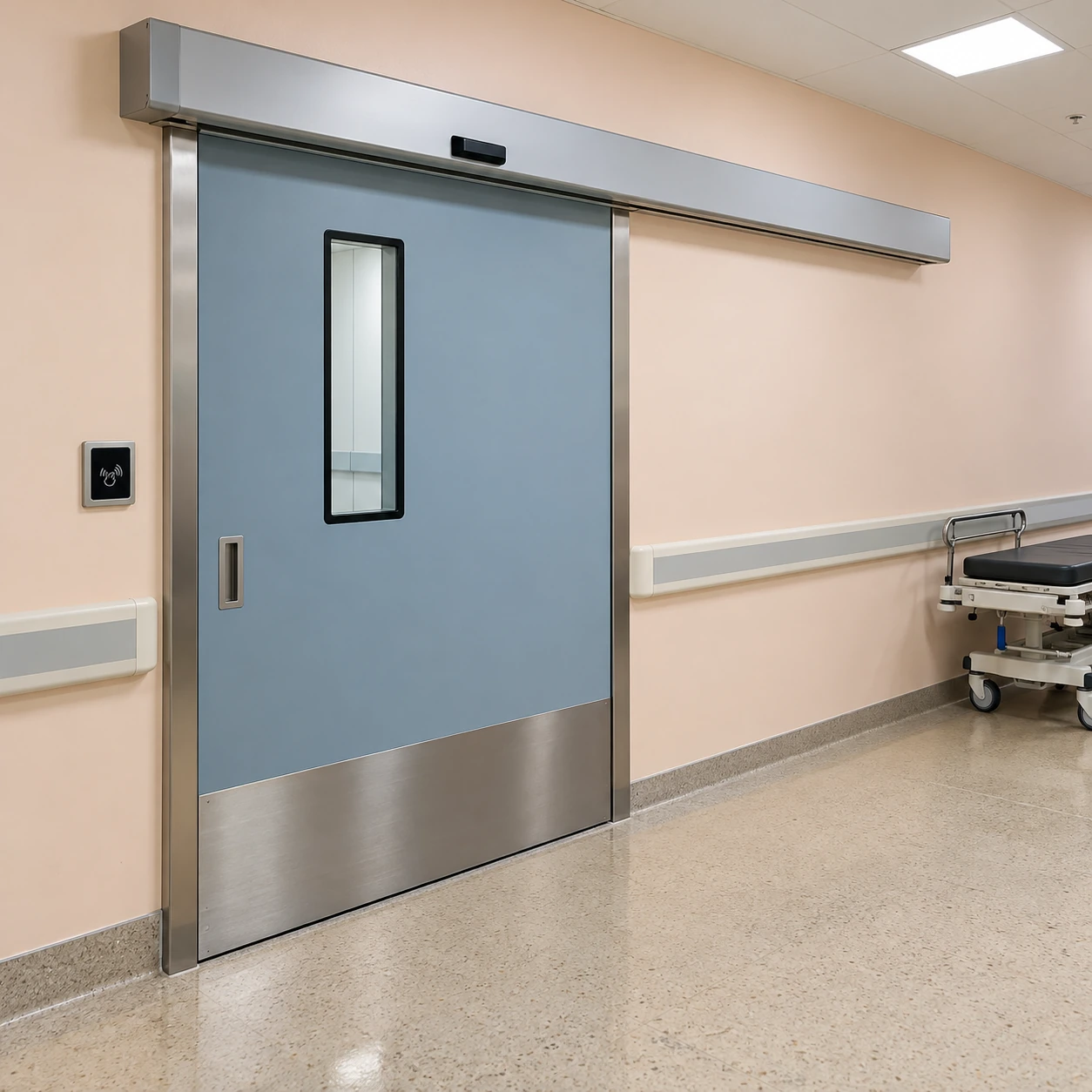
Hermetic Doors
automatic hermetic doors for hospitals
| Inside-frame opening W × H (mm) | 1500 × 2100; 1800 × 2100; 2000 × 2200 |
|---|---|
| Opening arrangement | Single sliding or bi-parting assembly |
| Leaf / finish | 50 or 60 mm panel construction; HPL or stainless facing |
| Vision panel | Optional flush glazing with privacy arrangement |
| Activation | Touchless switch, elbow switch or access-control request |
| Protective detection | Presence and obstacle protection selected for the passage |
| Control interfaces | Door status, lock and approved alarm / access functions |
| Power-loss arrangement | Manual release and optional backup function, as specified |
Opening options do not by themselves confirm bed clearance. Usable passage, approach space and the complete operator envelope are coordinated on the installation drawing.
Automatic hospital door dimensions, activation, glazing and control arrangements can be customized for the room function and clinical traffic route.
Automatic hermetic doors for hospitals need to support people and equipment moving at different speeds. A useful arrangement opens in response to an intentional request, protects the occupied passage and returns to its sealing position without making staff manage the door during every transfer.
Follow the complete transfer, not just the bed width
A bed approaching a doorway carries more than its frame. Side rails, attachments, a staff member at the side and a change in travel direction may all affect the space required. The approach corridor can be the limiting part of the route even where the opening itself appears generous.
Place the opening and its activation point so the team can make a controlled approach. The switch should be reachable before the bed or trolley occupies the closing path. Keep the parked leaf, wall protection and nearby equipment out of that approach space.
Request access
A touchless switch reduces the need to contact a handle, while a deliberate elbow or access-control request can suit another workflow. Select the trigger to avoid repeated unintended openings from traffic passing across the corridor.
Protect the occupied doorway
The activation device and the safety detection have different jobs. A request starts the cycle; protective detection must account for people and equipment remaining in the doorway. A slowly moving or paused transfer must not be managed only by a short timer.
Return to the closed boundary
After the passage is clear, the selected cycle returns the leaf to its sealing position. Door-open time affects how long the room boundary is interrupted, but reducing that time cannot take priority over safe passage.
Coordinate with the room's ventilation design
A sealed door can limit leakage while closed. It cannot maintain the same boundary while a bed passes through, and it does not establish the room's intended pressure relationship. The ventilation designer needs the actual opening pattern, adjacent door arrangement and room use.
For rooms with an interlocked entrance, the controls must reflect the approved operating and emergency strategy. An interlock intended to discourage two doors opening together is not an unconditional command to trap access when an alarm, fault or emergency occurs.
Make cleaning and observation practical
Flush glazing and smooth faces reduce ledges around the viewing area. Privacy options should be selected with the way staff need to observe the adjoining space. A kick plate can protect the lower face from routine contact, but its joints and edges still need to be cleanable.
Check compatibility between the cleaning products, door facing, window seals and perimeter gasket. Changing the surface finish alone does not resolve incompatibility in the seals or bonding materials.
Decide abnormal behavior before handover
Power interruption, an access-control failure and a fire alarm are distinct events. The required response depends on the door location and the facility's approved safety arrangements. Specify the role of manual release, locks and any backup power as separate functions.
Do not assume that every automatic hermetic door must behave identically when power fails. The accepted configuration and instructions need to be understandable to both clinical staff and the maintenance team.
Commission the door with its real use in mind
Qualified commissioning should cover the selected activation, protective detection, full travel, sealing action and relevant control interfaces. The handover should distinguish routine user checks from settings that require a competent service person. If protective operation is faulty, keep the door out of automatic service until it is assessed; do not bypass detection to restore traffic.
For the room-level selection beyond automatic movement, see hermetic doors for hospitals. For a new layout, compare the single-sided and center-opening arrangements on automatic sliding hermetic doors.
Automatic hospital door dimensions, activation, glazing and control arrangements can be customized for the room function and clinical traffic route.