ESD Wrist Straps & Cords
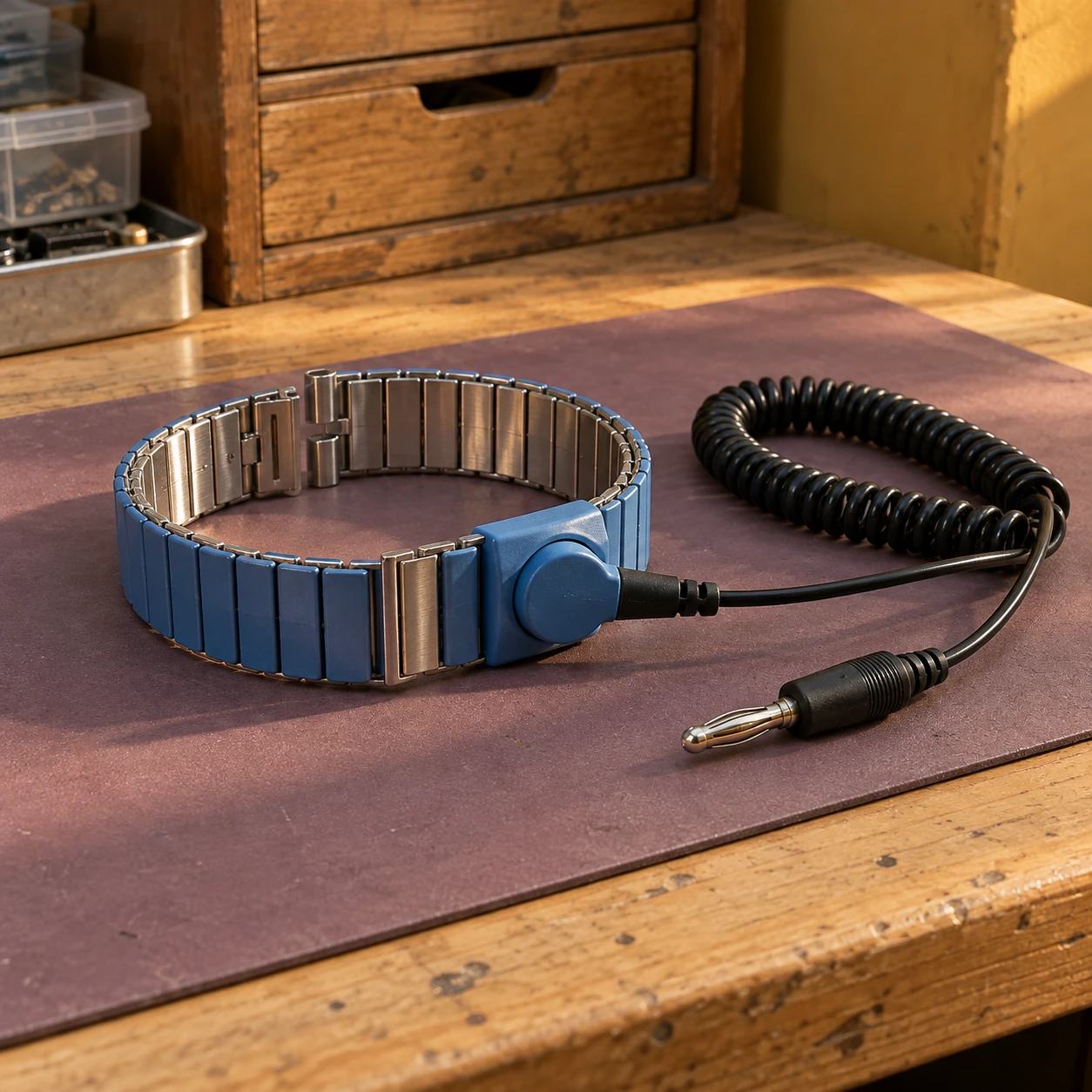
metal esd wrist strap
| Band construction | Stainless-steel inner links; protective outer link surfaces and an insulated snap housing |
|---|---|
| Sizing styles | Fixed-size expansion cuff or adjustable-link cuff |
| Fixed-size circumference | Approximately 140 / 165 / 184 mm unstretched; select a suitable wearer fit |
| Link width | Approximately 16 mm for the fixed-size link construction |
| Wrist connection | 4 mm male snap for a matching single-wire cord |
| Cord length choices | 6 / 12 ft nominal extended length, approximately 1.8 / 3.7 m |
| Cord circuit | Banana ground plug with a 1 MΩ series resistor at the wrist end |
| Supply and monitoring | Cuff only or complete set; dual-wire arrangements selected as a compatible system |
Fixed-size circumference is the relaxed band measurement, not a maximum wrist size. Adjustable-link constructions have their own fit and connector requirements.
Metal cuff sizing, outer finish, cord reach and compatible connections can be configured for your operating routine and workstations.
A metal ESD wrist strap uses moving conductive links to maintain contact around the wrist. Its value in repeated industrial use comes from fit, serviceable connections and a cleaning routine that suits the construction. A metal cuff should be selected as carefully as its cord; an uncomfortable or poorly maintained band can make the whole assembly unreliable.
Fixed-size expansion
A fixed-size cuff uses springing links to open for fitting and settle around the wrist. Offering several sizes avoids asking one highly stretched band to serve every wearer. Choose the relaxed size and contact fit together; the largest opening reached while putting it on is not its intended wearing circumference.
This arrangement can simplify issue and replacement when a team already has a recorded size distribution. Keep the size identity with the band so that an apparently similar spare does not change the fit.
Adjustable links
An adjustable cuff changes the effective band length through its clasp or link arrangement. It can reduce the number of fixed sizes needed, but adjustment must follow that construction's instructions. After adjustment, confirm secure closure, comfortable movement and the worn electrical connection.
Do not improvise link removal or modify the contact surface to obtain a fit. Where a particular wrist cannot be accommodated comfortably, another approved size or band construction is a better choice.
Let the cord leave the cuff without twisting it
A heavy pull from the coil can rotate the snap housing against the wrist or lift part of the band away from skin. Consider the operator's handedness, typical reach and location of parts trays when choosing the cable route. The cord should move with the task without passing under the assembly being handled.
Repeated loads at the snap also affect the connection. A cuff that feels firm on the wrist can still have a worn socket on its lead. Inspect the complete joint and use compatible replacement cords rather than treating every lead as interchangeable.
Make the cleaning decision before choosing metal
The inner links can be wiped, but the gaps, spring elements and housing still need an appropriate method. Specify cleaning agents, exposure and drying expectations when selecting the assembly. A metal surface is not automatically suitable for aggressive disinfectants, immersion or heat processing.
Keep the contact clear
Remove residues using the supplied care method and allow the band to dry. Avoid leaving a coating on the skin-contact side that alters its intended electrical behavior.
Preserve link movement
Look for stiff, bent or separated links and a closure that no longer stays set. A cuff should retain its intended movement without sharp damaged edges.
Confirm after service
Following cleaning, adjustment or replacement, verify the worn assembly under the site's procedure before it returns to sensitive-component work.
Order bands and leads as maintainable parts
Separate the quantity of complete sets from replacement cuffs and cords. An established workstation may need fresh bands without new ground leads, while a recurring cable problem may be solved by a better connection position rather than replacing every cuff.
For a dark outer construction, see the black metal wrist strap. For either finish, specify the circuit and any monitor before substituting components. The assembly controls personnel static charge and is not electrical insulating equipment for energized work.
Metal cuff sizing, outer finish, cord reach and compatible connections can be configured for your operating routine and workstations.