ESD Wrist Straps & Cords
esd wrist strap cords
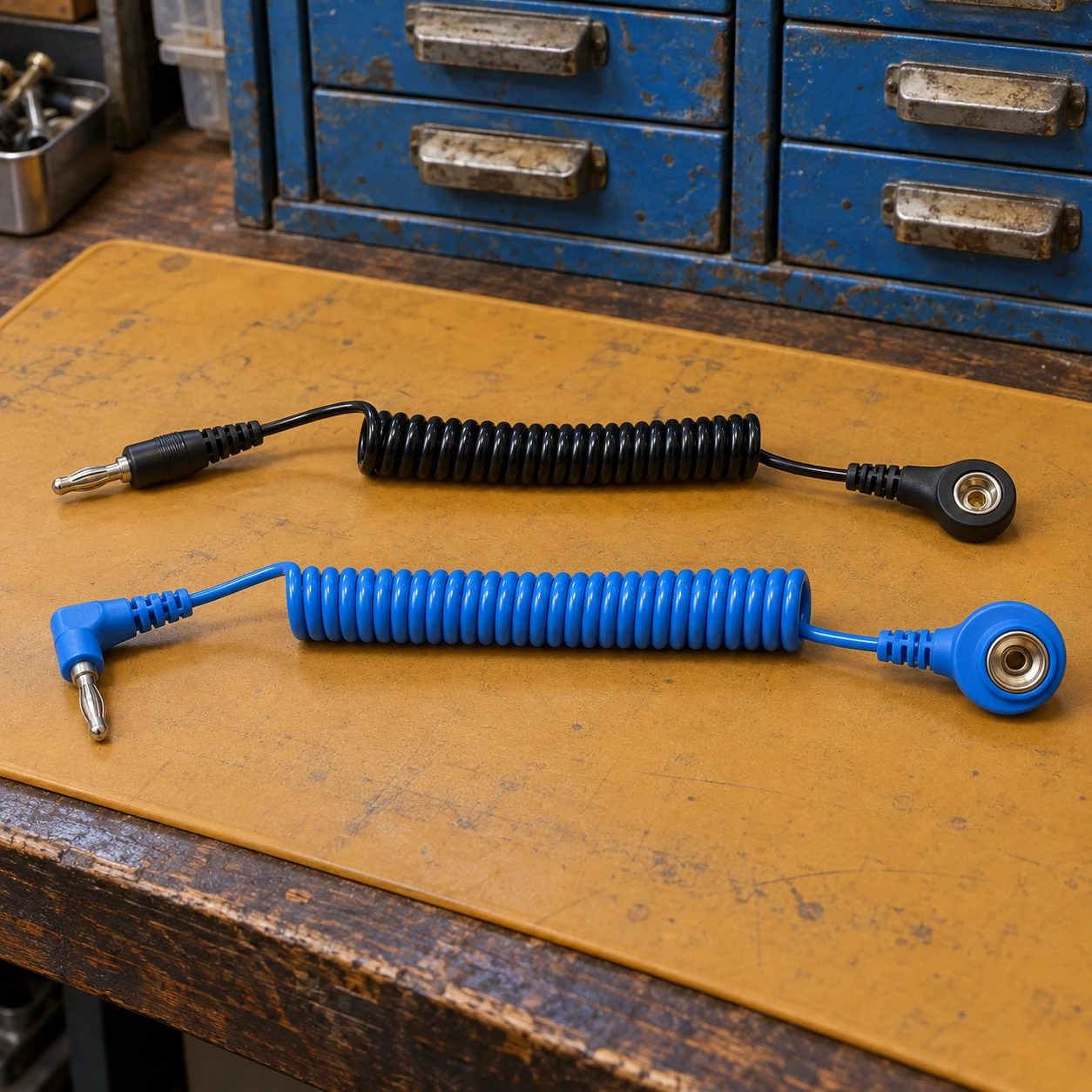
| Cord arrangement | Coiled single-wire grounding cord; matched dual-wire monitor cord by system requirement |
|---|---|
| Single-wire lengths | 6 or 12 ft nominal extended length, approximately 1.8 or 3.7 m |
| Alternative reach | Specify the normal wrist-to-ground-point travel and the allowed cable route |
| Wrist-end connection | 4 mm snap socket; 10 mm variants only with a matching wristband |
| Ground-end connection | Banana plug; straight or right-angle exit selected for the ground-point position |
| Single-wire resistor | 1 MΩ current-limiting resistor molded into the wrist-end assembly |
| Dual-wire circuit | Two separate conductors and the monitor-specified connector/resistor arrangement |
| Mechanical details | Flexible insulated jacket, molded strain reliefs and replaceable complete cord assembly |
Length options depend on the selected end fittings. Connector size, circuit and monitor compatibility are separate checks; extended length is not a relaxed working radius.
Cord length, terminal sizes, plug orientation and compatible monitoring connections can be configured for your workstation layout.
A replacement cord has to preserve the electrical path and the freedom of movement of the original wrist system. Matching only its color or stretched length can leave the operator with a loose snap, excessive pull or a cable that a monitor cannot recognize. Identify both ends and the circuit before ordering spares.
Read the replacement requirement from end to end
- Start at the band. Identify the snap size, socket or stud form and whether the band has one electrical contact path or two. Two snaps of similar appearance may have different retention or contact arrangements; forcing them together is not a reliable fit.
- Trace the cable circuit. A personnel cord incorporates the specified current-limiting resistance. A low-resistance bonding lead intended for equipment or a work surface is not an interchangeable wrist lead. Keep the resistor arrangement documented; do not bypass it to make a tester pass.
- Finish at the workstation. Record the ground jack or monitor connection and the space available around it. A right-angle exit can reduce an awkward projection at a front panel, while a straight plug may suit an unobstructed connection under the bench.
Single wire
A conventional single-wire cord links the conductive band to the designated ground point through its series resistor. Select the wrist socket and ground plug as a pair. It may also be used with a suitable single-wire monitor, but that decision follows the monitor's approved accessories and instructions.
Dual wire
A dual-wire arrangement provides separate paths that a compatible monitor evaluates through the wearer. The band, lead and monitor must be designed to work together. Replacing the cable with a single-conductor cord, or using an adapter that merely fits the socket, can defeat the monitoring function.
Why a longer cord can still feel too short
Catalog length often describes the extended cable. The operator experiences the spring force of the coil, the distance to the connection and the way the cord passes around the bench. Try the intended work movements with an approved sample before standardizing a long production run.
Do not stretch a short lead across a sharp edge or leave a long loop where a drawer, chair or moving fixture can catch it. Moving the designated connection to a sensible location may solve the reach problem more effectively than adding cable length.
Replace faults at the cord level
Loose or damaged ends
A cracked housing, bent plug or snap that releases during normal motion needs attention. The metal tip alone does not reveal the condition of the internal termination.
Intermittent continuity
Repeated bending near a molded end can damage a conductor. Investigate alarms with the approved tester or monitor procedure and remove a suspect cord from service pending confirmation.
Unidentified spares
Store cords by circuit and connector arrangement. Similar-looking leads should not share an unlabeled spares bin, especially where monitored and unmonitored benches coexist.
After replacing a lead, verify the complete worn system before returning to exposed-component handling. The grounding arrangement also needs to be suitable; a new cord cannot correct an unverified ground point. Wrist grounding accessories are not electrical insulating protection.
Cord length, terminal sizes, plug orientation and compatible monitoring connections can be configured for your workstation layout.