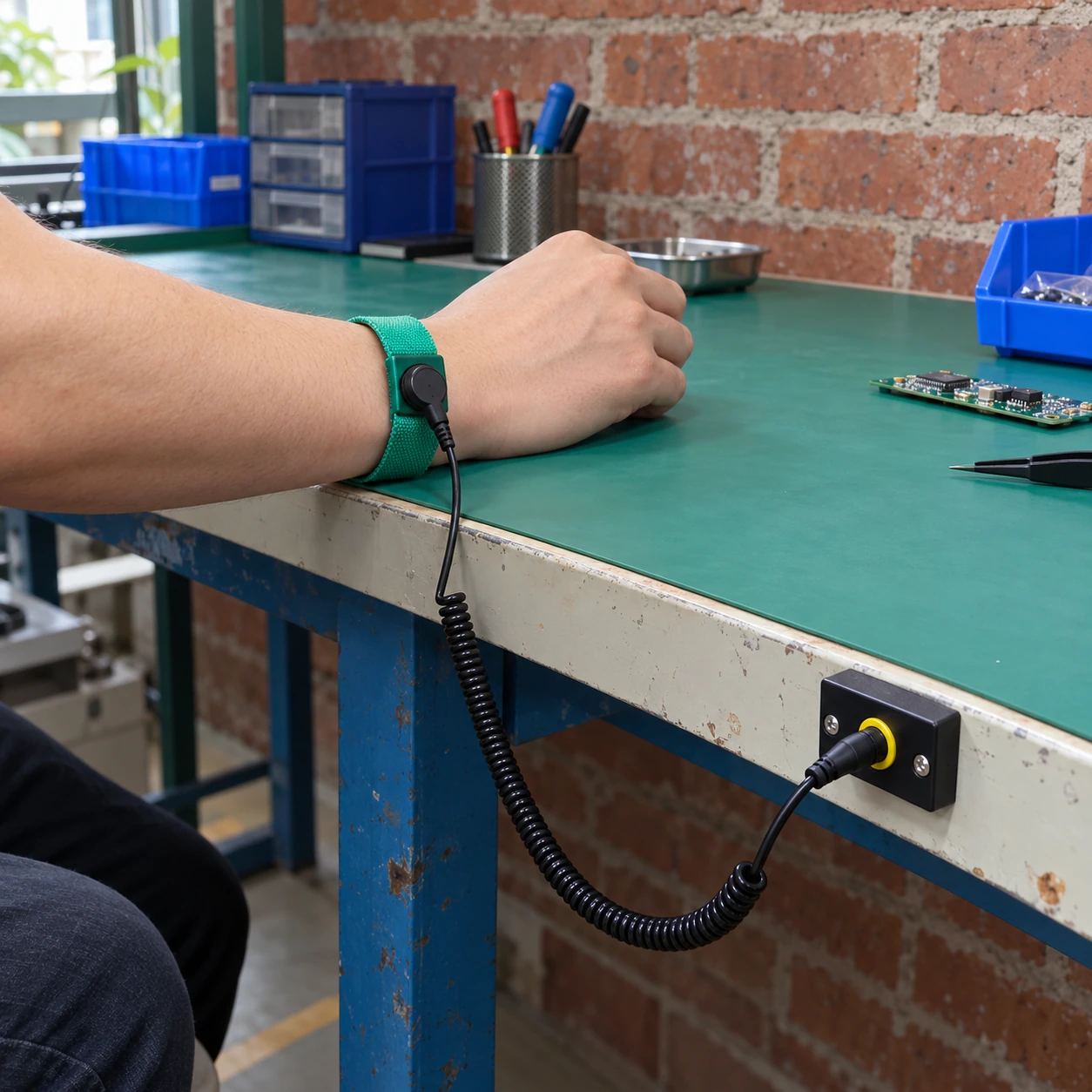
ESD Wrist Straps & Cords
esd wrist strap grounding
| Personnel connection | Adjustable fabric band or metal cuff with a compatible wrist cord |
|---|---|
| Fabric circumference | 120–200 mm adjustable configuration; metal cuff size selected for the wearer |
| Wrist cord reach | 6 / 12 ft nominal extended length, approximately 1.8 / 3.7 m |
| Single-wire interface | 4 mm wrist snap to banana-plug ground connection |
| Current limiting | 1 MΩ series resistor incorporated at the wrist end of the personnel cord |
| Workstation connection | Bench ground block or approved common-point assembly connected to a verified grounding system |
| Work surface | Separate compatible work-surface connection to the workstation common point |
| Verification arrangement | Worn-system tester or compatible monitor, plus a documented workstation ground verification procedure |
A wrist cord, a work-surface lead and a protective-earth bond serve different functions. Select each connection for its intended circuit and installation.
Wrist assemblies and bench connection arrangements can be configured around your working positions, existing grounding system and verification needs.
ESD wrist strap grounding depends on a complete path from the wearer to the workstation's designated reference. A sound band connected to an isolated metal object can leave that path ineffective. Treat the grounding arrangement as a workstation installation, with suitable accessories and verification after changes.
Skin contact → wrist cord → common point → verified ground
Each connection has a different job. The band collects charge from the wearer, the personnel cord provides the specified resistive path, and the common point brings the workstation's ESD connections to a shared reference. The common point must have a verified connection to the site's appropriate equipment grounding system.
Have qualified personnel establish and verify that installation. Do not improvise a connection to a mains terminal, water pipe or unidentified screw. A familiar metal object is not evidence of an acceptable ground.
Place the connection where people actually work
A ground block hidden behind storage boxes invites inconvenient cable routes and accidental disconnection. Locate the approved connection within the operator's normal reach, where the plug can be inserted without pulling on the cord.
Route the wrist lead away from drawer runners, chair castors and moving fixtures. A hanging coil should not become a snagging loop. If the job requires walking between stations, assess a suitable personnel-grounding approach for that task instead of stretching a wrist cable across a walkway.
The work surface and the wearer can share a common point while using their own intended connections. Avoid clipping the wrist lead to the edge of a dissipative mat or passing the wrist path through other accessories in a chain. Those arrangements introduce connections and resistance that may not have been assessed.
Resolve the symptom at the right part of the system
The worn-system test fails
Check fit, direct skin contact, the band, the cord and its connectors using the approved procedure. Substituting a known suitable component can help isolate a defect. Do not defeat an alarm or remove a resistor to obtain an acceptable indication.
The fault follows hand movement
Consider cable strain and a connection that opens as the operator reaches. A pass while sitting still does not explain an alarm that appears at the far tray. Reproduce the normal movement safely as part of the investigation.
The strap passes, but the bench has moved
A wrist tester result does not prove that the relocated workstation still has a suitable ground bond. Recheck the installation after a move, ground-lead replacement or electrical work, before releasing the station for sensitive-product handling.
The monitor gives an unfamiliar indication
Use that monitor's instructions and compatibility list. Different monitor technologies do not evaluate the same circuit in the same way. Record the exact band and cable combination when setting up or changing a monitored bench.
Keep verification tied to the work process
Set inspection and testing intervals in the site's ESD control program, taking account of handling volume, product sensitivity and the monitoring method. Retain results in a form that identifies the station and the component requiring action; a collection of untraceable pass marks is less useful for finding recurring failures.
For a new or modified bench, specify operator positions, cable travel, the existing approved ground point and any monitor. Compare cord configurations as part of that arrangement. ESD grounding is not electrical shock protection: follow the site's electrical-safety procedures and de-energization requirements for the work being performed.
Wrist assemblies and bench connection arrangements can be configured around your working positions, existing grounding system and verification needs.