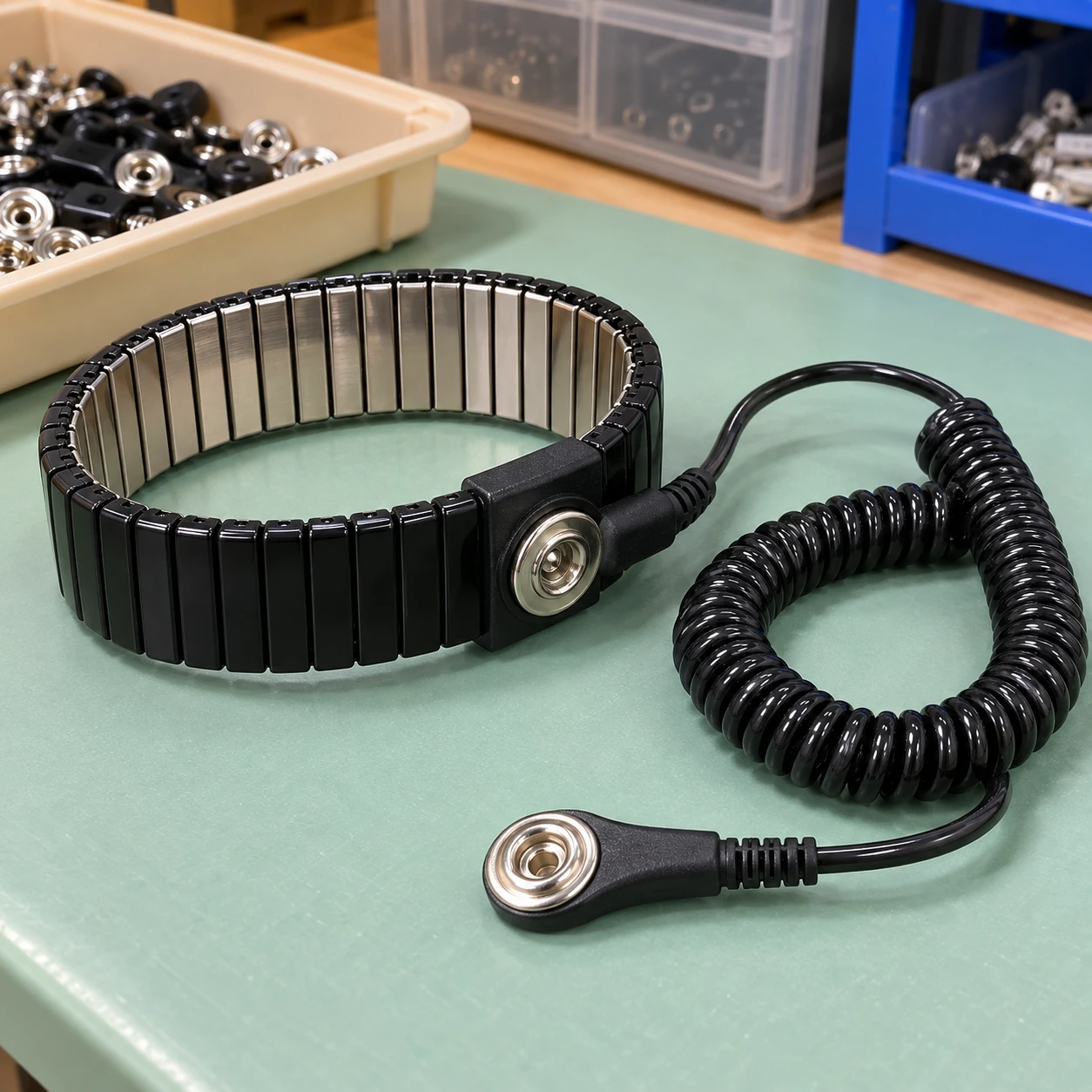
ESD Wrist Straps & Cords
hypoallergenic esd wrist straps
| Brand | shengtongjh |
|---|---|
| Skin-contact construction | Metal expansion links or conductive woven material, selected after reviewing the actual material declaration |
| Metal-band circumference options (mm) | Regular adjustable arrangement: 146.1–330.2; extra-large arrangement: 158.8–368.3 |
| Metal-band width and snap (mm) | 16.0 nominal width; 4 mm stud for the listed metal configurations |
| Alternative fabric system | Adjustable conductive fabric with compatible backplate and single- or dual-wire connection, specified as a complete assembly |
| Acceptance information | Material/finish disclosure, wearer fit trial, approved cleaning method and worn-system electrical verification |
The listed dimensions belong to adjustable metal-band configurations. Stainless steel is not a universal nickel-free or allergy-free declaration. No medical certification or individual tolerance guarantee is implied.
Contact materials, fit and cord interfaces can be customized after reviewing wearer requirements and the workstation grounding system.
Hypoallergenic ESD wrist straps are selected to reduce material-related discomfort while maintaining the required electrical contact. The word hypoallergenic does not mean that every wearer will tolerate every component. The band, backplate, fasteners, finishes and cleaning products all deserve attention.
Turn a comfort request into a material specification
Start with the surfaces that actually touch the wrist. A fabric band may still have a metal backplate or snap, while a metal band may include coatings, polymer caps and cleaning residues. Describing only the outer band material leaves important contact surfaces unspecified.
Ask for the composition and finish of those parts, including relevant declarations for a known sensitivity. Do not infer the absence of nickel, latex or other substances from a photograph or a broad marketing label. A stainless-steel description alone does not resolve every skin-contact concern.
Fit can matter as much as the material
A band that slides repeatedly can rub the skin and lose reliable contact. One that is overtightened can also be uncomfortable during a full shift. Select the size and adjustment method around the wearer rather than expecting one tight setting to solve both mechanical and electrical issues.
Trial the proposed construction during representative work, including reaching, handling tools and normal wrist movement. Check whether the cord pulls the band sideways. Changing its routing or working reach can remove a source of discomfort without altering the contact material.
For woven contact bands
Review the conductive yarn, elastic components and inner contact arrangement. A soft outer surface does not establish the composition of the inside. Replace damaged or stretched bands with the specified material rather than an ordinary textile substitute.
Conductive fabric and a metal backplate may both touch the wearer. Keep both in the material review and consider how moisture and the approved cleaning cycle affect day-to-day use.
For expansion-link bands
Check the link edges, underside finish and adjustment range. A smooth, correctly fitted band can provide a different contact feel from elastic fabric, but metal construction should not be presented as a medical solution.
Keep the band and cord connection compatible. A comfort-driven cuff replacement must still match the monitoring system and its required contact arrangement.
Do not insulate the contact to hide a problem
Adding tape, a sleeve or an unapproved liner between the wrist and the contact surface can interrupt the grounding path. If irritation occurs, stop using the affected band and follow the workplace's health and safety process while an alternative is evaluated. This is a product-selection issue, not a diagnosis.
Cleaning should follow the selected manufacturer's instructions, with residues removed as specified. Recheck the worn system after a material, fit or cleaning change. Comfort acceptance and electrical acceptance are separate checks.
Approve a repeatable replacement
Document the approved contact materials, size and cleaning method alongside the electrical interface. That makes later repeat orders more reliable than asking for a generic allergy-friendly strap. See ESD wrist straps for the complete connection path, or send the material and fit requirements to shengtongjh.
Contact materials, fit and cord interfaces can be customized after reviewing wearer requirements and the workstation grounding system.