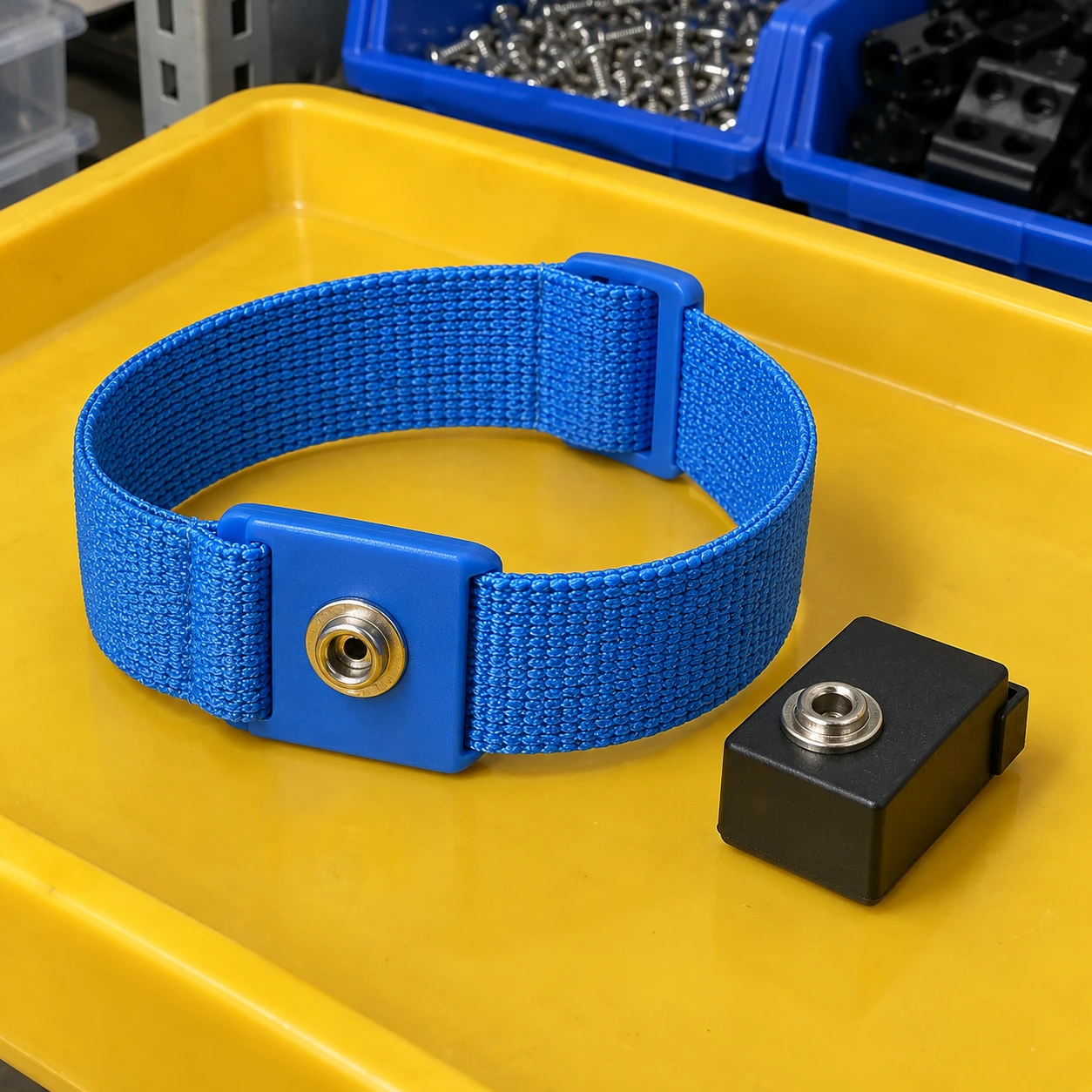
ESD Wrist Straps & Cords
cordless esd wrist straps
| Brand | shengtongjh |
|---|---|
| Procurement scope | Review of cordless-style bands and selection of verified personnel-grounding alternatives |
| Cordless grounding performance | No verified grounding performance or compliance claim is offered for a passive cordless band |
| Grounded alternative circumference (mm) | Metal expansion options: small 139.7–254; medium 165.1–304.8; large 184.2–330.2 |
| Grounded alternative interface (mm) | 16.0 nominal metal-band width and 4 mm stud, with a compatible grounding cord; these are not cordless-band specifications |
| Mobile-task alternative | Suitable footwear and flooring assessed together under the site ESD control plan |
Dimensions describe connected wrist-strap alternatives only. No arbitrary size or protective performance is assigned to an unqualified cordless product. Select controls around the task and verify the complete installed system.
A grounded wrist-strap package or suitable mobile-personnel control arrangement can be customized to the task and site ESD plan.
Cordless ESD wrist straps are often sought to avoid a trailing lead. A passive wristband without a defined connection to ground must not be assumed to provide the personnel-grounding function of a connected wrist-strap system. This page explains that limitation and the alternatives to evaluate.
A visible wristband does not prove a discharge path
A connected wrist strap provides an intentional route between the wearer and the designated grounding or bonding point. Removing that route changes the function. A small housing on a band, or a claim that it releases charge into the air, is not evidence that the wearer remains at the required potential during work.
NASA reported that the wireless wrist straps it tested failed to prevent charge accumulation or drain it as required. Those results are a reason to demand relevant performance evidence, not to treat a cordless band as an interchangeable replacement for a connected assembly. Read NASA's published findings.
Identify why the cord is causing difficulty
At a seated assembly bench, the problem may be an inconvenient socket, a cord pulled across the working area or a reach that does not match the task. Review the connection position and routing before discarding the grounding method. The approved arrangement must allow normal work without pulling on the wrist.
At moving equipment, a trailing cord can create an entanglement concern. That requires a task-specific safety and ESD review. A cord-free band is not a substitute for resolving the machine interaction, and a longer lead does not automatically solve it.
For seated electronics handling
Use the personnel-grounding arrangement required by the ESD control plan. A correctly fitted wired cuff with an appropriate connection and verification routine is the usual starting point. Confirm the cord and monitor compatibility when changing the workstation layout.
A grounded work surface does not automatically ground a person who is not connected to it. Likewise, touching a metal object once does not establish continuous control throughout the handling operation.
For walking or standing work
A suitable footwear-and-flooring system may provide the mobility the operator needs. Both elements and the wearer must be evaluated together; ordinary shoes on an arbitrary floor do not form an equivalent arrangement.
Review transitions, insulating floor coverings and the actual movement pattern. The selected control needs to remain effective throughout the relevant task, with the site’s verification method and acceptance criteria defined.
Keep ionization in its proper role
Ionization can address charge on suitable isolated conductors or insulating objects in a controlled process. It does not by itself validate a passive cordless bracelet or make every person near an ionizer adequately grounded. Personnel control and charge control on process materials should be planned together without assuming one proves the other.
Request evidence for the intended job
Before approving any proposed replacement, identify the grounding mechanism, representative test conditions and results for the actual personnel-control requirement. Product appearance and a seller's general antistatic description are insufficient. shengtongjh does not present the pictured cordless-style band as qualified personnel-grounding equipment.
For a connected option, review ESD wrist straps. To address mobility, describe the workstation movement and existing floor system so the appropriate control arrangement can be discussed.
A grounded wrist-strap package or suitable mobile-personnel control arrangement can be customized to the task and site ESD plan.