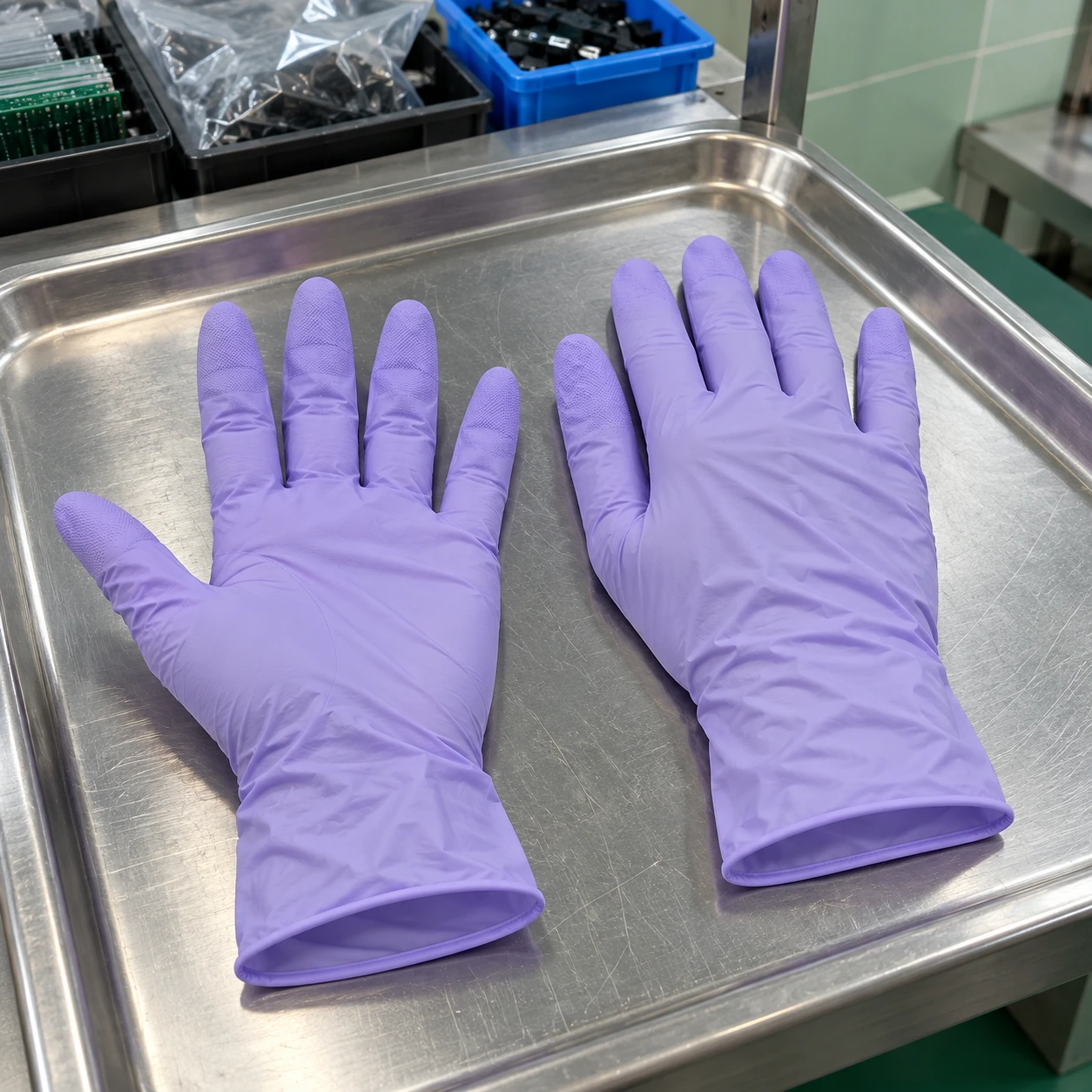
ESD Gloves
esd gloves nitrile
| Main construction | Powder-free disposable nitrile with glove-specific ESD qualification |
|---|---|
| Nominal flat width (mm) | S 85 / M 95 / L 106 / XL 116; selected film style |
| Overall length choices (mm) | 229, 240 or 300; construction dependent |
| Single-wall palm thickness (mm) | Approximately 0.12–0.13 across selected film constructions |
| Contact finish | Smooth or textured; rolled cuff |
| Reusable alternative | Conductive knit with foam-nitrile palm; sizes 6–12 |
| Electrical evidence | Test data for the exact formulation and intended use condition |
Flat width is glove width, not hand circumference. Lengths and thicknesses describe separate film configurations, not a universal size chart.
Nitrile construction, cuff coverage, fit and packing can be customized for the process, subject to the selected glove's verified electrical and barrier properties.
Nitrile appears in two different glove constructions: an unsupported disposable film and a coating on a knitted liner. Selecting ESD gloves nitrile starts by deciding which of those structures the handling task requires.
Disposable nitrile film
An unsupported glove forms a continuous film around the hand, without a knitted backing. It can help separate skin residues from handled products and is normally replaced after its permitted use. Thin film and fingertip texture influence the feel of small latches and components.
Electrical behaviour depends on the specific formulation. A powder-free or latex-free description answers a different question and must not be used as a substitute for ESD evidence. Confirm the selected glove's suitability for the workstation before using it on exposed sensitive devices.
Nitrile-coated conductive knit
This construction adds a nitrile working surface to a textile liner containing conductive material. It can be useful for dry assembly where a breathable back and handling durability are priorities. It remains a knitted work glove with local coating coverage.
A dipped palm does not turn the uncoated back and cuff into a liquid barrier. Nor does a foam coating establish chemical resistance for a cleaning operation. Select that protection separately if the task includes exposure to a liquid or solvent.
Fit the film to the movement
A disposable glove should allow a comfortable hand opening and a controlled pinch. Excess film at a fingertip can fold onto a connector, while an undersized glove can become heavily stretched across the palm. Assess fit with the component and any hand tool that will actually be used.
Overall length controls cuff reach, not hand size. A longer cuff may help overlap a sleeve during controlled handling, but it does not correct a palm that is too narrow. Likewise, flat glove width is a product dimension; it should not be confused with the circumference of a worker's hand.
Where an underglove is required by the process, evaluate the complete combination. Adding a second layer changes fit and the hand-to-contact interface, so results obtained with only the outer glove may not represent the final arrangement.
Cleanliness and ESD need separate evidence
A glove can be suitable for static-sensitive handling without meeting a particular process's particle or residue limits. A cleanroom glove can also require additional evaluation for its electrical behaviour. The IEST glove-practice overview treats these properties as separate evaluation areas.
For controlled environments, define the surfaces contacted, acceptable residues and how the gloves enter the area. Powder-free does not mean sterile, and a clean-looking film does not establish a particle-release result. See nitrile cleanroom gloves when those requirements are central to the task.
Change gloves when the process changes
Moving from outer cartons to exposed assemblies can transfer unwanted residues even when a glove has no visible tear. Set issue and change points around those transitions. Damaged or contaminated disposable gloves should be removed from use under the site's procedure, rather than washed and returned to production.
For purchasing, specify whether nitrile means a disposable film or a coated textile, then identify fit, cuff coverage, contact finish and required electrical evidence. The disposable ESD glove page covers issue, change and storage arrangements in more detail.
Nitrile construction, cuff coverage, fit and packing can be customized for the process, subject to the selected glove's verified electrical and barrier properties.