ESD Bench Mats
ESD Bench Mats
| Cut size, W × L × thickness | 610 × 914 × 1.5 mm; 600 × 1200 × 2 mm (nominal, construction-dependent) |
|---|---|
| Working surface | Rubber; single-layer or colored dissipative face with conductive backing |
| Surface finish | Smooth or lightly textured, low-reflection finish |
| Groundable point | 10 mm stud option; other fittings matched to the selected lead |
| Accessories | Mat ground lead; compatible common point hardware; personnel cord supplied separately |
| Format and fit | Cut sheet or sized bench covering; connector position agreed before cutting |
Size combinations describe different mat constructions. Select the electrical characteristics, material and grounding arrangement together; color alone does not identify ESD performance.
Bench coverage, cut dimensions and grounding-point position can be customized for the application.
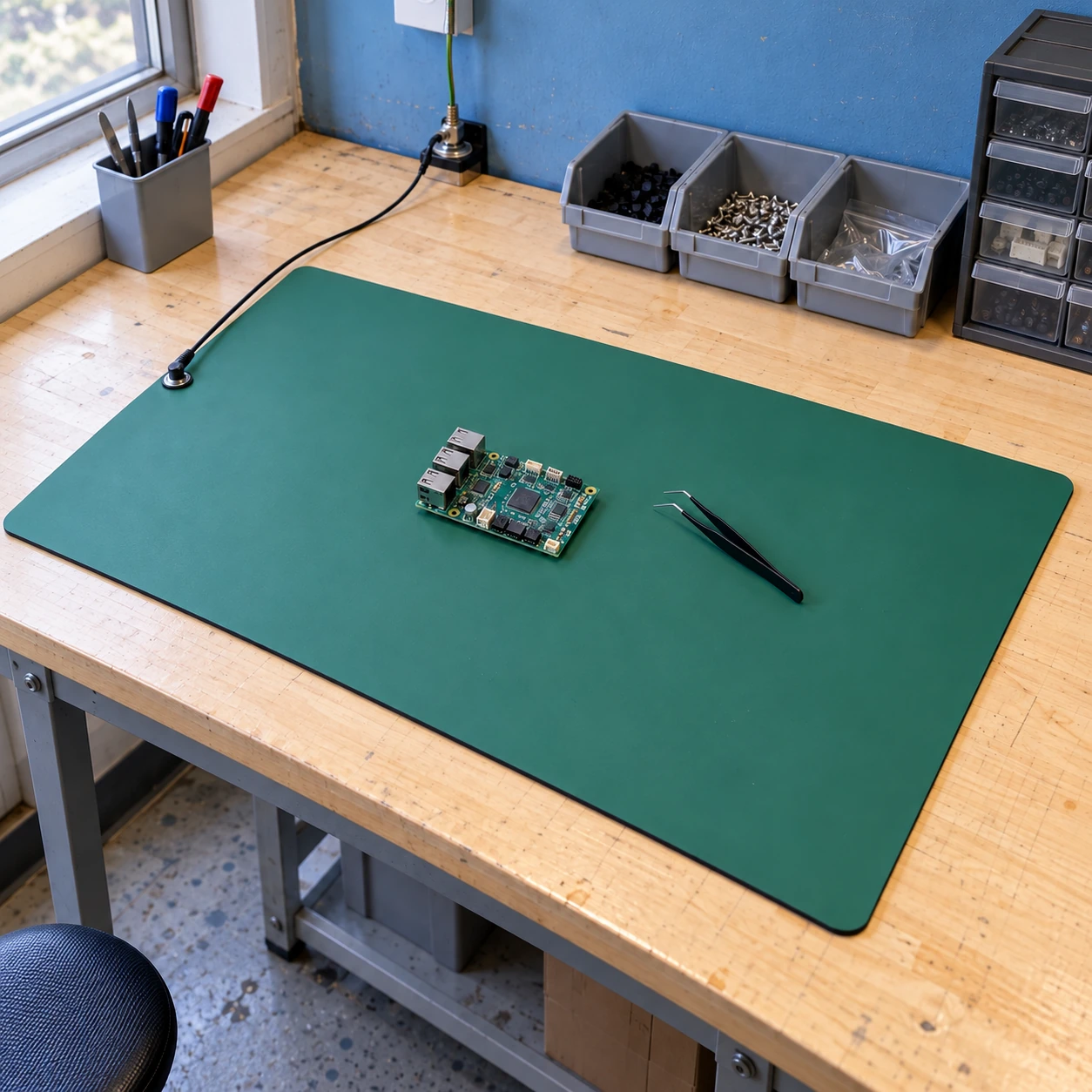
ESD Bench Mats create a defined contact surface for exposed circuit boards, components and assembly tools. A suitable dissipative working face connected to the workstation ground helps control charge on contacting conductors. The mat also makes the protected handling area easy to organize, but it must work with personnel grounding and the other items placed on the bench.
Protect the place where parts actually rest
The working area must include the locations used for receiving, inspecting and setting down a board. A small central mat loses much of its value when operators park sensitive assemblies on an ordinary laminate edge or an insulating tray next to it. Lay out the board, fixture and hand-tool positions first, then size the covering so the normal handling sequence stays on the intended surface.
Leave the grounding point accessible after installing bins, lamps and test instruments. Keep the front edge flat and supported by the table, with enough clearance for drawers and operator movement. An overhanging sheet can catch on clothing, while a connector hidden beneath an instrument becomes difficult to inspect.
Read the construction beneath the color
A dual-layer rubber mat combines a working face with a more conductive backing. This gives the working surface and the path to the grounding point different roles. A single-layer material may also suit a specified task, but it needs its own electrical and physical assessment. Neither green paint nor a black underside establishes the performance of an unknown sheet.
Compare point-to-point resistance with resistance to the groundable point, and check the method, conditioning and test voltage behind the results. These values answer different questions. A material report should be followed by checks on the installed mat with its actual connector and lead; it does not establish the performance of every completed workstation.
Match the surface to the work
- Assembly and inspection: choose a finish that provides useful contrast without excessive glare. Keep the surface clear enough to find small parts and remove debris without dragging it across boards.
- Soldering and rework: use the iron's holder and a suitable local heat-resistant accessory. A general rubber mat should not be assumed to tolerate prolonged hot-tip contact. Check flux and cleaning-agent compatibility for the selected formulation.
- Test and repair: distinguish ESD control from electrical insulation. Use the site's electrical safety procedures for powered work; an ESD mat is not a shock-protection barrier.
- Controlled environments: assess particle release, cleaning and packaging separately. An electrical resistance result is not a cleanroom cleanliness rating.
What a grounded mat cannot remove
An insulating container or plastic film can retain charge even while sitting on a grounded mat. Remove unnecessary insulating items from the handling zone. Where process-essential insulators remain, evaluate appropriate ionizing air equipment and its placement. Keep that decision separate from the mat's contact-grounding function.
Also consider the transition into and out of the station. A board stored in suitable protective packaging should be opened within the controlled handling area, with the operator's grounding established before exposed parts are touched.
Keep a replaceable surface predictable
Use the approved cleaner rather than ordinary furniture polish or a coating that leaves an insulating film. Remove contamination before it hardens, and let the surface dry before checking or using it. Inspect snap retention, lead strain and surface damage after moving equipment. Cuts, swelling, delamination or persistent contamination are reasons to investigate or replace the mat.
For repeat orders, record the material construction, dimensions, connector position and agreed test criteria. Provide the bench layout and cleaning process when requesting a quotation, and distinguish bare matting from a kit with grounding accessories. This makes replacement easier without assuming that every mat of the same color is equivalent.
Bench coverage, cut dimensions and grounding-point position can be customized for the application.