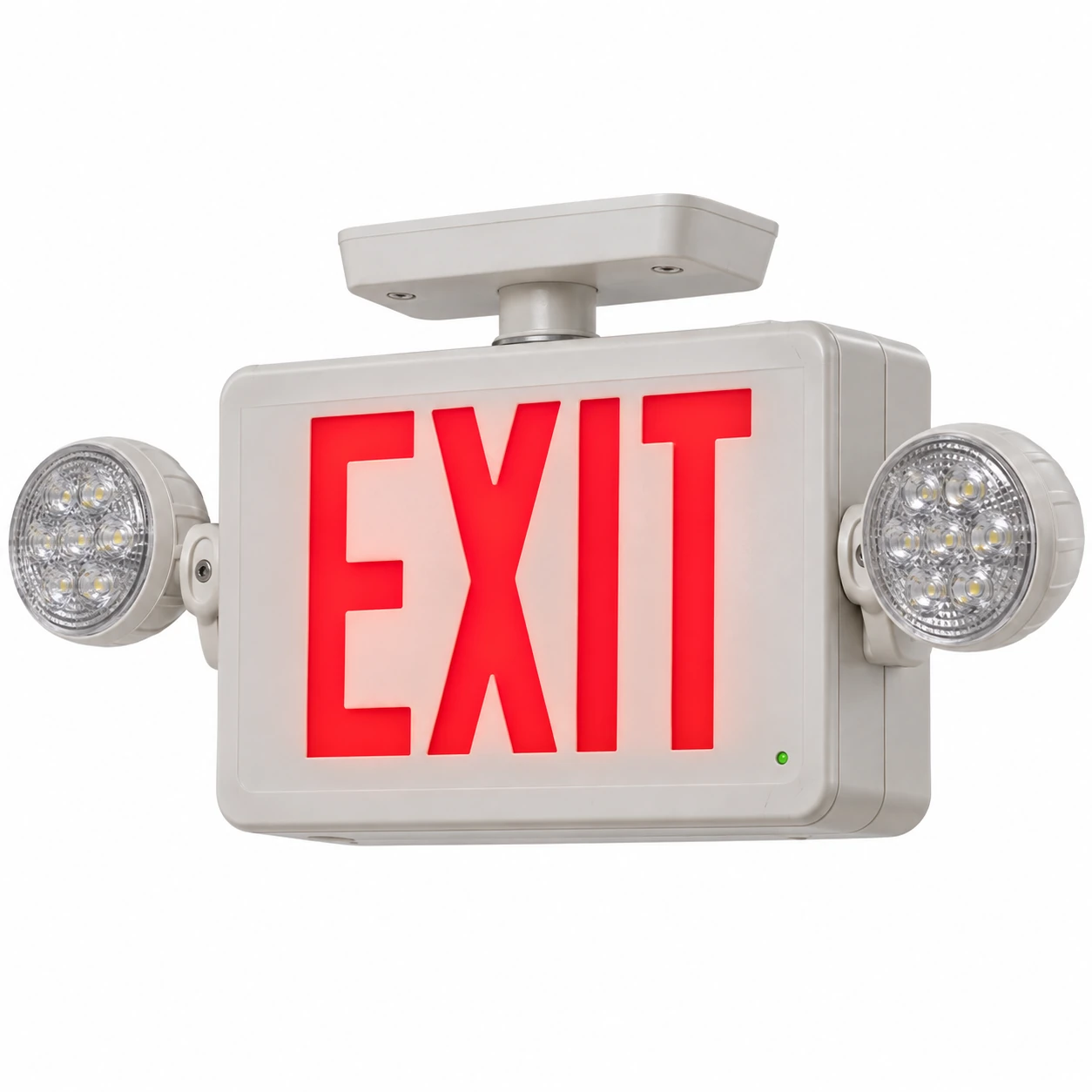
Emergency Lighting
exit lights with emergency lighting
| Compact combo size, approximately W × H × D (mm) | 349 × 221 × 54 |
|---|---|
| Alternative side-head arrangement | Sign body 330 × 191 × 54 mm; approximately 502 mm overall width with side heads |
| Sign face | Single or double face; red or green lettering selected for the approved sign scheme |
| Emergency heads | Two adjustable LED heads; top or side arrangement by configuration |
| AC supply options | 120/277 V AC, 60 Hz; 120–277 V AC, 50/60 Hz on a matching version |
| Backup and test | Integral battery; 90-minute configuration, status indicator and optional self-diagnostics |
Head position changes the installed envelope and light distribution. Select the sign language, colour, direction and backup performance for the destination requirements.
Sign faces, mounting, head positions and monitoring can be customized for the doorway and approved evacuation layout.
Exit lights with emergency lighting combine an illuminated exit message with lamps that light the surrounding route. The two jobs share an enclosure but need separate checks: a clearly readable sign does not prove there is enough light on the walking surface.
One enclosure, two optical jobs
The illuminated face tells people which way to leave. The attached heads provide light on the route near the sign. These functions can share power equipment, but they are evaluated differently. Sign visibility depends on the face, approach direction, contrast and mounting; route illumination depends on the beam distribution, aiming, distance and obstacles.
A combination unit is useful where a suitable sign location is also a suitable lighting position. It is less helpful when the sign must sit above a tall doorway while the heads need a different position to reach a landing or turn. In that case, a separate sign and emergency luminaire can give a better result.
Set the face for the approach
A wall-mounted sign generally serves people approaching its visible face. A ceiling or end-mounted sign may need two faces where people approach from opposite directions. Directional indicators must agree with the approved route. Fitting an arrow because it is included in the box can create an incorrect instruction.
Lettering, colour and pictograms are chosen for the destination's sign scheme and applicable requirements. An English EXIT face in a product image is one configuration, not a statement that the same face is accepted for every project.
Aim the lamps for the floor
Heads mounted on the sides increase overall width and can conflict with a door frame, conduit or adjacent wall. Top-mounted heads change the height and aimable range. Allow enough movement to direct each beam where it is needed without hiding the sign.
Photometric data for the selected head should be used at the final height and orientation. Advertising a maximum spacing does not describe every corridor, stair or doorway.
Account for every load on the shared battery
During an outage, the battery may supply the sign face, two local heads and any permitted remote heads. The total load belongs in the selected unit's duty. A version with remote capacity is different from a version intended only for integral lamps, even where the enclosures look identical.
Do not add a remote lamp merely because its voltage matches. The unit must support the additional load, wiring arrangement and required duration, and the lamp must be compatible with its output. Changes to the face or lamp type also need the appropriate replacement components. Improvised substitutions can affect charging, output or the assembly's approval.
Check the sign and the lighting during maintenance
A readable sign with failed heads leaves one job unfinished. Working heads with a dark or damaged face leave the other unfinished. A planned test should observe both, including the approach view and the light reaching the route. Automatic diagnostics are useful, but their scope should be understood; not every system detects a moved head or a newly placed obstruction.
Keep the test button, indicator and battery access reachable after signs, door closers and other services are installed. Where the unit is above a frequently used entrance, plan safe access for battery replacement without obstructing the escape route during occupied operation.
Choose the combination for its installation benefit
The main advantage is coordinated sign and lamp equipment at a single practical location. Fewer enclosures can simplify fixing and servicing, but it should not force both functions into a poor position. Compare the full installed envelope, mounting support, face direction and emergency distribution before selecting the assembly.
For locations that need separate equipment, exit emergency lighting explains how signs and route luminaires work together. A room plan and a view of the doorway are useful procurement inputs because they reveal the two different sight lines the product must serve.
Sign faces, mounting, head positions and monitoring can be customized for the doorway and approved evacuation layout.