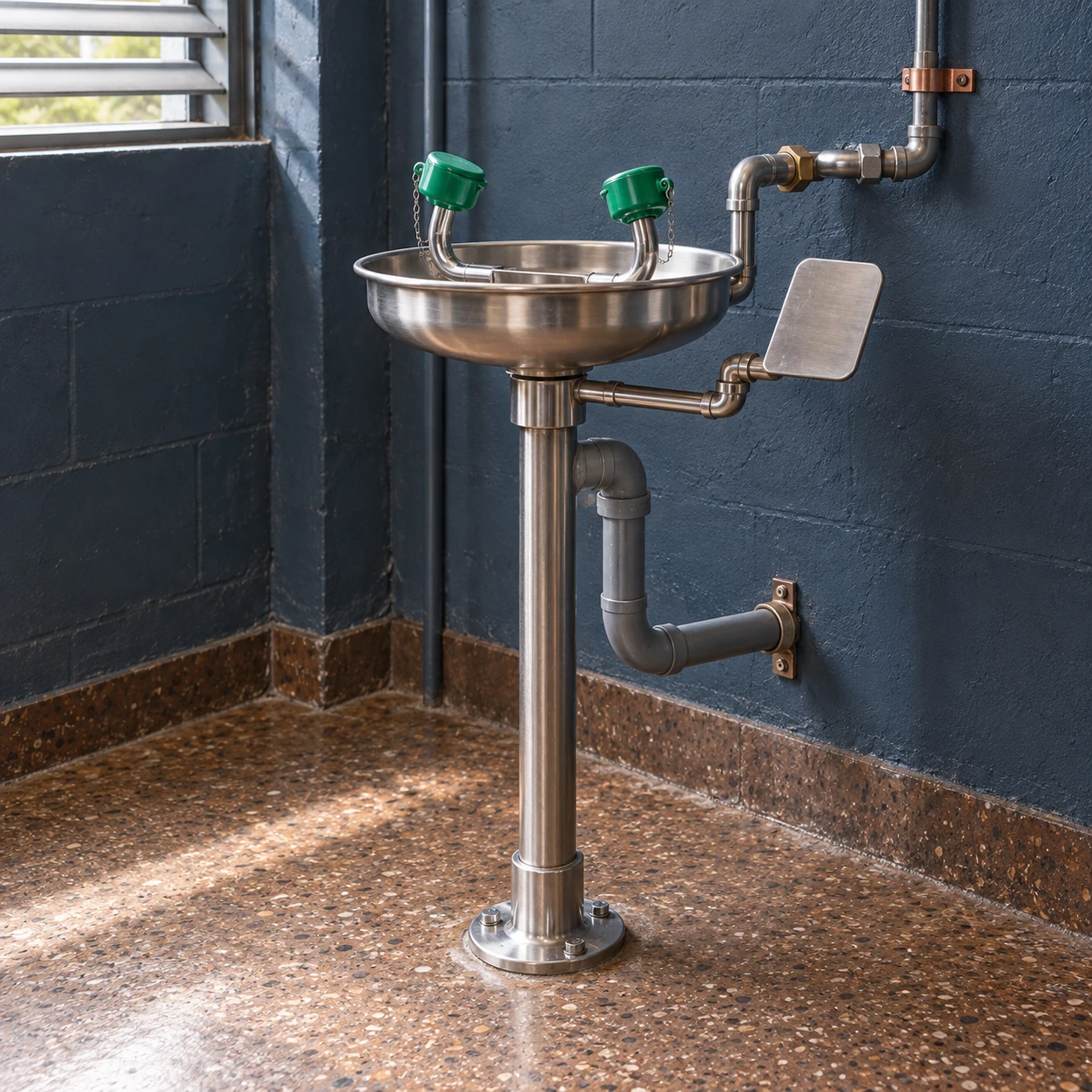
Emergency Eyewash Stations
plumbed emergency eyewash station
| Fixture arrangement | Floor-anchored pedestal or supported wall-mounted bowl |
|---|---|
| Bowl sizes | 280 mm diameter ABS; approximately 283 mm diameter stainless steel |
| Construction choices | 304 stainless steel bowl with coated or stainless support; material schedule matched to the exposure |
| Water inlet | 1/2-inch NPT female or Rp 1/2, according to valve construction |
| Waste outlet | 1-1/4-inch NPT female or 1-1/4-inch tailpiece, according to fixture construction |
| Activation | Hand paddle and stay-open valve; compatible foot operation where specified |
| Water conditioning | Emergency-service tempering and freeze protection where required by the installation |
| Serviceable components | Protected eyewash heads, inlet strainers, flow-control components and valve service parts |
NPT threads, Rp threads and plain tailpieces are different interfaces. The selected assembly and installation drawing must identify each connection and the required supply conditions.
Pedestal or wall mounting, materials, connection arrangements and temperature-control accessories can be configured for the site water service.
A plumbed emergency eyewash draws from a permanent water service. Its practical advantage is an established supply at a known location, but the fixture can deliver correctly only when the connected pipework, temperature controls and available pressure are suitable during use.
Check pressure while the water is flowing
A static pressure reading does not show what remains when other equipment is drawing water. Long small-bore branches, restrictive fittings and partly closed valves can weaken the flushing pattern. Supply design should use the selected fixture's operating range and consider simultaneous demand on the service.
Excess pressure is not a useful safety margin at the eyes. Retain the specified flow-control parts and protected outlet geometry rather than enlarging holes or removing components to make the spray look stronger. Verify that both outlets develop the intended pattern at commissioning, including under the expected demand condition.
The equipment's supply isolation must remain available for service without allowing accidental shutdown during normal operation. Identify it clearly and manage isolation through the site's maintenance procedure.
Water temperature must remain suitable throughout use
A short burst at an acceptable temperature is insufficient when a hot or cold slug arrives later from the branch. Where tempering is needed, select equipment intended for emergency eyewash service, including its specified response to supply faults. A general washbasin mixer should not be assumed suitable.
Consider the branch route as well as the mixing valve: exposed pipework may heat in sunlight or freeze, while an infrequently used internal branch can hold stagnant water. Protect the system in a way that preserves access to the station and lets maintenance staff reach the temperature-control components.
Give the discharge a clear route
The bowl collects water; it does not resolve every drainage issue. Choose the waste connection, trap or collection arrangement for the building and the substances handled nearby. Keep discharged water away from electrical hazards and assess contaminated runoff under the site's waste procedures. Drain fittings must not reduce the space needed to stand at the eyewash.
What to verify at handover
- Operation: the actuator opens readily, the valve remains open without being held, and the nozzle covers release as designed.
- Delivery: the fluid pattern, sustained flow and temperature meet the selected project standard under actual supply conditions.
- Access: signs and lighting make the fixture easy to identify, and the route remains usable during ordinary work.
- Servicing: the responsible team has instructions, compatible spare parts and an activation and inspection schedule.
The ISEA guide calls for weekly activation of plumbed equipment and annual inspection against the applicable requirements. Follow the selected manufacturer's procedure, including flushing the stagnant portion of the supply. A tick on a checklist should represent an actual check of delivery and condition.
For a constrained room, see the wall-mounted arrangement. If no dependable pipe connection can be provided, evaluate a self-contained station with a suitable servicing plan.
Pedestal or wall mounting, materials, connection arrangements and temperature-control accessories can be configured for the site water service.