Emergency Eyewash Stations
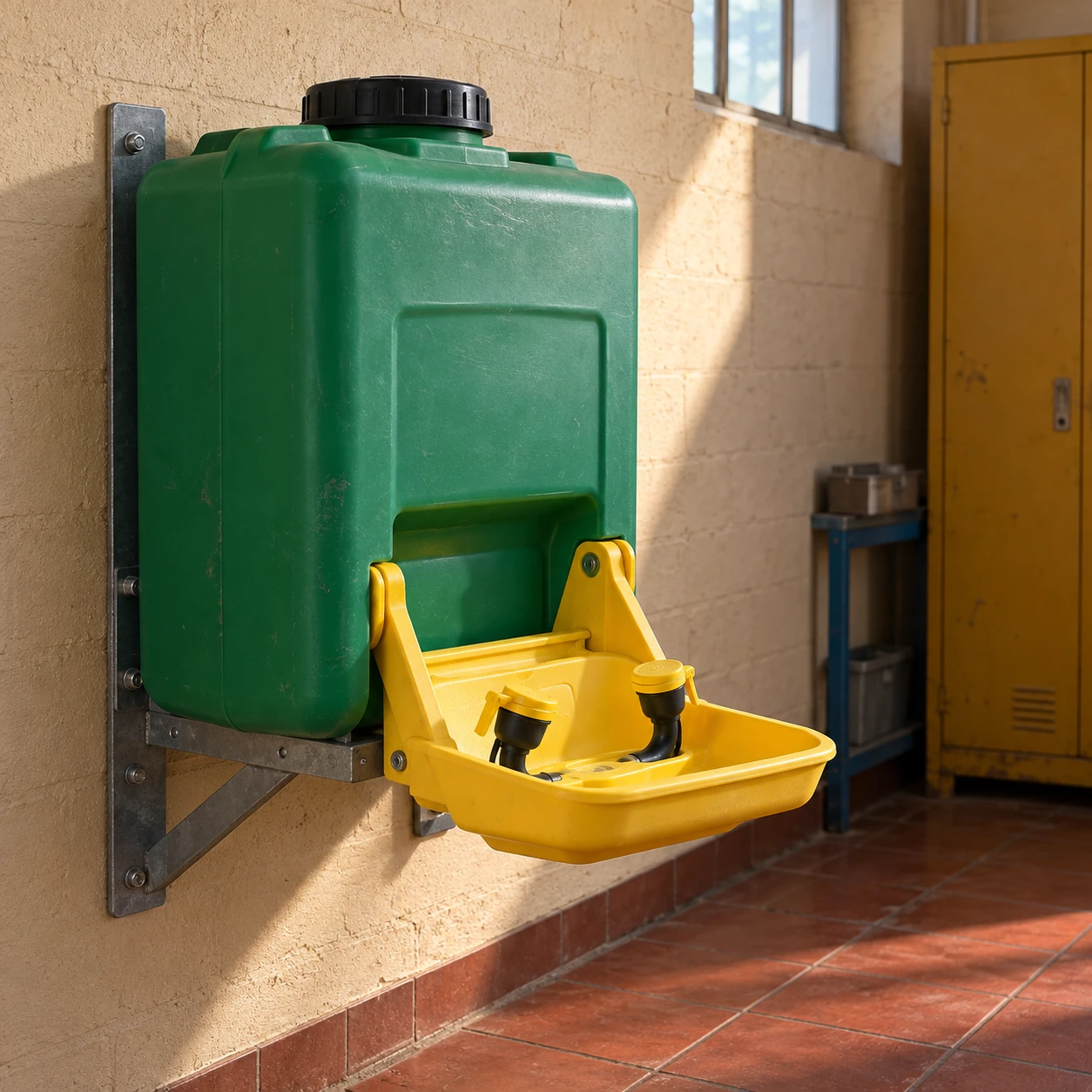
self contained emergency eyewash station
| Fluid storage | 34.1 L compact reservoir; 35 L compact reservoir; 60.6 L larger reservoir |
|---|---|
| Compact exterior W × D × H | 559 × 257 × 368 mm for a 34.1 L assembly; 550 × 260 × 370 mm for a 35 L assembly |
| Larger exterior W × D × H | 546 × 495 × 572 mm for a 60.6 L assembly |
| Construction | Polyethylene reservoir with protected flushing outlets and a wide filling access |
| Operating method | Gravity discharge through a pull-down activation tray; no pressurised building supply required |
| Support | Wall bracket or compatible stand supporting the filled assembly at its specified operating height |
| Flushing fluid | Water or a preserved flushing solution permitted by the selected equipment manufacturer |
| Service accessories | Compatible covers, replacement outlet parts, approved fluid treatment and discharge collection options |
Dimensions describe the reservoir assemblies, not the installation clearance. Check tray travel, filling access, bracket position and the supporting structure against the selected drawing.
Reservoir format, supporting bracket or stand and service accessories can be selected to suit the location and maintenance arrangement.
A self-contained emergency eyewash stores flushing fluid at the point of use. It can serve a remote maintenance area or temporary work position without a new water branch, provided that its discharge performance, support and servicing are suitable for primary emergency use.
Stored volume is only the starting point
In a gravity-fed station, the reservoir sits above the outlets and the water level falls during use. The outlet assembly must maintain a suitable flow pattern as that level changes. Dividing tank capacity by a desired flow rate does not demonstrate that the equipment can wash both eyes throughout the required duration: residual fluid, head pressure and outlet geometry also matter.
Select an assembly with documented flushing performance for the applicable standard. A larger tank may provide operational margin, but it also increases the filled load and the amount of fluid to service. Do not substitute a general water container or a personal rinse bottle for a tested primary eyewash arrangement.
Support the filled unit
The wall, bracket and fasteners carry the equipment plus its stored fluid. Assess that load at the actual fixing points. A thin partition or unsecured shelf may be unsuitable even if the empty unit appears light. Use the specified mounting orientation so gravity delivery works as intended.
Protect the working position
Leave room for the tray to open and for a person to reach the flushing position. A portable reservoir still needs a defined, recognisable location. Moving it to another room requires a new access check; portability should not turn into uncertain availability.
Keep the fluid usable
Storage in direct sun, a hot process area or a cold external enclosure changes fluid temperature. An indoor plastic tank is not automatically suitable outdoors. Temperature protection must suit the complete assembly and local conditions, without enclosing the control behind a difficult-to-open door.
Plan replenishment before the first use
A refillable tank and a sealed-cartridge unit have different maintenance requirements. Use the fluid type, treatment, cleaning method and replacement interval specified for the purchased assembly. Do not mix an improvised preservative or assume that a clear-looking reservoir contains acceptable flushing fluid.
Assign someone to check readiness and service dates. After an activation, follow the equipment's cleaning and refill procedure and provide suitable alternative emergency coverage until the station is restored. Keep the required replacement parts and fluid supplies available for that process.
When a water connection is the better long-term choice
For a permanent workplace with accessible services, a plumbed emergency eyewash may reduce repeated reservoir handling. It still requires water-quality and operational checks. Compare the complete installation and maintenance effort, including who refills the tank, how it is safely handled and where its discharge is collected.
CCOHS guidance distinguishes primary self-contained equipment from supplemental personal wash units. The specified equipment delivery duration is a selection criterion; the exposure response itself follows the substance safety data sheet and the workplace emergency procedure. Send the proposed location, expected storage temperature and available mounting surface with your equipment enquiry.
Reservoir format, supporting bracket or stand and service accessories can be selected to suit the location and maintenance arrangement.