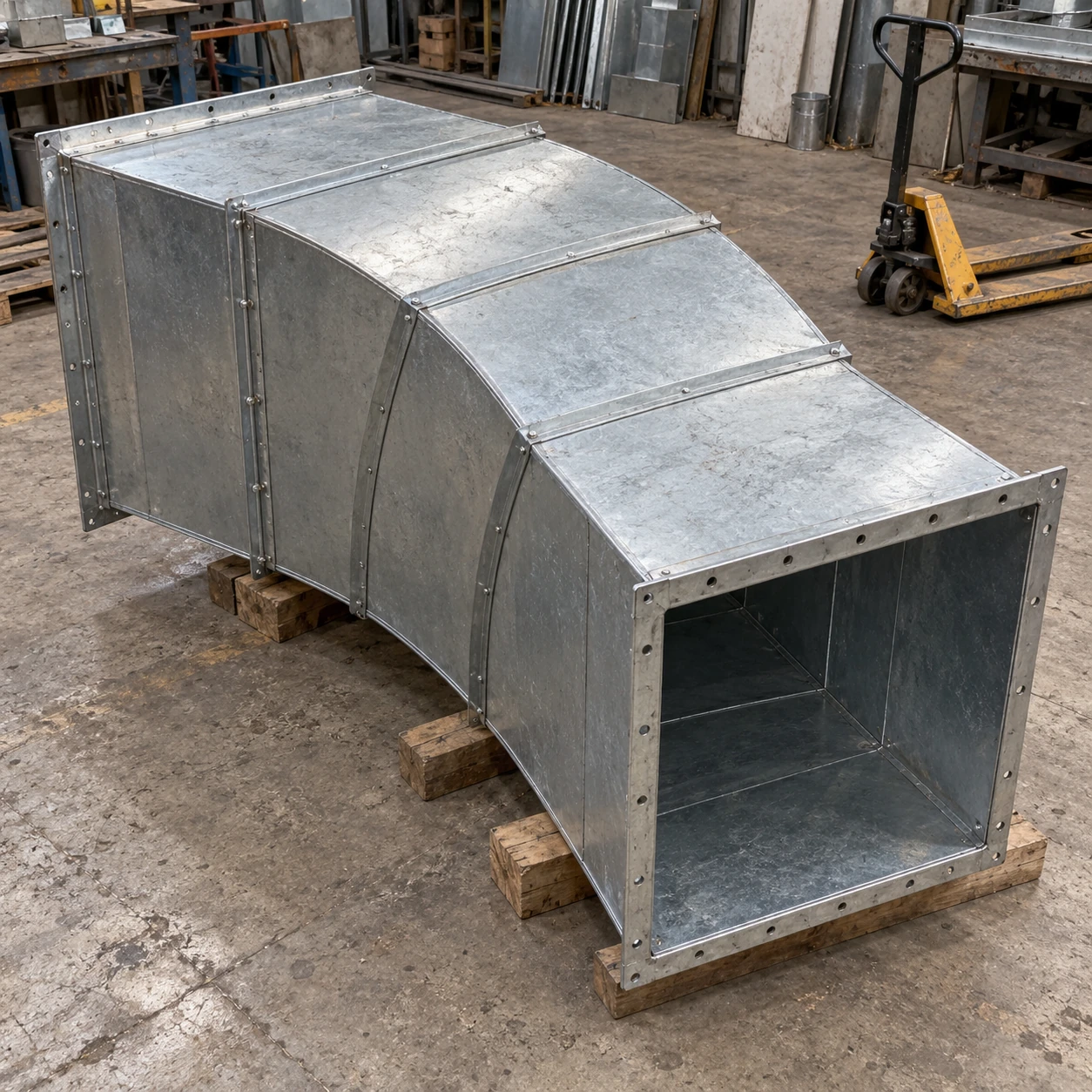
Large openings, handling and structural coordination
large duct elbows
| Round nominal bore (mm) | 630 / 800 / 1000 / 1250 |
|---|---|
| Rectangular opening W × H (mm) | 800 × 400 / 1000 × 600 / 1200 × 800 |
| Angle | 45° or 90° |
| Shell | Segmented round or reinforced rectangular sheet construction |
| Connections | Coordinated flange and gasket assembly |
| Delivery arrangement | Complete fitting or engineered assembly sections |
These are air-passage dimensions. Handling weight, lifting details, reinforcement and transport envelope require the selected fabrication drawing.
Large duct elbows can be configured for the air duty, building access and installation sequence.
A large elbow is often one of the most difficult parts of a duct route to bring into a building. Its opening may fit the duct design while its curved envelope cannot pass through a doorway or between installed services. Delivery and assembly deserve attention before fabrication.
Follow the fitting from delivery to final position
- Check the access route. Include door openings, temporary openings, turning space and the height available beneath the lifting arrangement. The largest diagonal of the packed fitting may govern access.
- Decide where assembly occurs. If a complete elbow cannot pass, define engineered split sections and accessible site joints. Dividing a fitting changes its assembly and sealing work; it should be part of the fabrication plan.
- Establish the supports. Coordinate the fitting, adjoining duct, insulation and any access loads with the support design. Do not treat a sheet-metal flange as an improvised lifting point.
More surface area changes the structural problem
Large flat faces can deflect under pressure, while large round shells also require construction appropriate to their diameter and duty. A scaled-up outline does not establish the necessary thickness or stiffening. Reinforcement and flange stiffness should be designed together, including operation under suction where relevant.
Visible panel movement or joint separation calls for investigation of the structure and operating pressure. Adding random screws or straps after installation may interfere with the air passage or transfer loads to another weak point.
Reserve room outside the nominal size
Bolts, flange corners, stiffeners and external insulation extend beyond the opening. The access space for applying sealant and tightening fasteners can be larger again. Keep the service corridor clear where a future inspection door or removable section is planned.
For high-volume routes, confirm airflow and resistance along with the elbow dimensions. A large opening is not itself a capacity rating, and poor placement next to a fan can still impair performance. See HVAC duct elbows for equipment-adjacent arrangements.
Large duct elbows can be configured for the air duty, building access and installation sequence.