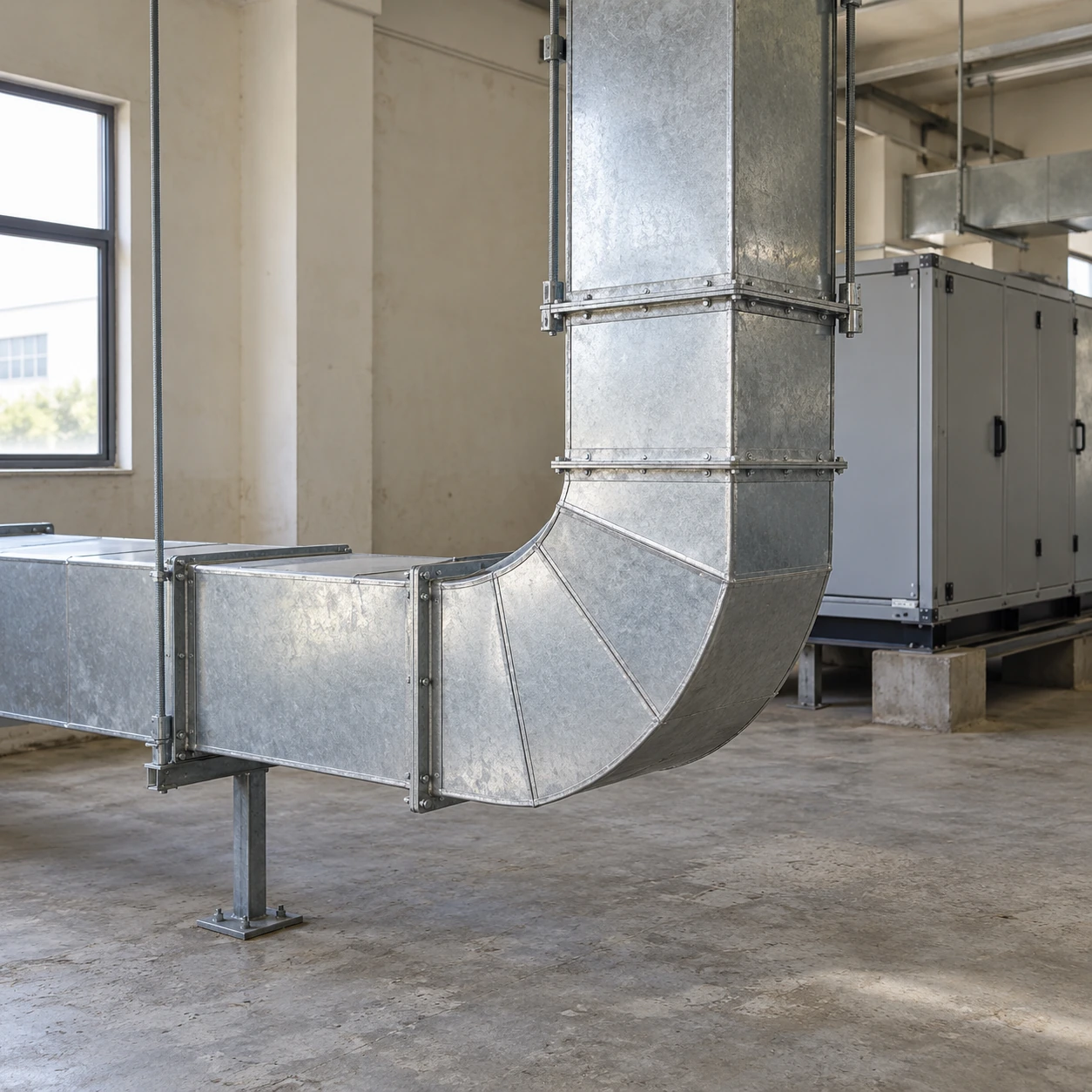
Bends within the complete air system
hvac duct elbows
| Round nominal bore (mm) | 160 / 250 / 400 / 630 |
|---|---|
| Rectangular opening W × H (mm) | 300 × 200 / 500 × 300 / 800 × 400 |
| Bend | 45° or 90°; radius or designed vane arrangement |
| Air duty | Supply, return or extract, with construction matched to duty |
| Joint style | Gasketed spigot, clamped or flanged |
| Finish | Bare metal or specified external insulation |
Pressure class, leakage requirement and reinforcement depend on the assembled duct system; bore alone does not establish a rating.
HVAC duct elbows can be configured for the system duty, equipment interfaces and coordinated route.
An HVAC elbow influences the components around it. A turn beside a fan can affect the fan's inlet flow, while a turn ahead of a damper or measuring station can affect how that device operates. Selection should include this local sequence, not just the fitting in isolation.
Keep disturbed flow away from sensitive components
Air leaving a bend is not necessarily distributed evenly across the duct. A fan, control damper, airflow sensor or terminal installed immediately after it may see a different inlet condition from the one used in its published performance data. Provide the approach and discharge conditions required by the equipment manufacturer.
A universal straight-length rule cannot cover every fan and fitting combination. Where space is constrained, review the specific arrangement and account for its system effect rather than assuming the catalogue fan duty will remain unchanged.
Supply and return behave differently at leaks
A supply-side joint can lose conditioned air into the surrounding void. A negative-pressure extract or return joint can draw surrounding air into the duct. Seal selection and installation quality matter on both sides, although the visible symptoms differ. A thicker elbow does not automatically provide a tighter connection.
Balance the route, then the branches
If a distant zone remains short of air, examine restrictions along its path before repeatedly closing other branches. A flattened connection, abrupt elbow or obstruction may consume pressure that balancing alone cannot recover. Document changes to the route so the final air balance reflects the installed system.
Commissioning information that remains useful
Record damper positions, fan operating condition and measurement locations with the final layout. Keep service access to concealed joints and nearby devices. If a future extension adds another turn, its extra resistance and effect on existing branches should be reviewed as part of that modification.
Coordinate the elbow with the air handling unit and with any duct silencer in the same run; neither component should have its service space consumed by the fitting.
HVAC duct elbows can be configured for the system duty, equipment interfaces and coordinated route.