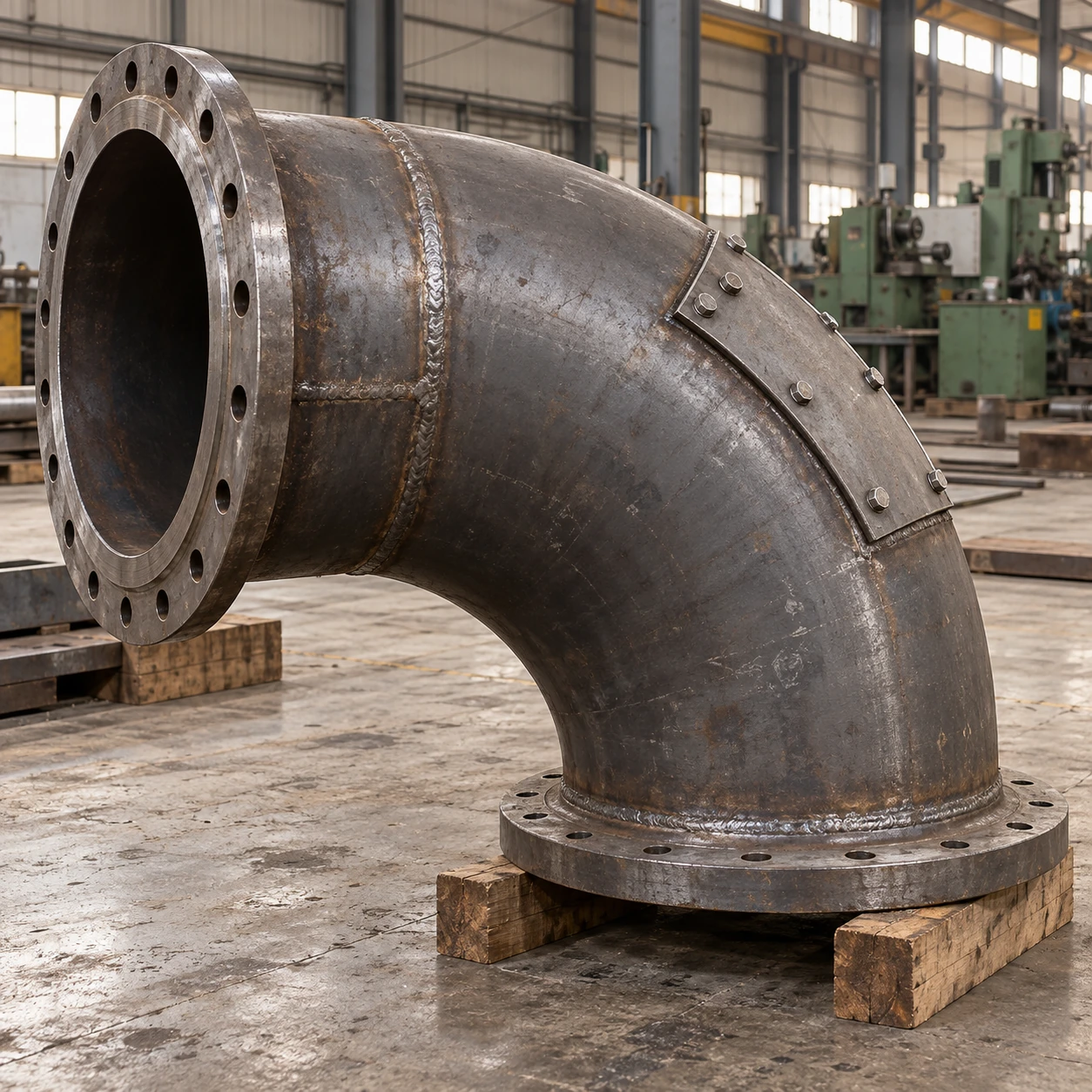
Right-angle turns in particle-carrying extraction
industrial duct elbows 90 degree
| Direction change | 90° |
|---|---|
| Round nominal bore (mm) | 200 / 250 / 315 / 400 / 500 |
| Radius | Standard or extended centerline radius by duty |
| Shell construction | Specified welded steel, galvanized or stainless construction |
| Connections | Matched bolted flange or rated clamp system |
| Maintenance options | Removable spool, inspection opening or specified wear-back construction |
Bore and angle do not establish a pressure, temperature or wear rating. Material, thickness and joint details require the actual process conditions.
Industrial 90-degree duct elbows can be configured for the process material, route and replacement strategy.
A right-angle turn in an extraction line redirects the air and the material carried with it. The elbow's outer curve can become a wear location, while its position between fixed runs determines how easily that worn component can be inspected and replaced.
Make the outer curve part of the maintenance plan
Particles have momentum and may strike the outside of the turn rather than follow the air perfectly. The severity depends on particle characteristics, concentration and velocity. An extended radius, heavier construction or a replaceable wear feature can be considered for the duty; none provides a universal service-life guarantee.
Locate the inspection point where the expected wear can actually be assessed. An access cover that faces a wall or sits beneath an immovable service tray is of little practical use. Keep the cover and its sealing detail compatible with the process conditions.
Coordinate the replacement sequence
- Support the neighboring runs. The elbow should be removable without leaving adjoining duct hanging from its last connection.
- Provide withdrawal space. Account for flange separation, lifting equipment and the complete curved body, not only the open diameter.
- Keep the replacement definition. Record end orientation, radius, seam arrangement, material and wear details so a replacement reproduces the intended passage.
Control internal steps and seam direction
Where a construction has overlapping segments, its intended airflow direction matters. Specify that direction when the end styles are not interchangeable. Material-catching lips or mismatched ends can create deposits and concentrated wear; external alignment alone does not confirm a continuous internal passage.
Sticky, abrasive and corrosive duties need different responses. Increasing thickness may help a wear problem but will not prevent chemical attack or remove a deposit pocket. Describe the actual material and maintenance method when selecting the construction.
Industrial 90-degree duct elbows can be configured for the process material, route and replacement strategy.