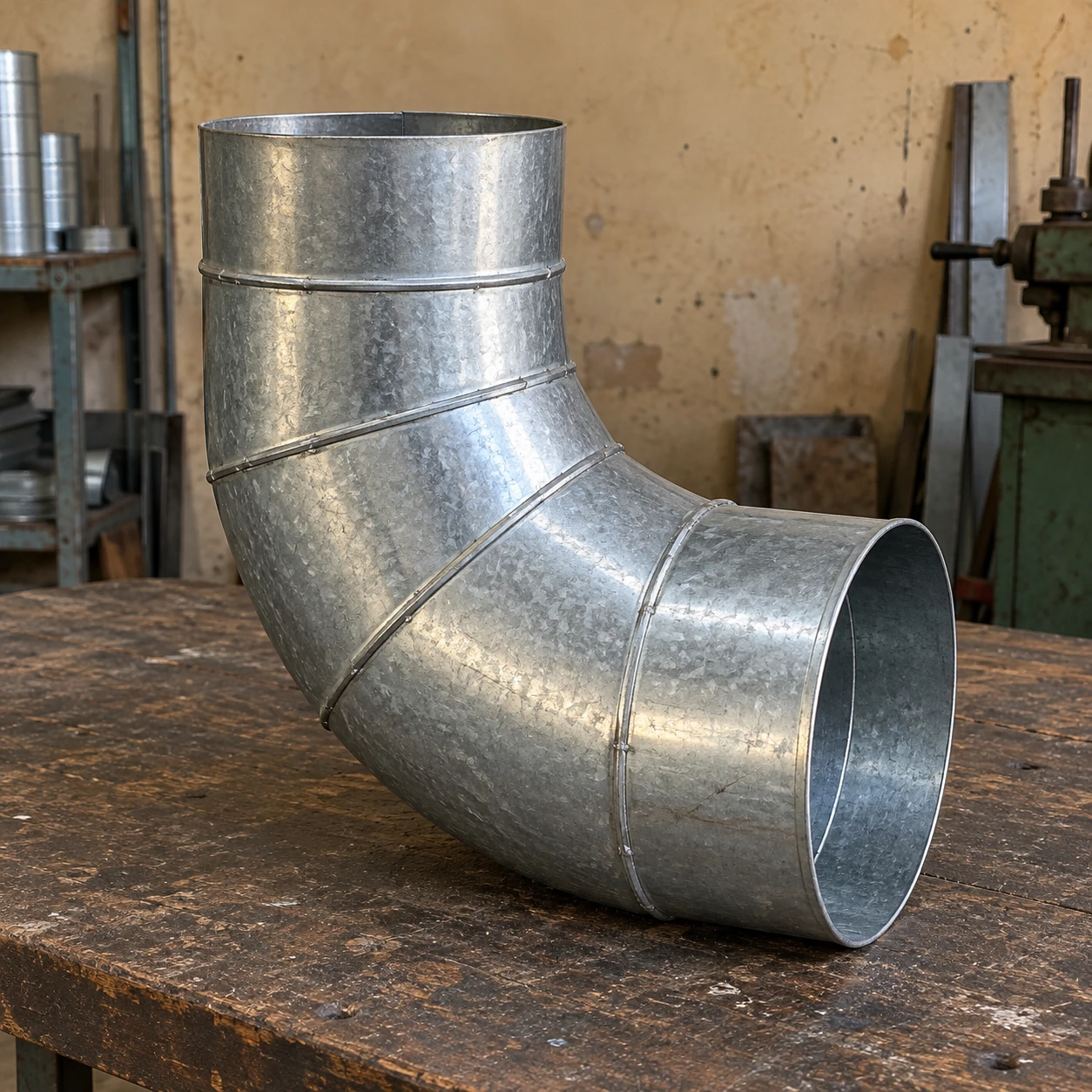
Right-angle turns and available bend space
90 degrees duct elbows
| Direction change | 90° between inlet and outlet axes |
|---|---|
| Round nominal bore D (mm) | 100 / 160 / 250 / 400 / 630 |
| Rectangular opening W × H (mm) | 300 × 200 / 500 × 300 / 800 × 400 |
| Round centerline radius | R ≈ 1D or 1.5D constructions |
| Rectangular geometry | Radius passage or designed mitered/vane arrangement |
| Ends | Matched spigot, clamp or flange interfaces |
The angle defines direction only. The radius, end lengths and connection details determine the fitting envelope.
90-degree duct elbows can be configured for the available corner, air duty and adjoining duct system.
A right-angle duct turn can be made with very different fittings. A broad radius bend, a compact guided corner and an adjustable segmented elbow may all change direction by the same angle, but they do not occupy the same space or produce the same airflow conditions.
Draw the whole corner
Mark the two duct centerlines, then add the elbow body, its straight ends and the connection allowance. Finally include insulation, flanges and the room needed to assemble them. Checking only the point where the axes intersect can leave the heel of the fitting inside a beam or wall.
For a circular bend, distinguish centerline radius from throat radius. For a rectangular bend, identify which opening dimension lies in the plane of the turn. Those conventions prevent a nominally correct elbow from occupying an unexpected footprint.
When a compact corner is necessary
Use the selected geometry's resistance data and any specified air guides. Do not remove vanes solely to make cleaning easier without reviewing the effect on the passage. If the air stream makes a vane bank impractical, revisit the route or choose a different elbow construction.
When two smaller turns are considered
A pair of gentler bends can form an offset or move the corner away from an obstruction. The arrangement adds joints and changes the overall envelope. Its total loss depends on the bends, spacing and approach flow; it is not automatically lower than a single well-designed right-angle elbow.
Can the same elbow be used before any fan?
No single connection layout suits every fan. The bend can deliver uneven or rotating inlet flow, and outlet arrangements can also affect performance. Follow the selected fan's connection requirements and account for the actual arrangement when choosing the duty.
Does the elbow set the airflow capacity?
The elbow forms part of the resistance network. Airflow depends on the fan and the complete duct system, including filters, terminals and other fittings. Diameter and angle alone are not a capacity specification.
For process extraction at a right-angle turn, review industrial duct elbows 90 degree.
90-degree duct elbows can be configured for the available corner, air duty and adjoining duct system.