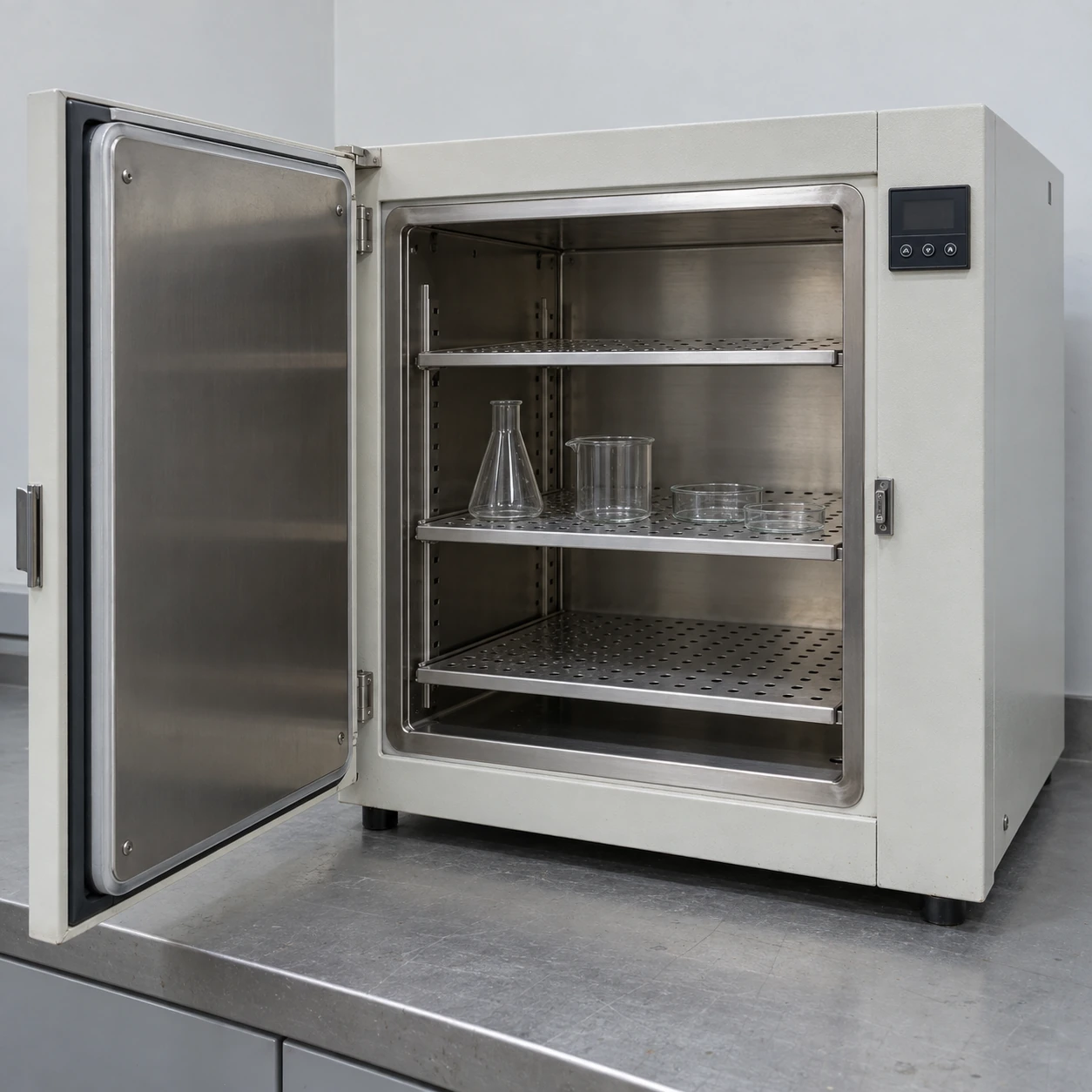
Dry Heat Sterilizers
dry heat sterilizer
| Brand | shengtongJH |
|---|---|
| Format | Batch cabinet; bench-top or floorstanding |
| Chamber options, W × D × H (mm) | 450 × 490 × 450; 600 × 540 × 500; 600 × 500 × 1000 |
| Corresponding outer dimensions (mm) | 560 × 600 × 820; 710 × 650 × 870; 710 × 650 × 1640, W × D × H |
| Chamber and shelves | Stainless steel, removable perforated shelves |
| Heating approach | Natural-convection or forced-air configuration |
| Temperature and records | Programmable controller; selected operating limit and recording package |
| Power supply | 115 V or 220 V equipment versions, matched to the chosen heater and installation |
The permitted process depends on the selected equipment, load and packaging. Chamber dimensions do not equal the usable loaded space.
Chamber size, loading accessories, air circulation and control functions can be customized for the intended use.
A dry heat sterilizer transfers heat to compatible items through hot air inside an insulated chamber. It can suit laboratory glassware and selected metal components that tolerate the process. Choosing the cabinet starts with the material and load arrangement, then the required heating, holding and cooling behaviour.
Why a hot chamber does not mean a finished load
The controller senses air or a defined measurement point. A thick metal component or a closely packed tray can take longer to heat than that point. This is why the exposure stage of an approved process cannot simply be counted from the moment the display first reaches its set value.
Heat-up, exposure and cooling serve different purposes. Heat-up brings the load towards the process condition; the exposure stage delivers the specified treatment; cooling brings the items to an appropriate handling condition while controlling contamination. Throughput should be judged over the whole sequence, including loading and unloading.
Choose how the air moves
Natural convection
Air moves as it warms and rises. This approach has a comparatively simple chamber arrangement and may suit appropriate small, uncomplicated loads. Dense loading and blocked vertical paths can make heat distribution more difficult.
Forced circulation
A fan moves hot air through the chamber. It can improve heat transfer and distribution, but the load still needs to leave the designed circulation paths open. Fan speed, tray arrangement and the position of components work together.
The CDC overview of dry heat distinguishes static-air and forced-air equipment and notes the limitations created by slow heat penetration and high processing temperatures. Equipment selection must still follow the instructions and qualification for the actual application.
Choose the load before choosing litres
Empty heat-resistant glassware and suitable metal pieces are different from liquid-filled vessels, electronic assemblies or mixed-material parts. Handles, adhesives, seals, coatings and lubricants may set a lower temperature limit than the main item. Use material compatibility information for the complete article.
This type of general cabinet is not selected for flammable solvent evaporation or arbitrary chemical processing. A normal drying oven that reaches a high temperature is also not automatically a qualified sterilizer.
Leave space for the complete workflow
Usable loading space excludes areas reserved for airflow, sensors and safe clearance. Outside the cabinet, allow for the opening door, a load carrier and a protected place to receive processed items. Heat released into a small room can also affect working conditions and the building cooling load.
Where items are processed inside bags, select dry heat sterilizer pouches that are compatible with the equipment and the approved exposure. Wrapping changes the load and belongs in its qualification.
Read a cycle record as process evidence
A useful record identifies the selected programme, temperatures, timing and any interruption. It supports investigation of a changed load or an alarm rather than leaving only an operator's memory of the display. Release of a processed load follows the site's established validation and monitoring requirements; a completed timer alone is insufficient.
For open glassware that must also be protected from particles during treatment or cooling, consider a purpose-built filtered chamber. An ISO Class 7 dry heat sterilizer specification addresses an additional air-cleanliness requirement, with its own evidence.
Chamber size, loading accessories, air circulation and control functions can be customized for the intended use.