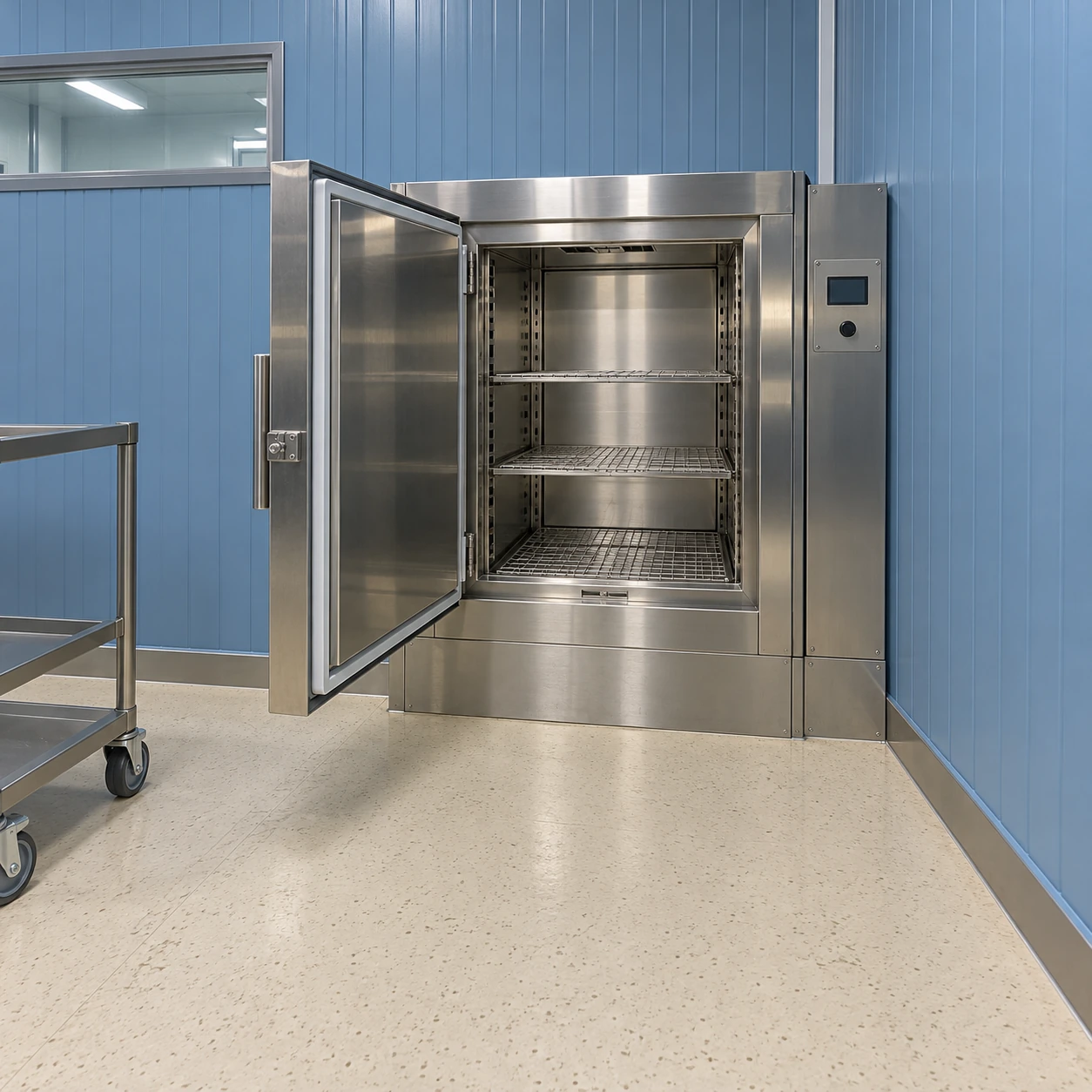
Dry Heat Sterilizers
iso class 7 dry heat sterilizer
| Brand | shengtongJH |
|---|---|
| Equipment form | Clean-air batch cabinet, single-door or pass-through |
| Chamber W × D × H (mm) | 540 × 390 × 530; 540 × 540 × 760; 540 × 540 × 1410 |
| Single-door outer W × D × H (mm) | 760 × 640 × 860; 760 × 790 × 1110; 760 × 790 × 1910, respectively |
| Air-cleanliness specification | ISO Class 7 in the agreed chamber zone and operating state; qualification for the supplied configuration |
| Air treatment | Filtered inlet with chamber sealing and a matched recirculation/cooling design |
| Temperature design options | Up to 250 °C; 300 °C high-temperature configuration selected separately |
| Materials and access | Stainless chamber; removable carriers; stainless outer casing and wall trim options |
| Control and installation | Door interlocking, measurement access and cycle records selected with the application |
Outer dimensions above apply to the single-door configuration. Pass-through versions, filter extensions, wall trim and maintenance clearances require their own installation drawing.
Chamber size, door configuration, wall interfaces and monitoring options can be customized for the intended process and room layout.
An ISO Class 7 dry heat sterilizer is selected when the process needs a defined chamber air-cleanliness level alongside dry-heat treatment. The term should describe the specified equipment environment, with evidence for its operating conditions. Placing an ordinary oven in an ISO Class 7 room does not give the oven chamber the same classification.
Keep the room and chamber requirements separate
The room supplies the surroundings for loading, maintenance and unloading. The chamber contains its own surfaces, air circuit and load. Each has a different boundary. A room report therefore cannot replace equipment evidence, and an equipment report does not classify the surrounding room.
The required class should follow the process specification. ISO Class 7 permits a higher particle concentration than ISO Class 5 at the same applicable particle size. It is not an interchangeable label for a process that needs ISO Class 5 chamber conditions. Neither class measures sterilization effectiveness.
Choose the handling route
| Arrangement | What the room layout must support |
|---|---|
| Single door | One loading and unloading side, clear separation of incoming and processed items, room for the open door and carrier. |
| Pass-through | A coordinated wall opening, sealed perimeter, defined receiving side and interlocked door operation. |
| Separate service access | Reachable filters, heater and control components without obstructing normal transfer or damaging the room boundary. |
Pass-through equipment can make a material route easier to control, but it does not establish that route by itself. The receiving environment, door release conditions and carrier movement still need to match the facility's process.
Specify the air circuit as a system
Some manufacturer designs achieve a Class 7 chamber using filtered inlet air and controlled construction without an internal recirculation HEPA filter. Other equipment uses a different arrangement. The useful comparison is the documented result under the required conditions, including cooling, rather than the number of filters fitted.
For a retrofit, agree where make-up and exhaust air go and how the cabinet affects the adjoining room. An uncontrolled connection to building ventilation can change equipment pressure and cooling behaviour.
Allow for the load and maintenance space
A narrow tall chamber may suit a shelf carrier but still be awkward for a bulky fixture. Choose the chamber around the item and carrier together, then reserve space to withdraw them completely. Wall trim and a doorway can also reduce practical access even when the cabinet fits the room.
Leave filter replacement and electrical service access in the layout from the start. Access through the wrong side of a room partition can disrupt the controlled area each time maintenance is needed.
Define what will be demonstrated at handover
Identify the chamber zone, applicable particle sizes and operating conditions for cleanliness assessment. Temperature performance and the actual loaded process need their own acceptance work. Where a high-temperature depyrogenation process is intended, state that objective explicitly rather than inferring it from the cabinet's maximum rating.
Door or seal replacement, a revised load carrier and changes to air connections can affect the established condition. The maintenance and change-control plan should identify when relevant checks or requalification are required.
For an installation enquiry, provide the intended load, the rooms on each side, a dimensioned access layout and the required process evidence. shengtongJH can use that information to coordinate a suitable equipment and installation scope.
Chamber size, door configuration, wall interfaces and monitoring options can be customized for the intended process and room layout.