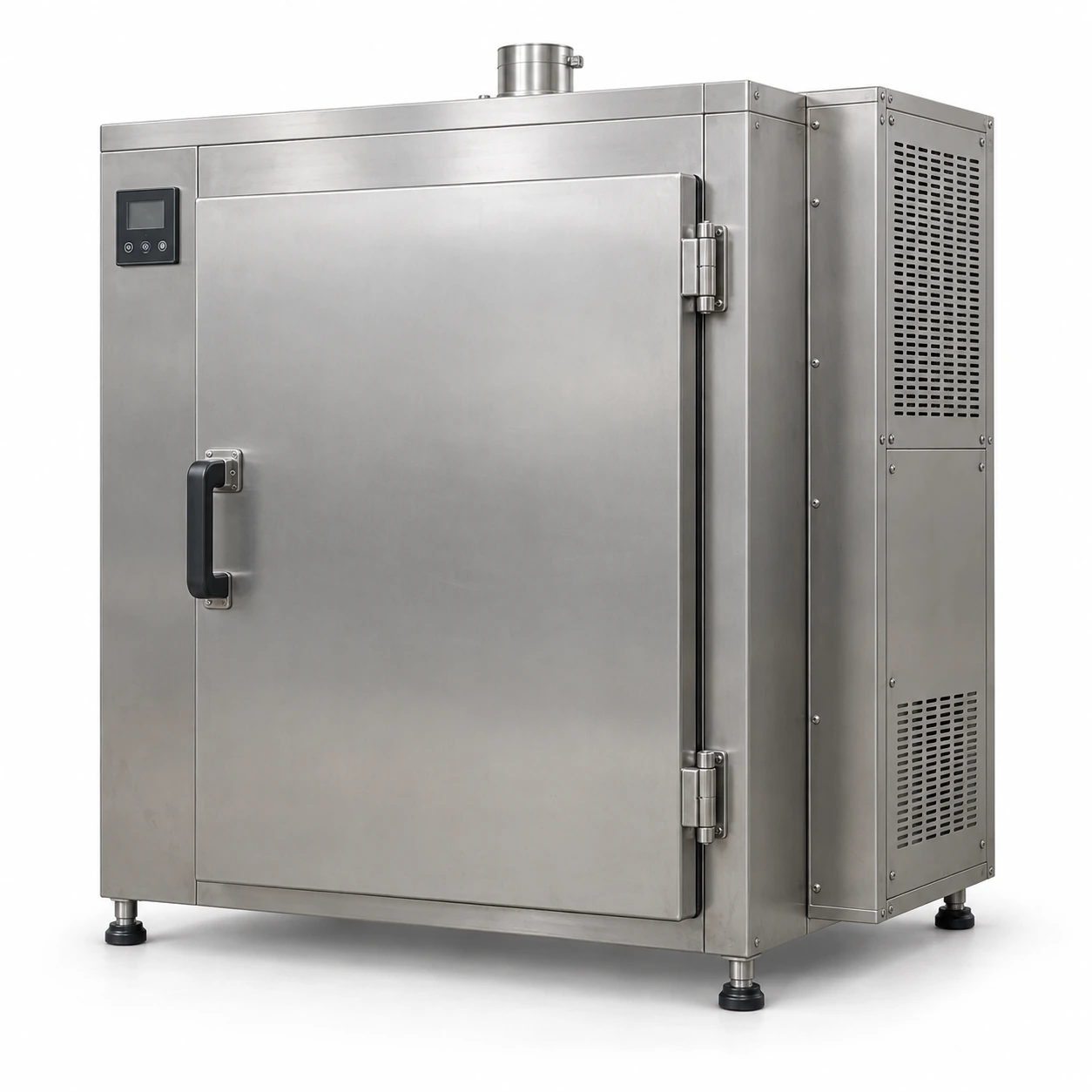
Dry Heat Sterilizers
iso class 5 dry heat sterilizer
| Brand | shengtongJH |
|---|---|
| Equipment | Filtered batch dry heat sterilizer; single-door or pass-through configuration |
| Chamber options, W × D × H (mm) | 480 × 660 × 480; 660 × 660 × 660; 800 × 850 × 800 |
| Nominal chamber volumes | 152 L; 287 L; 544 L, respectively |
| Air-cleanliness requirement | ISO Class 5 within the specified chamber zone and defined operating conditions; equipment-specific qualification required |
| Air handling | High-temperature recirculation filtration with matched inlet, exhaust and cooling-air treatment |
| Chamber material | 304 stainless steel; 316L option where required by the application |
| Thermal specification | 250 °C or 300 °C equipment design options; operating cycle established for the load |
| Access and records | Door interlocks, measurement ports, temperature records and filter-test access selected with the system |
The ISO class is a procurement and qualification requirement, not a sterility claim. Overall cabinet dimensions include the filter housing and depend on the selected door and service arrangement.
Chamber dimensions, filtration, door arrangement and monitoring functions can be customized to suit the process and facility.
An ISO Class 5 dry heat sterilizer combines a thermal process with a defined low-particle environment inside the process chamber. This matters for suitable exposed glassware or components that must remain protected while they are heated and cooled. The required class, operating stages and qualification evidence must be part of the selected equipment specification.
Specify the chamber boundary and the operating stages
ISO 14644-1 classifies airborne particle concentration. An ISO Class 5 chamber specification therefore needs a defined measurement zone and operating state. A room classification outside the cabinet, a filter label or a particle count taken in a different condition does not establish the chamber result during the intended process.
For procurement, state whether the requirement applies during heating, exposure, cooling and the period before unloading. The supplied evidence should identify those conditions. Particle cleanliness and the effectiveness of the thermal treatment are separate acceptance questions.
Three parts of the air path work together
Recirculation
Heated air returns through the load. A suitable high-temperature filtration arrangement controls particles in that circuit, while the distribution surfaces and load carrier leave a clear path across the useful chamber.
Make-up air and exhaust
Air entering or leaving the system changes the chamber balance. Inlet treatment, exhaust protection and sealing need to be coordinated so that uncontrolled leakage does not bypass the intended particle-control route.
Cooling
The treated load still needs protection as its temperature falls. The cooling method should preserve the agreed chamber cleanliness and pressure behaviour, rather than drawing unqualified room air directly over exposed items.
High-temperature construction matters
A filter assembly includes more than the media. Its frame, sealing arrangement and surrounding housing experience thermal movement. A room-temperature filter intended for a ventilation unit cannot simply be assumed suitable for an oven recirculation circuit.
Service access must allow the filter and seal system to be inspected and replaced as intended. The subsequent test requirements belong in the maintenance plan. Filter differential pressure can help identify changes in the air circuit, but it does not prove filter integrity or chamber classification by itself.
Protect the load after treatment
Door opening and transfer can reintroduce particles after a successful cycle. In a pass-through arrangement, the wall seal, receiving environment and door-release logic become part of the process interface. The way a tray moves out of the chamber deserves as much attention as the cabinet's heating specification.
A smaller batch cabinet can be appropriate when loads are intermittent. A continuous tunnel is a different handling system with different line interfaces; the ISO class wording alone does not decide between them.
Separate the evidence for each result
Review chamber particle classification, filter-system testing, temperature distribution and loaded process validation as distinct items. The same cabinet can have good air-cleanliness results while still needing a different loading pattern to obtain the required treatment at the most difficult point in the load.
Sterilization and depyrogenation also have different objectives. A general sterilization cycle does not automatically establish endotoxin reduction. Where depyrogenation is required, its process conditions and acceptance evidence must be agreed specifically; neither the ISO Class 5 label nor the maximum temperature rating supplies that evidence.
Use the quotation enquiry to describe the exposed material, batch arrangement, required chamber conditions and receiving area. These determine whether this configuration or a different dry heat sterilizer is appropriate.
Chamber dimensions, filtration, door arrangement and monitoring functions can be customized to suit the process and facility.