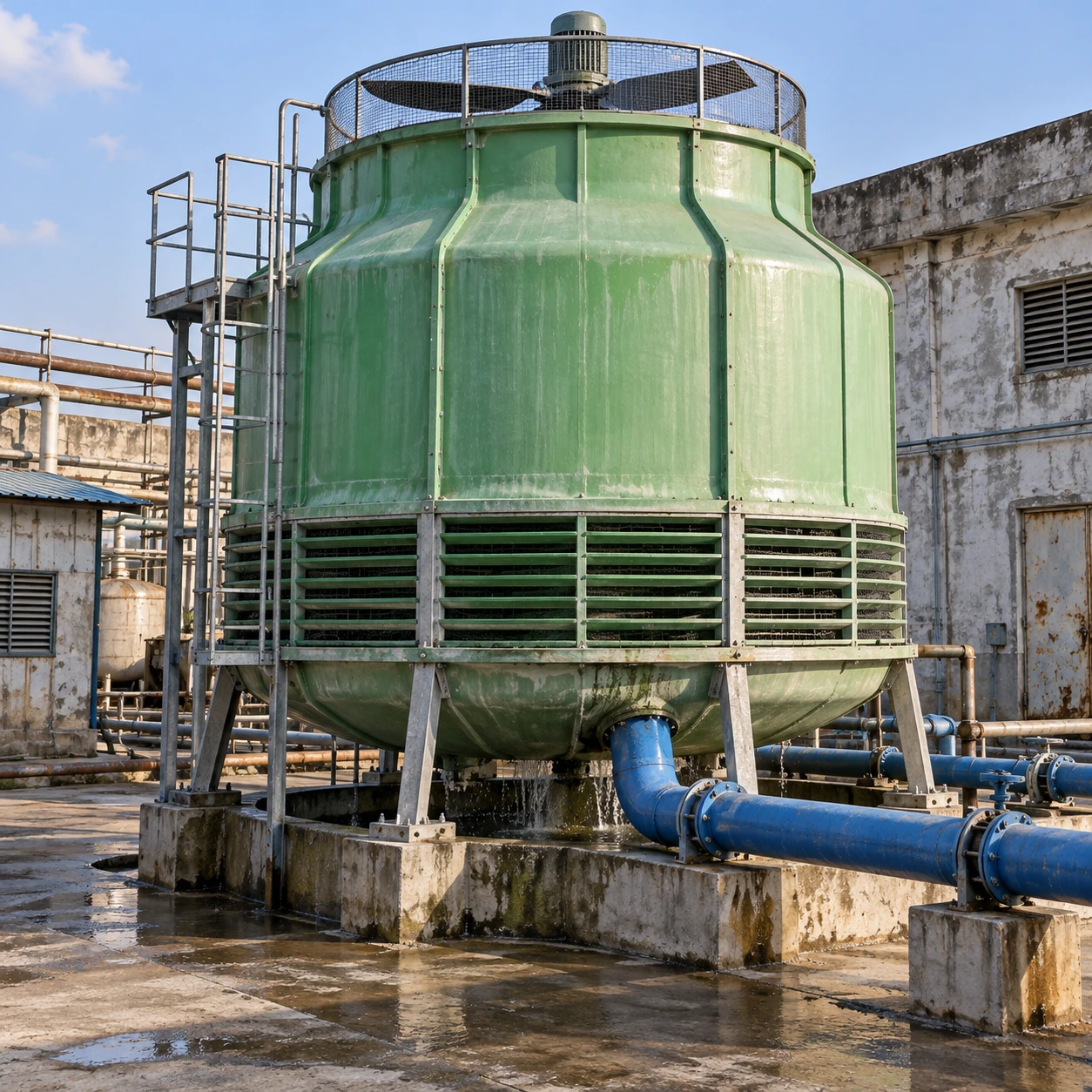
Cooling Towers
evaporative cooling tower
| Brand | shengtongJH |
|---|---|
| Cooling method | Open-circuit evaporative heat rejection |
| Common flow duties | 20 / 50 / 100 m³/h, selected at the required temperature range |
| Thermal selection | Hot water, cold water and entering-air wet-bulb temperature specified together |
| Round size classes | Approx. Ø1,200 × 2,300 / Ø1,800 × 2,500 / Ø2,500 × 3,100 mm, diameter × height |
| Fan motor choices | 0.37 / 1.1 / 2.2 kW, subject to tower selection |
| Body and basin | FRP; corrosion-resistant frame and fasteners as selected |
| Fill | PVC for suitable conditions; temperature-compatible alternative when required |
| Water services | Automatic make-up, overflow, drain and controlled blowdown |
| Electrical supply | 380–415 V, 3-phase, 50 Hz; voltage and frequency options |
| Operating accessories | Drift eliminator, basin level alarm and treatment connections |
Flow is not a stand-alone cooling rating. Tower size and fan selection depend on the water temperature range, approach and local climate.
Materials, cooling duty, basin arrangement and water connections can be customized to the factory operating conditions.
An evaporative cooling tower uses the evaporation of a small part of the circulating water to carry away heat. It can serve ordinary factory cooling circuits where suitable make-up water, drainage and routine water management are available.
Understand the temperature limit before ordering
A tower is useful when the process can accept water temperatures achievable under the site's summer conditions. It is not a substitute for a refrigeration machine when chilled water is needed below that limit. Humid weather reduces the available evaporative cooling effect, so dry-bulb air temperature alone is insufficient for selection.
The same tower will not deliver the same leaving-water temperature at every heat load. Compare offers at identical flow, entering-water temperature and wet-bulb conditions rather than comparing isolated capacity labels.
The water balance affects daily operation
Make-up water replaces evaporation, controlled blowdown, drift and any unintended leakage. A drifting basin level may therefore indicate a service problem, not simply a need for a larger supply pipe. Check float or level controls, overflow paths and the ability of the supply to cope with normal demand.
Evaporation leaves many dissolved substances behind. Controlled blowdown helps manage their accumulation, but excessive bleed wastes water and treatment chemicals. A site-specific water-treatment configuration connects the water-saving objective with the actual quality limits of the system.
Keep heat-transfer surfaces usable
Scale, solids and biological deposits can impair distribution and heat exchange. Select fill that suits the circulating water and can be accessed for service. High inlet temperature also affects fill choice; ordinary fill should not be assumed suitable for every hot process return.
Plan for interruption
A stopped production line may leave warm stagnant water in the tower. Shutdown, cleaning and restart procedures belong in the operating plan. Seasonal service requires more than switching the fan off until the next demand.
Is a wet tower the right choice?
It can be a practical option for an industrial site with an acceptable water supply and routine maintenance support. Where water use is constrained, compare an adiabatic fluid cooler at the same process temperatures. Where consistently colder water is required, assess a refrigeration-based cooling system instead of promising more from evaporation than the climate permits.
Materials, cooling duty, basin arrangement and water connections can be customized to the factory operating conditions.