Cooling Towers
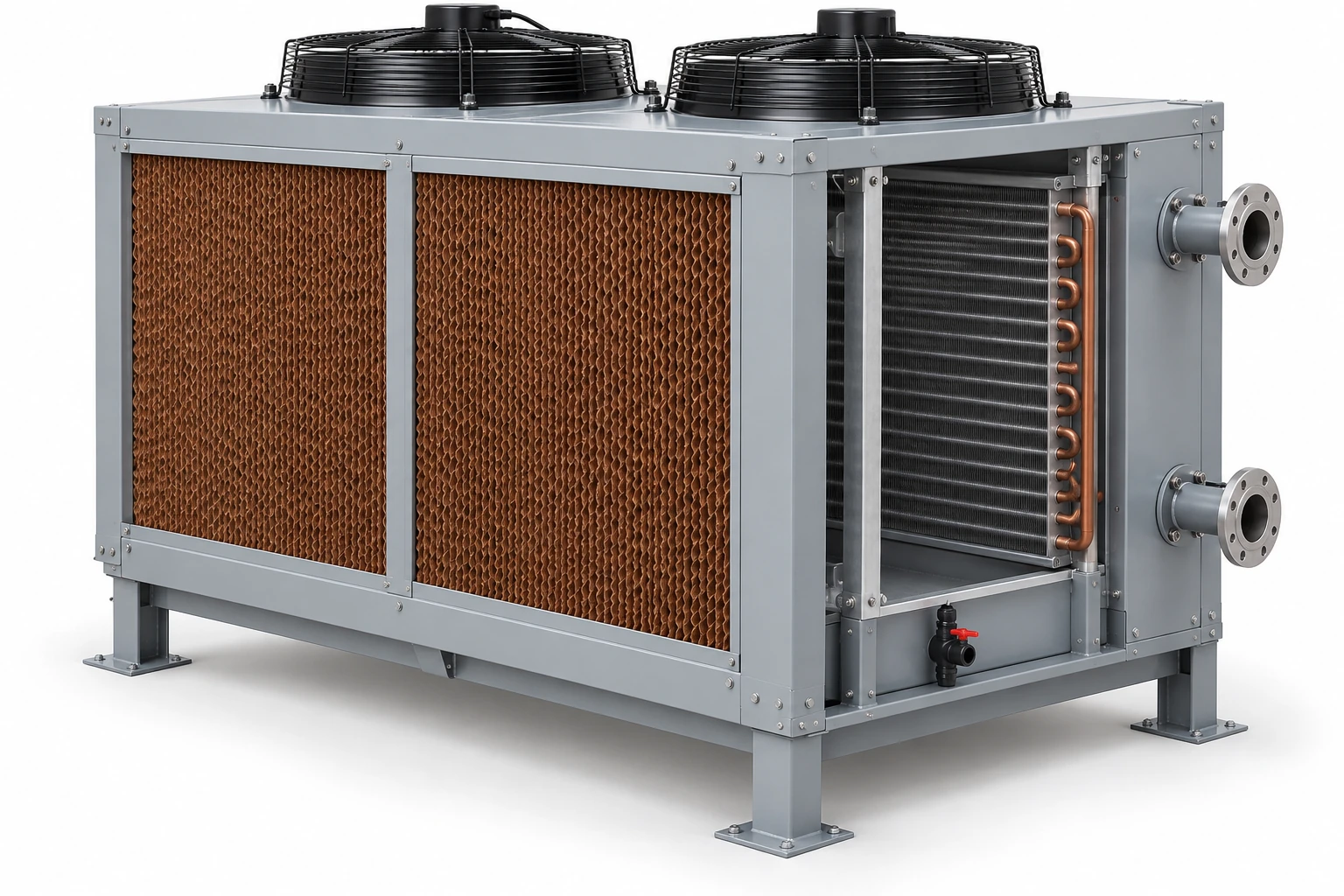
adiabatic cooling tower
| Brand | shengtongJH |
|---|---|
| Equipment | Conventional closed-fluid-loop cooler with adiabatic inlet pads |
| Operating modes | Dry air cooling and water-assisted pre-cooling |
| Duty selections | 50 / 100 / 200 kW heat-rejection enquiries; selection at stated fluid and ambient conditions |
| Fan arrangement | Two or four axial fans; speed control option |
| Coil | Finned-tube water or compatible water/glycol circuit |
| Equipment dimensions | Compact or extended frame; W × D × H in mm confirmed with coil and fan selection |
| Larger frame class | Approx. 2,400 × 3,100 × 1,900 mm, W × D × H; service clearances additional |
| Water system | Pad distribution, drainage and optional recirculation arrangement |
| Power supply | 380–415 V, 3-phase, 50 Hz; other supplies by selection |
| Control inputs | Leaving-fluid temperature, ambient condition and water availability |
| Options | Coil coating, freeze protection, pad access and local control panel |
Heat duty is not an electrical input rating. Dry and assisted capacities differ and must be selected separately for the specified fluid temperatures and local climate.
The cooler frame, coil, pad arrangement and controls can be customized to the industrial cooling duty and site water constraints.
The term adiabatic cooling tower is often used for a fluid cooler that combines a finned coil with evaporative air pre-cooling. Process water stays inside the coil, while wetted inlet pads assist cooling when required. This differs from an open tower that exposes circulating process water directly to air.
Use water when it provides a benefit
In dry operation, the fans move ambient air across the coil. When conditions require assistance, wetted pads lower the temperature of incoming air through evaporation. The benefit depends on humidity as well as air temperature, so an arrangement suited to a dry region may perform differently in a humid one.
Water use can be reduced by operating dry when the duty permits, but no fixed annual saving applies to every installation. Operating hours, fluid setpoint and local weather all matter.
Protect the process circuit
The coil keeps process fluid separate from the pad water. This can simplify the water boundary for equipment that should not receive open tower water. It does not mean the complete installation is maintenance-free: the coil, pads and water system each need appropriate care.
What happens if water is unavailable?
The unit may continue in dry mode, but its available duty changes. Define whether the process can tolerate warmer water, reduced production or a standby cooling source during that condition. A controller that disables pad water cannot guarantee full assisted-mode capacity without water.
Choose service access over unnecessary complexity
For an ordinary industrial installation, removable pads, reachable drains and accessible fan assemblies are valuable practical features. Ensure there is enough space to withdraw pads and clean the coil without dismantling nearby pipes. Dirt on the air side reduces performance even when the process water remains clean.
Water quality affects pad scaling and service intervals. Select the supply and drainage arrangement for the actual water source and operating schedule. Where freezing is possible, the coil fluid and exposed water system need their own protection strategy; switching the fans off is not adequate freeze protection.
Compare equipment at the same duty
Provide required fluid temperatures, heat load, water or glycol composition, summer dry-bulb and wet-bulb conditions, and permitted water use. Ask for both dry and assisted performance at those conditions. If very low process temperatures are required, compare a refrigeration-based chiller rather than assuming adiabatic assistance will achieve them.
For sites with sufficient make-up water and an acceptable open-water circuit, an evaporative cooling tower may also be considered. shengtongJH can coordinate a conventional equipment comparison without adding premium features that do not serve the application.
The cooler frame, coil, pad arrangement and controls can be customized to the industrial cooling duty and site water constraints.