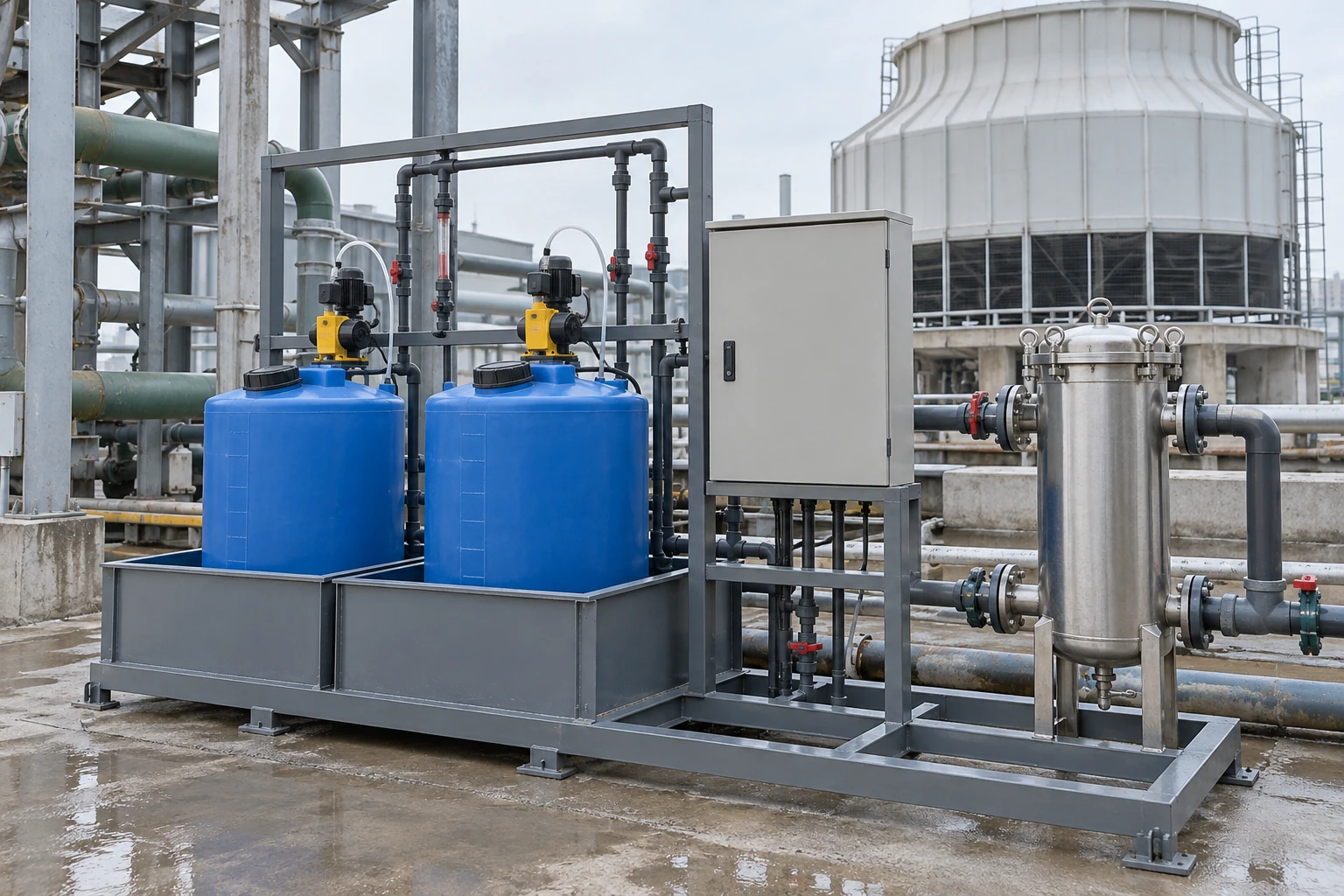
Cooling Towers
cooling tower water treatment
| Brand | shengtongJH |
|---|---|
| Package arrangement | Wall-mounted control panel, dosing skid or separate filtration module |
| Dosing configuration | One, two or three independent chemical feed channels |
| Tank options | 50 / 100 / 200 L chemical-compatible tanks with suitable containment |
| Metering-pump selection | Adjustable delivery matched to chemical concentration, dose and injection pressure |
| Side-stream filtration | Screen, media or separator selection matched to particle load and flow |
| Monitoring | Conductivity and temperature; optional pH and treatment-specific sensors |
| Blowdown | Automatic valve with conductivity control and make-up water metering |
| Electrical options | 220–240 V control supply; 380–415 V three-phase pump package where required |
| Arrangement sizes | Compact panel, single-skid or split-skid layout; W × D × H in mm specified with the selected tanks and filter |
| Protection | Low-tank-level alarm, dosing interlock, isolation and sampling points |
Treatment setpoints, pump output and package dimensions are selected from the water analysis and equipment arrangement. Chemical compatibility and discharge requirements govern the final configuration.
The dosing, filtration and control package can be customized to the water quality, operating pattern and available service space.
Cooling tower water treatment combines equipment and an operating programme to manage deposits, corrosion and biological growth. This page covers treatment equipment for the circulating-water circuit, including dosing, filtration, measurement and controlled blowdown.
A clear basin does not tell the whole story
Water can look clean while dissolved minerals become concentrated as evaporation occurs. Deposits on heat-transfer surfaces then interfere with cooling, while unsuitable chemistry can attack metal components. Suspended dirt is a different problem: it collects in low-flow areas and can obstruct small passages. Choosing a single filter without separating these causes leaves important problems unresolved.
Dissolved material
Conductivity monitoring helps control concentration through blowdown and replacement water. The permissible operating range depends on the make-up supply, wetted materials and treatment programme; one universal setting cannot suit every site.
Suspended solids
Side-stream filtration removes selected particles from a portion of the circulating flow. Filter grade, cleaning method and pressure loss must suit the dirt being collected. It does not remove all dissolved salts.
Biological control
A qualified water-treatment specialist should establish chemical selection, monitoring and corrective actions. Filtration alone is not disinfection. Closed process coils also do not eliminate the need to manage an exposed spray-water circuit.
Make the equipment serviceable
Place sampling points where operators can obtain representative water safely. Keep chemical containers accessible for replacement, provide compatible containment and separate incompatible chemicals. A skid that fits through the door but blocks tank removal creates an avoidable maintenance problem.
Dosing should be coordinated with proven water flow and the control strategy. Consider what happens during a power interruption, loss of make-up water or extended shutdown. Alarm indications are useful only when somebody is responsible for responding to them.
Specify a package that can be operated
Provide the latest water analysis, system volume, make-up consumption, operating schedule and existing treatment arrangement. These determine tank replenishment intervals and equipment duties more reliably than cooling-tower size alone. For an existing plant, recurring deposits, corrosion observations and filter-cleaning frequency are valuable selection information.
shengtongJH can coordinate equipment sourcing around that treatment specification. Commissioning records, chemical instructions and the site water-management programme should remain with the operating team. The CDC cooling-tower guidance explains why ongoing management is needed in addition to installing hardware.
The dosing, filtration and control package can be customized to the water quality, operating pattern and available service space.