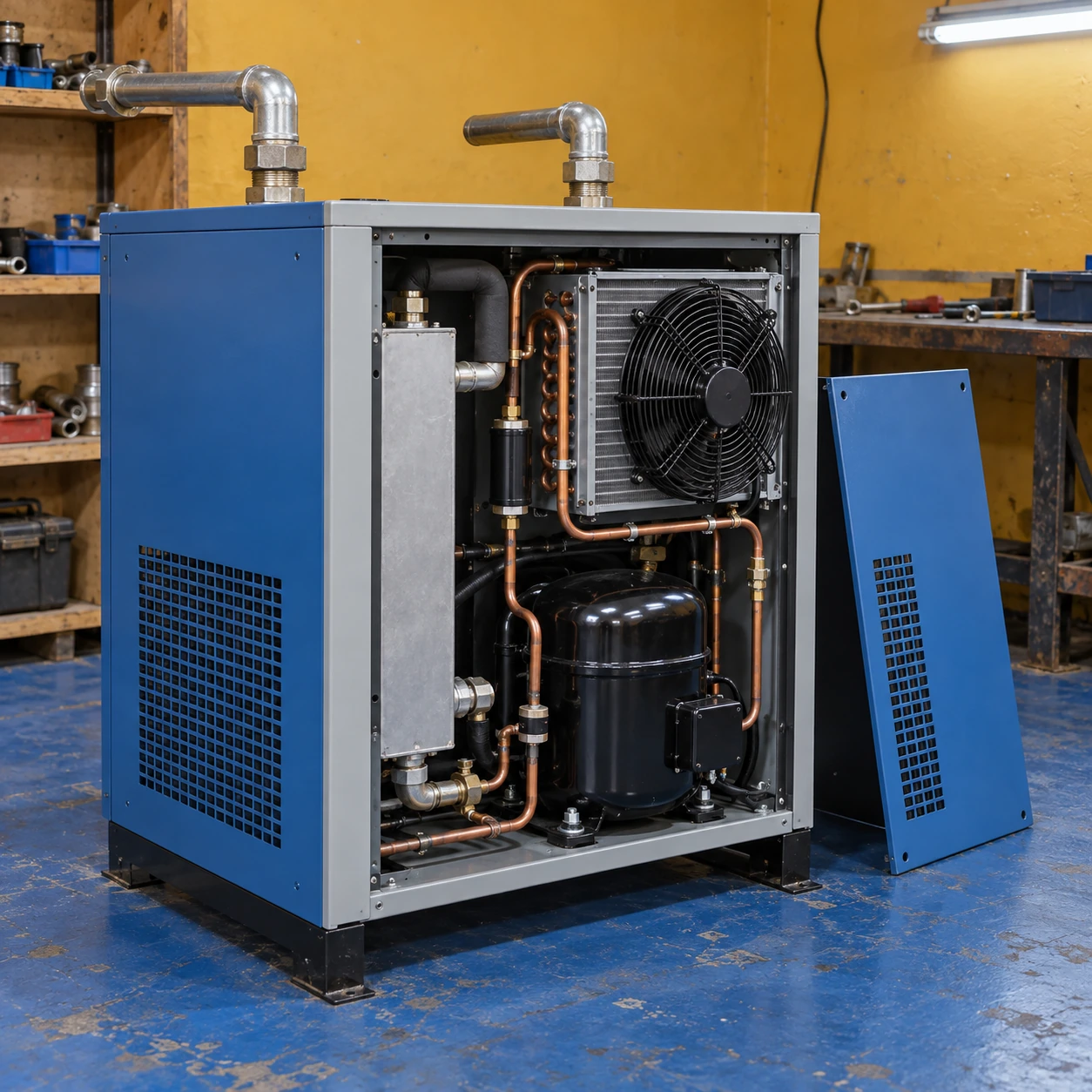
Compressed Air Dryers
refrigeration compressed air dryer
| Cabinet W × D × H (mm) | 630 × 484 × 779; 620 × 540 × 963; 764 × 660 × 1009 |
|---|---|
| Cooling circuit | Selected air-to-air heat recovery, refrigerant evaporator and moisture separator |
| Condensing arrangement | Air-cooled condenser with accessible ventilation and cleaning surfaces |
| Pressure dew point | +3°C selection point at 7 bar(g), 35°C inlet and 25°C ambient |
| Inlet-flow choices | 0.65–3.90 m³/min nominal; apply the matched configuration's correction factors |
| Electrical configuration | 230 V, single phase, 50 Hz family; other versions selected for the destination |
| Load control | Continuous, cycling or variable-output arrangement appropriate to the duty |
| Service provisions | Accessible drain, removable panels, temperature indication and fault signalling |
Flow refers to 1 bar absolute, 20°C dry air. Refrigerant, electrical input, operating limits and cabinet arrangement belong to the selected unit; dimensions exclude ventilation and service space.
The refrigeration package, control method and installation interfaces can be matched to your compressed-air duty.
A refrigeration compressed air dryer is a heat-transfer machine as well as a moisture separator. It has to remove heat from incoming compressed air and release that heat somewhere else. Understanding that path explains why room ventilation, inlet temperature and condenser condition can change drying performance.
Two circuits meet at the heat exchanger
The compressed-air circuit carries the process air through cooling and water separation. The refrigerant circuit supplies the cooling and carries the absorbed heat towards the condenser. They serve different functions and should remain separated by the heat exchanger.
In a typical arrangement, the outgoing dry air first recovers heat from the incoming wet air. This reduces the load on refrigeration and raises the delivered air temperature. The outlet can therefore feel warm even when its moisture content has been reduced successfully. Touching the outlet pipe is not a reliable dew-point test.
Air cooling depends on the surrounding room
The condenser needs a supply of suitably cool air and a route for heated exhaust to escape. A clear front grille is insufficient if the exhaust immediately recirculates around the cabinet. Nearby compressor heat, a closed plant-room door or accumulated dust can make the local condition worse than the site’s reported ambient temperature.
Where air cooling cannot be supported, a water-cooled configuration may be considered. It introduces water-temperature, flow, quality and fouling requirements, so it is a different utility commitment rather than a simple cure for poor ventilation.
Hot inlet air changes the selection
A dryer receives both a thermal load and moisture carried by the incoming air. If upstream cooling is inadequate, both can rise. Capacity at a published reference point must be corrected using the selected unit’s data.
A high-inlet-temperature design can include additional cooling arrangements and may use different rating conditions. Do not compare its flow label directly with a conventional dryer until the pressure, inlet temperature, ambient condition and required dew point match.
Low load needs controlled cooling too
As air demand falls, the control system must avoid inappropriate cooling and unstable operation. Continuous arrangements, thermal-storage cycling and variable-output systems handle this in different ways. The useful comparison includes part-load consumption, moisture stability and the permitted operating sequence, not only the full-load electrical input.
Design access around the parts that need attention
Leave the specified space for condenser cleaning, drain servicing and panel removal. Locating pipework directly across a removable cover can turn a routine service task into a production shutdown. Keep condensate discharge accessible and routed to suitable collection or treatment.
Refrigerant-circuit diagnosis and repair require competent service personnel and the applicable refrigerant handling procedures. A buyer can provide operating temperatures, alarms and symptoms without attempting to alter the charge or bypass protective controls.
For the complete equipment boundary, see the dryer unit package. For recurring wet-air symptoms, the replacement and diagnosis page explains the information needed before selecting a new machine.
The refrigeration package, control method and installation interfaces can be matched to your compressed-air duty.