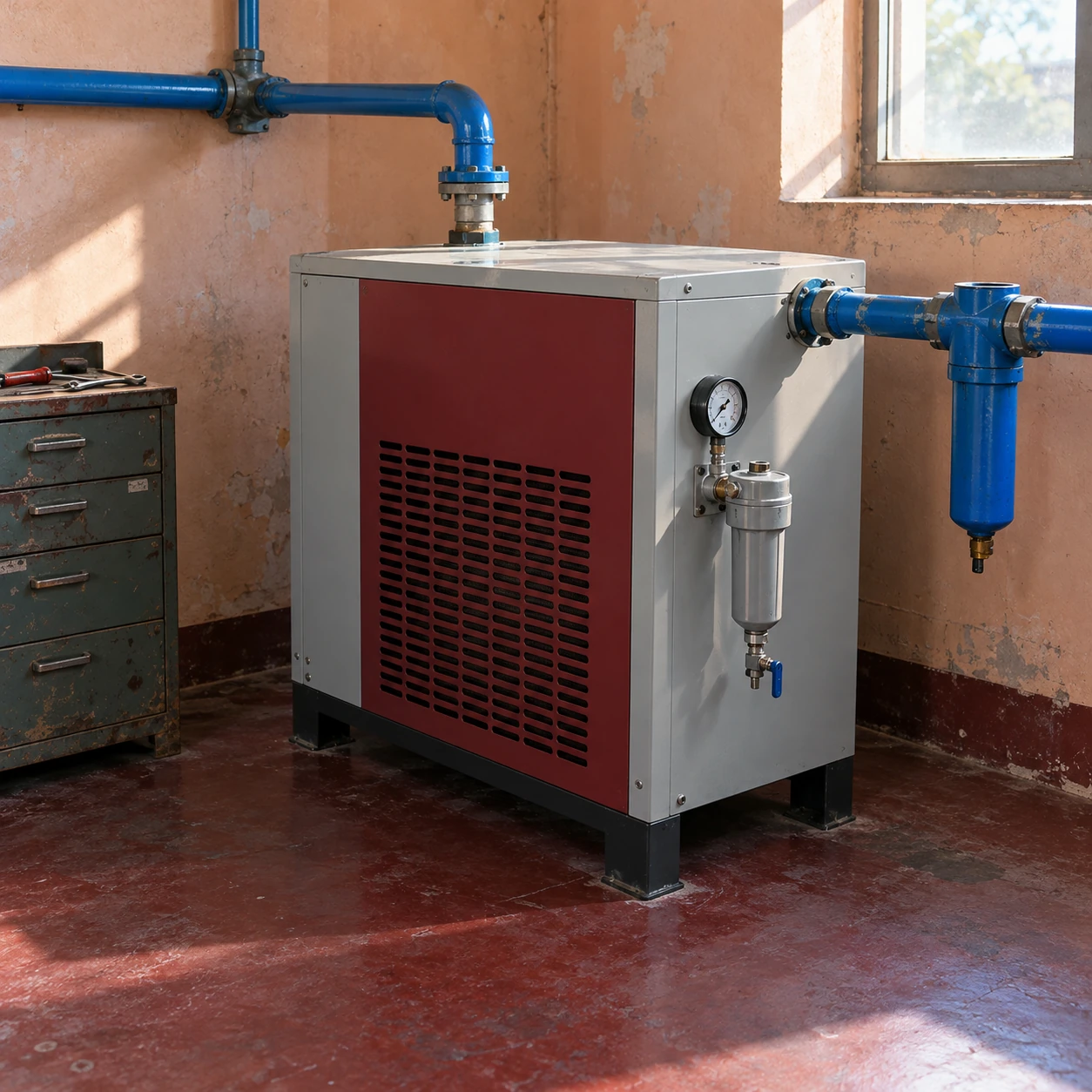
Compressed Air Dryers
compressed air dryer refrigerated
| Replacement cabinet W × D × H (mm) | 630 × 484 × 779; 620 × 540 × 963; 764 × 660 × 1009 |
|---|---|
| Nominal inlet-flow choices | 0.65–3.90 m³/min, with correction for actual duty |
| Selection conditions | 7 bar(g), 35°C saturated inlet and 25°C ambient for the stated nominal family |
| Pressure dew point | +3°C at the selected rating point |
| Air connections | G3/4, G1 or G1-1/4; adapters and pipe support identified separately |
| Electrical supply | 230 V, single phase, 50 Hz configuration; match the destination supply |
| Drain arrangement | Automatic discharge with accessible inspection and service isolation |
| Retrofit options | Moisture alarm, pressure monitoring and coordinated inlet filtration |
Flow is referenced to 1 bar absolute and 20°C dry air. Equipment dimensions exclude pipes and access space; a replacement must match both operating duty and installation interfaces.
The refrigerated package and installation connections can be adapted to the existing compressed-air service.
A refrigerated dryer replacement should solve the reason water reaches the process, not simply occupy the old unit’s space. Increased production, warmer inlet air, a blocked drain or an open bypass can produce similar symptoms. Separating those causes helps determine whether the right action is maintenance, a corrected installation or a different dryer selection.
Use the timing of the problem
- Water appears during the busiest shift
- Compare actual simultaneous demand with the dryer’s corrected capacity. A receiver upstream can release a short burst through the dryer that exceeds the compressor’s steady output. Check the lowest pressure during that event, not just the pressure at idle.
- Performance deteriorates on hot afternoons
- Record the inlet temperature and the air reaching the condenser. A hotter compressor room, dust-loaded condenser or recirculating exhaust can change the operating point without any change to the nominal production flow.
- The dryer appears normal but a branch stays wet
- Check whether untreated air can pass through a bypass or another connection. Existing downstream pipework may also contain collected water. Establish the outlet moisture condition before assigning a fault to the refrigeration circuit.
Drainage can defeat otherwise effective cooling
Condensed water must leave the separator reliably. A failed drain, restricted discharge or unsuitable connection can leave liquid in the air path. Drain performance should be checked against the equipment instructions and the site’s condensate arrangement, including any downstream backpressure restriction.
A timed drain and a level-controlled drain behave differently. Excessive opening can waste compressed air, while an unsuitable opening interval or obstructed valve can fail to remove the collected liquid. Select and maintain the drain for the actual service.
A colder pipe can expose a technology limit
A refrigerated dryer may be operating correctly while pressurised air later enters pipework colder than its pressure dew point. Replacing it with a higher-flow refrigerated unit does not necessarily fix condensation in that location.
Consider a different drying method or dedicated branch treatment where the required moisture level is lower. The technology comparison explains that distinction.
Measure before you order the replacement
Capture flow or a reliable demand assessment, minimum line pressure, the hottest inlet and condenser-air conditions, and an outlet pressure-dew-point measurement where available. Note the sequence of compressor, receiver, filters and dryer. A nameplate photograph identifies the existing equipment but cannot establish its current duty.
Make the changeover complete
The replacement plan should include supported pipe connections, electrical protection, drain routing and service access. Review the condition of filters and the downstream system as part of commissioning. Otherwise, retained water or contamination may obscure whether the new unit is performing correctly.
For an installation that cannot stop, agree how treated air will be maintained during the change. A bypass alone supplies an air path, not equivalent drying. Send the installation information through the enquiry form to define a replacement package and its boundaries.
The refrigerated package and installation connections can be adapted to the existing compressed-air service.