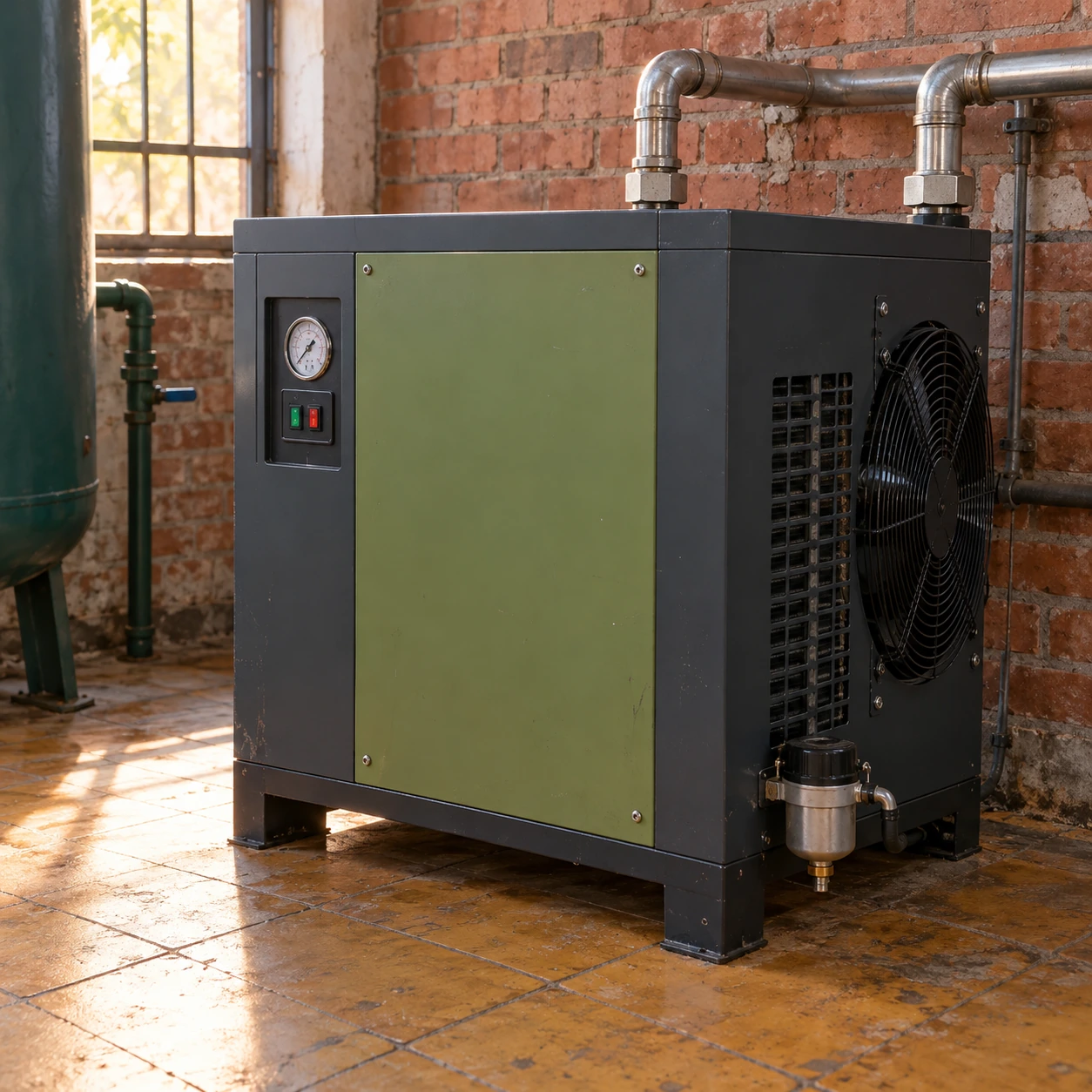
Compressed Air Dryers
refrigerated compressed air dryer
| Cabinet W × D × H (mm) | 630 × 484 × 779; 620 × 540 × 963; 764 × 660 × 1009 |
|---|---|
| Nominal capacity choices | 0.65–3.90 m³/min across the selected cabinet configurations |
| Rating basis | 7 bar(g); saturated 35°C inlet; 25°C ambient; +3°C pressure dew point |
| Flow reference | 1 bar absolute, 20°C, dry air; apply selected-unit correction factors |
| Air connections | G3/4, G1 or G1-1/4, matched to the configuration |
| Power supply | 230 V, single phase, 50 Hz; other supplies require a matched electrical version |
| Condensate handling | Automatic drain with service access and a suitable discharge connection |
| Control choices | Continuous-duty or load-responsive refrigeration; dew-point indication and alarm options |
These are configuration choices, not interchangeable capacity ratings. Final cabinet, electrical load and performance conditions are specified together; dimensions exclude service clearance.
Refrigerated dryer capacity, controls and connections can be configured for your air demand and installation.
A refrigerated compressed air dryer removes moisture by cooling the compressed air until water condenses, separating that liquid and carrying it out through a drain. Its value depends on all three steps working together. A cold heat exchanger with a blocked drain can still send water towards the process.
Recover cooling
In a typical air-to-air heat exchanger, incoming warm air gives up heat to the outgoing dry stream. This reduces the refrigeration load and warms the outlet air, helping limit condensation on downstream external surfaces.
Condense and separate
The refrigeration section then cools the compressed air further. The separator must capture the liquid at the actual air velocity; excessive flow can undermine a unit that appears large enough when judged only by its cabinet.
Discharge the water
The drain is part of the drying system. Its discharge route, backpressure limits and access for service matter as much as the front-panel display.
When refrigeration fits
Indoor pneumatic services often need protection against liquid water without a subzero dew point. Refrigeration can meet that duty with a comparatively straightforward treatment arrangement, provided the selected rating remains valid through the busy and hot parts of the working day.
If pressurised pipework becomes colder than the selected dew point, or the process specifically needs much drier air, changing to a larger refrigerated cabinet does not resolve the underlying technology limit. Review a regenerative desiccant dryer for that duty.
Allow the condenser to breathe
An air-cooled dryer rejects heat into its surroundings. Placing it against a wall, inside an unventilated cupboard or beside a hot compressor discharge can raise the air entering its condenser. The nominal room temperature measured elsewhere may no longer describe the dryer’s real conditions.
Keep the specified inlet and outlet ventilation paths open, and leave access for cleaning the condenser. A dirty grille or recirculating hot exhaust can reduce capacity without any increase in process demand.
Compare the working day, not only the maximum flow
A steady process and an intermittent workshop can reach the same peak flow but use energy differently. Continuous refrigeration control, thermal storage and variable-output arrangements respond differently as the load falls. Compare the relevant part-load information and restart behaviour; do not assume that a larger machine or an energy-saving label guarantees lower running cost.
Make moisture performance observable
Arrange a suitable pressure-dew-point measurement point downstream and provide a clear response to high-moisture alarms. A temperature shown on a refrigeration controller may describe an internal sensor rather than an independently measured outlet dew point.
For selection, provide the expected flow range, minimum operating pressure, hottest inlet and ambient conditions, electrical supply and downstream moisture requirement. The quotation scope can then include the dryer, drain, filters and controls as a matched package.
Refrigerated dryer capacity, controls and connections can be configured for your air demand and installation.