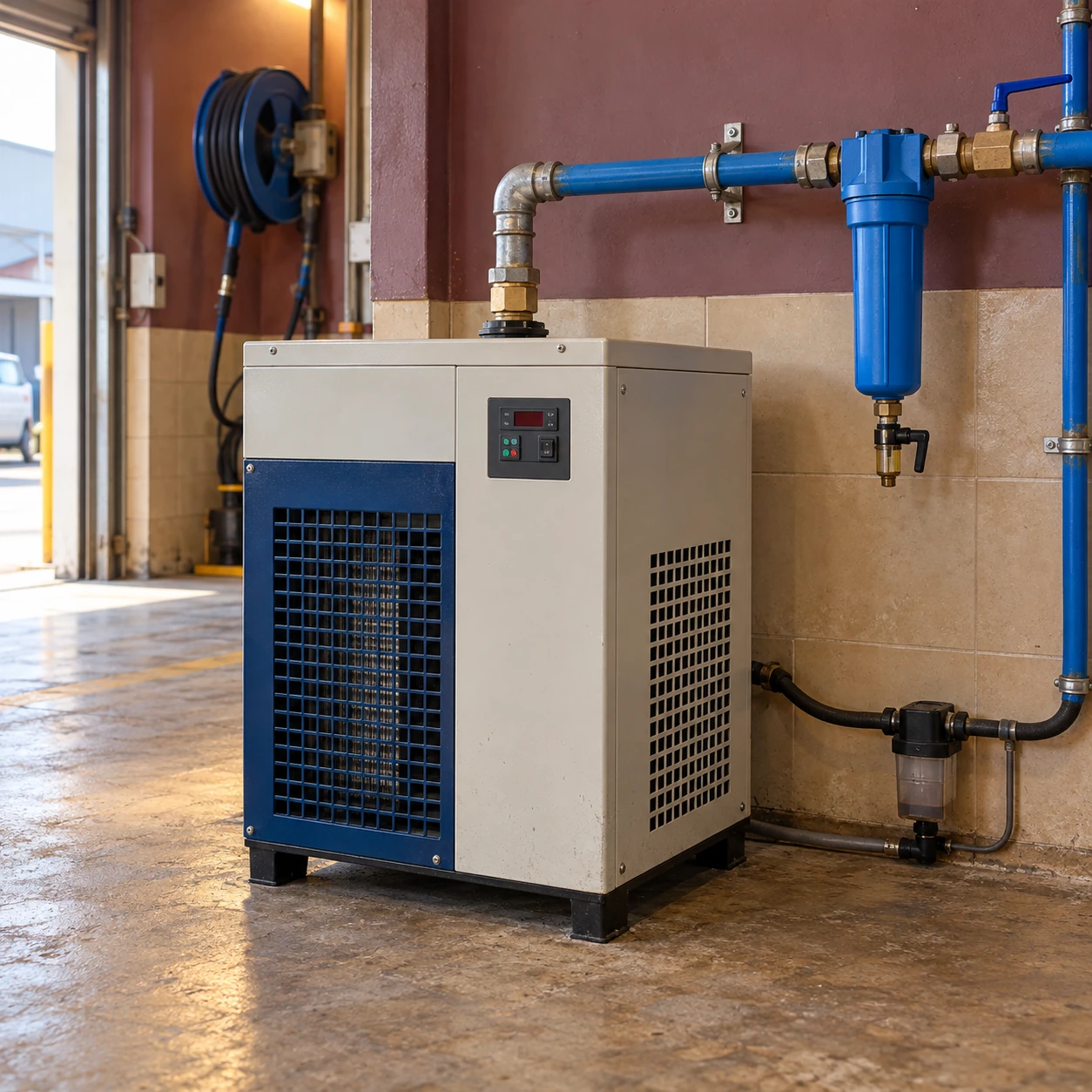
Compressed Air Dryers
commercial compressed air dryer
| Typical arrangement | Refrigerated drying for indoor workshop and facility air services |
|---|---|
| Cabinet W × D × H (mm) | 630 × 484 × 779; 620 × 540 × 963; 764 × 660 × 1009 |
| Nominal flow family | 0.65–3.90 m³/min, with selection for simultaneous use and actual conditions |
| Rating basis | 7 bar(g), saturated 35°C inlet, 25°C ambient and +3°C pressure dew point |
| Air-volume reference | 1 bar absolute, 20°C, dry air |
| Electrical version | 230 V, single phase, 50 Hz family; matched alternatives by selection |
| Moisture collection | Automatic drain with an accessible discharge route |
| Operating options | Load-responsive control, moisture indication and selected branch filtration |
Equipment dimensions exclude ventilation and service access. Final capacity is corrected to the installation; the package is selected for the connected professional equipment and its air-quality requirements.
The dryer, controls and filtration can be configured for your commercial operating schedule and workspace.
A commercial compressed air dryer often works with short bursts of tool use, periods of low demand and a compact equipment area. The practical aim is reliable air for professional equipment without turning the dryer into an inaccessible or frequently neglected service item.
Select for the busy period
A workshop can have a low daily average but a high simultaneous demand when several tools or pneumatic machines operate together. The compressor receiver can release stored air faster than the compressor produces it, so a dryer placed after that receiver may experience a larger short-term flow.
List the air users that can run together and how long their cycles last. Keep the pressure needed at the equipment in view after losses through filters, the dryer and hoses. Selecting solely from compressor horsepower or tank size can overlook the actual treatment duty.
For general indoor services, refrigeration may provide the required moisture condition. A colder outdoor line or a more demanding process needs a separate assessment; the fact that most tools work acceptably does not prove that every outlet receives suitable air.
Intermittent use changes the control choice
A dryer that spends much of the day at low load should be compared on part-load behaviour as well as maximum capacity. Load-responsive refrigeration can be relevant, but the benefit depends on the actual schedule and selected design.
Follow the equipment’s start, stop and standby instructions. Repeatedly switching a dryer with every short tool cycle is not automatically an appropriate energy-saving strategy. The required air condition must be restored before a moisture-sensitive user starts work.
A small room still needs a heat path
A refrigerated cabinet releases heat through its condenser. Keep it away from blocked ventilation paths and allow for the heat already produced by the compressor. An attractive enclosed corner can become a hot pocket during a busy shift.
Leave access to filters, the drain and removable panels. Service work should not require moving a permanent workbench or disconnecting unrelated machines.
Make the routine checks easy to own
Assign responsibility for drain operation, filter condition and abnormal moisture or temperature indications. Route condensate to suitable collection or treatment and keep the connection accessible. A drain problem can affect the whole workshop even when the dryer motor continues to run.
Where different users need different air quality, identify the final branch treatment. Moisture removal does not replace control of oil and particles for painting, sensitive instruments or other process-specific duties.
Choose central or local treatment deliberately
A central dryer can serve several ordinary pneumatic users. An inline membrane assembly may suit a small dedicated branch, but its purge consumption should be compared with the broader system. Installing several local devices can create more maintenance points than one accessible central package.
Prepare a practical enquiry
Send the connected equipment, simultaneous demand, working pressure, operating hours and available installation space. Include the hottest expected room conditions and any cold pipe runs. The unit package can then be selected with the required connections, drainage and controls instead of by cabinet size alone.
The dryer, controls and filtration can be configured for your commercial operating schedule and workspace.