Compressed Air Dryers
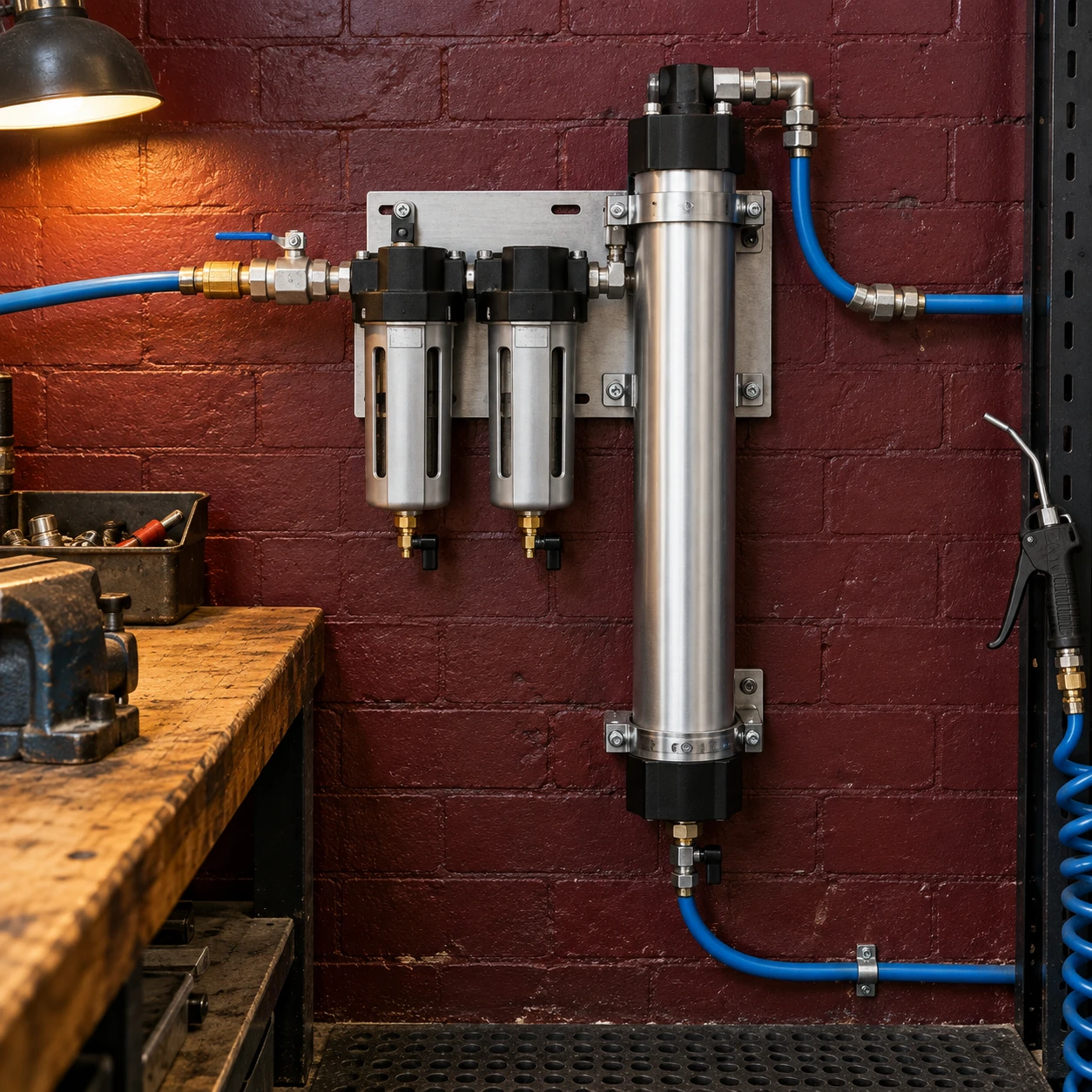
inline compressed air dryer
| Drying arrangement | Hollow-fibre membrane module with specified upstream filtration |
|---|---|
| Module height choices (mm) | 290.7; 349.8; 368, before the complete filter and bracket arrangement |
| Nominal outlet flow | 100, 250 or 500 L/min (ANR) for the selected module |
| Nominal operating point | 25°C inlet, 0.7 MPa and +3°C pressure dew point |
| Air-port choices | 1/8, 1/4, 3/8 or 1/2; specify Rc, G or NPT and the matched module |
| Energy requirement | No electrical supply for membrane drying; compressed air is consumed as purge |
| Inlet preparation | Liquid separation and coalescing filtration to the module's inlet specification |
| Installation options | Bracket mounting, modular filter connection and defined purge-air discharge |
Heights describe membrane modules, not complete assemblies. Outlet-flow, inlet-flow and purge-flow values are different; final performance is selected at the actual pressure, temperature and moisture load.
The inline dryer, inlet filters and mounting arrangement can be matched to your pneumatic branch and workspace.
An inline compressed air dryer treats the air passing through a pipe or machine branch. For a limited flow near the point of use, a membrane module can provide compact vapour removal without a refrigeration cabinet. It still needs suitable inlet air, enough supply for its purge stream and a clearly defined outlet requirement.
A water trap and a dryer do different jobs
A separator or filter bowl removes entrained liquid under its operating conditions. Water vapour can pass through it and condense later. A membrane dryer addresses vapour by allowing it to cross selective fibres, while purge air carries the moisture away.
This makes the module useful for selected instrument and pneumatic branches, but it does not make every inline filter assembly a dryer. Identify the actual drying element and its rated outlet condition before comparing products with similar bowls or connection sizes.
Air quality requirements still extend beyond water. A membrane module does not by itself establish particle, oil or special application suitability.
Size for the air the machine receives
The process consumes outlet air, while the supply must also cover purge. A module selected against inlet flow alone may deliver less usable air than expected. Compare the rated net outlet at the required pressure dew point and actual inlet temperature, then add the corresponding purge demand to the upstream supply calculation.
Membrane performance changes with pressure, temperature and flow. Published low dew-point figures must also state whether they refer to pressurised air or air expanded to atmosphere; those are different measurement conditions.
Protect the fibres before asking them to dry
Bulk liquid, oil contamination and particles can compromise the drying element. Use the filter grades and arrangement specified for the selected module, including effective drainage before the membrane. Placing a dryer after a neglected filter transfers the maintenance problem into a more expensive component.
Keep the specified purge outlet clear and follow its routing limits. It is part of the moisture-removal path, not an accidental air leak to be plugged. Where the branch is shut down between shifts, use an approved isolation and restart arrangement so that process air is not admitted before the required condition has been restored.
Where a branch package helps
A local assembly can serve one machine with a modest, well-defined flow, particularly where the rest of the plant has a less demanding moisture requirement. Keep it near enough to limit downstream exposure while preserving access to drains, filters and the module.
When central treatment is preferable
Several continuously loaded branches can accumulate substantial purge demand. Compare their combined consumption and maintenance with a central refrigerated dryer or another selected arrangement. Compact size alone is not a system-efficiency measure.
Specify the complete branch
Provide net machine demand, supply-pressure range, inlet temperature, existing filtration and the moisture requirement. Identify the thread standard and mounting space as well as the port size. The supply enquiry can then cover the module, filters, brackets and interfaces together.
The inline dryer, inlet filters and mounting arrangement can be matched to your pneumatic branch and workspace.