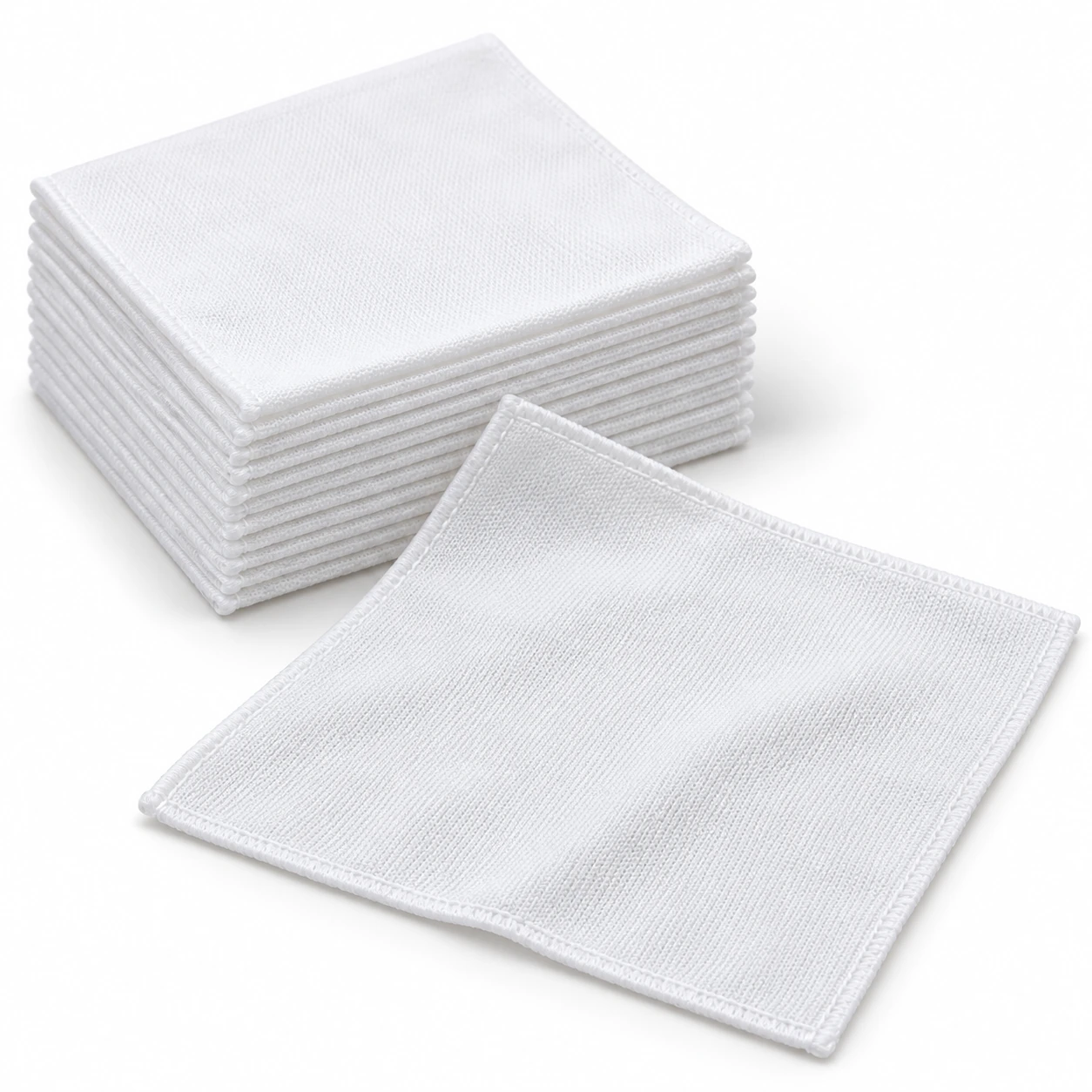
Cleanroom Wipes
cleanroom wipe
| Brand | shengtongJH |
|---|---|
| Supply form | Dry, non-sterile wiping cloths |
| Fabric options | Continuous-filament knitted polyester; polyester/cellulose nonwoven for compatible tasks |
| Nominal sheet L × W | 100 × 100 / 230 × 230 / 300 × 300 mm |
| Edge options | Cut edge or sealed edge, selected with the fabric construction |
| Sheet presentation | Flat stacked or folded |
| Colour | White |
| Pack quantity options | 75 / 150 / 300 sheets per bag, matched to sheet size and material |
| Packaging | Sealed bags; double-bag presentation where required by the transfer procedure |
| Liquid use | Dry pickup or wet wiping with a surface-compatible cleaning solution |
| Selection documentation | Material, particle/fibre release, extractables and absorbency data for the selected grade |
| Customization | Sheet size, edge finish, pack quantity and packaging arrangement |
Select the fabric and edge as one combination. A room classification alone does not define the wipe needed for a particular surface.
Wipe material, sheet dimensions, edge finish and packaging can be customized to suit your application and handling requirements.
A cleanroom wipe should remove unwanted material without leaving another problem behind. The right choice depends on the surface, the residue, the cleaning liquid and the contamination your process cannot tolerate.
Remove residue without adding fibres
A cloth that absorbs a spill well may still be unsuitable for an optical surface or an exposed electronic assembly. Loose fibres can remain on the part; a rough or loaded wiping face can drag trapped particles across it. For precision work, examine the wipe together with the actual surface and liquid, rather than choosing only by how soft it feels in the hand.
Knitted polyester is a practical option where repeated handling and resistance to abrasion matter. A polyester/cellulose nonwoven can be useful for absorbent general cleaning, but a process that excludes cellulosic fibres needs a different material. Neither construction is automatically correct for every controlled area.
The edge matters when the cloth is folded
Cut and sealed edges behave differently when the sheet is handled, rubbed or drawn around a corner. A sealed edge can help restrain loose filaments; it still needs to be assessed against the part because edge stiffness and surface contact matter. Folding the wipe to keep exposed edges away from a critical contact area can help, provided the fold does not hide grit from a previous pass.
Flat work surfaces
A sheet that sits evenly under the hand gives useful contact without excess material bunching underneath. Change to a fresh face as soil is collected. A larger sheet is not an advantage if it is difficult to control around small fixtures.
Fixtures and machine access
Check whether corners, fasteners or unfinished edges snag the fabric. Use a suitable tool or swab for recesses the cloth cannot reach; forcing a sheet into a gap can leave material behind or make retrieval difficult.
Choose around the work, not only the room
Electronics assembly, optical inspection, precision machining support, printing and industrial laboratories can all require controlled wiping. Their acceptance criteria differ. Visible cleanliness may be enough for an external machine panel, while a coating or bonding process may also be sensitive to residues that cannot be seen.
For liquid cleaning, compatibility includes the wipe, solution and surface finish. Too little liquid can leave soil attached; excessive liquid can migrate into joints or electrical openings. The selected method should leave the part ready for its next production step, not merely appear wet and clean.
A useful production trial
- Use the actual surface and expected contamination, including an area with representative edges or texture.
- Keep the liquid and wiping method consistent while comparing candidate materials.
- Check the result using the process acceptance method: visible residue, fibres, surface inspection or relevant analytical testing.
- Record sheets consumed per task and discarded material after opening a pack. Pack size affects waste as well as purchase cost.
Keep unused cloths inside their packaging until needed, and separate used wiping material from the clean supply. Where controlled liquid loading is the main issue, compare a presaturated cleanroom wipe. Where the process requires sterile supplies, use the separate sterile cleanroom wipe selection criteria; a clean-looking dry cloth does not establish sterility.
Wipe material, sheet dimensions, edge finish and packaging can be customized to suit your application and handling requirements.