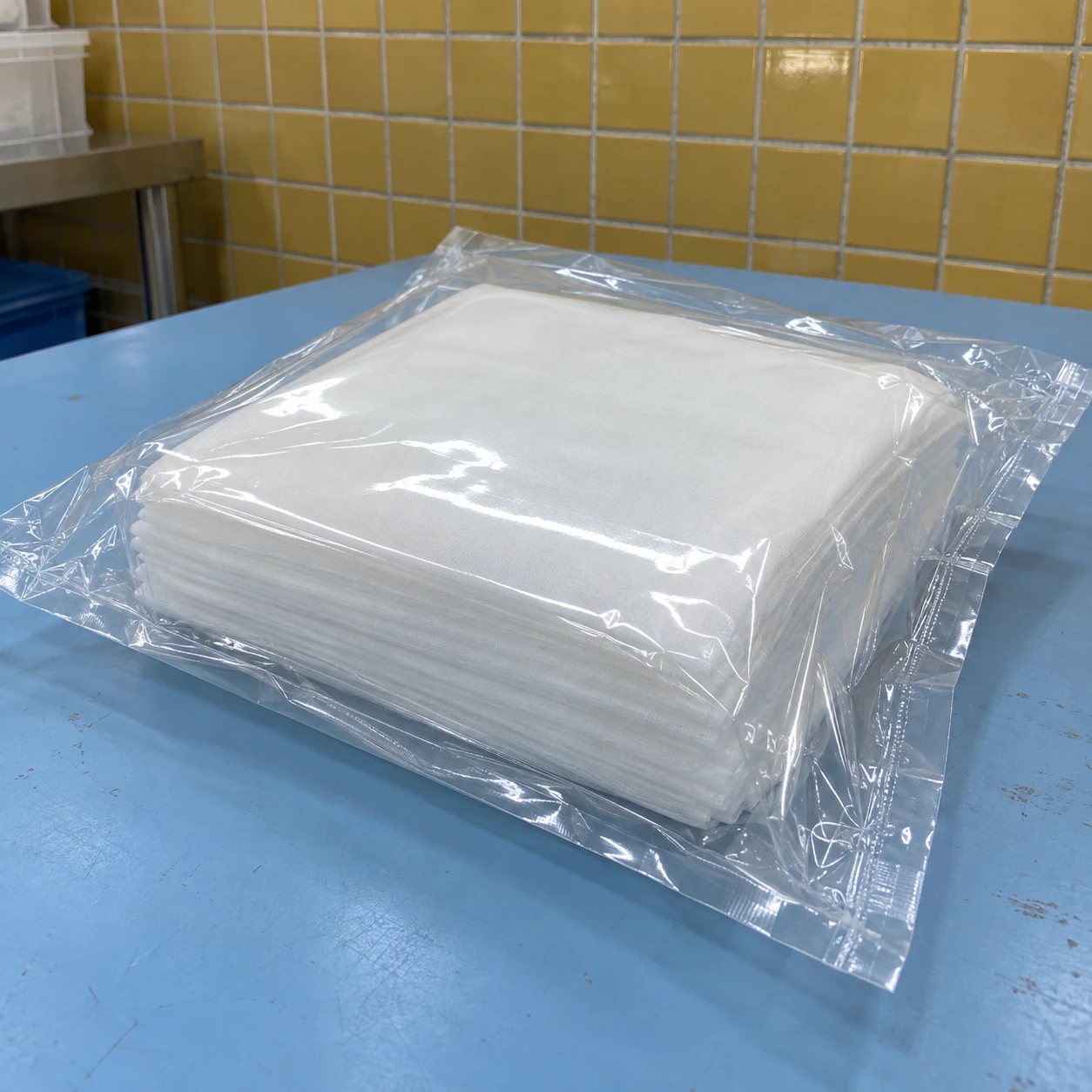
Cleanroom Wipes
sterile cleanroom wipe
| Brand | shengtongJH |
|---|---|
| Supply format | Dry wiping cloth; validated sterile configuration to be specified with supporting evidence |
| Nominal unfolded cloth L × W | 100 × 100 / 230 × 230 / 305 × 305 mm; dimensions specified in millimetres |
| Substrate | Knitted polyester selected for the surface and cleaning liquid |
| Edge construction | Sealed border; cut-edge alternative where accepted by the process |
| Inner-pack choices | 10, 20 or 50 cloths, depending on the selected size and packaging configuration |
| Packaging layers | Two-layer nested packaging with a defined sterile barrier and transfer sequence |
| Sterilization option | Validated gamma process applicable to the selected wipe and packaging |
| Release documentation | Product-specific validation support and lot-linked processing/compliance records |
| Label information | Product identity, lot number, expiry/use-by date and storage conditions for the selected supply |
| Performance selection | Relevant particle/fibre, residue, absorption and chemical-compatibility information |
| Additional requirements | Endotoxin or other process-specific limits only when supported by applicable product evidence |
The sterile specification applies only to the documented, released supply configuration within its stated storage and expiry conditions. It does not establish that every wipe option offered is sterile or that a wiped surface is sterilized.
Cloth size, edge construction and pack quantity can be customized to the application, subject to confirming that the resulting product and barrier packaging remain covered by the required validation and release documentation.
A sterile cleanroom wipe is selected when a manufacturing process requires a sterile consumable at the point of use. The supply specification must cover the validated sterilization process and the intact barrier package, as well as the cloth's cleaning performance.
Make sterile supply a complete purchasing requirement
A sterile label should be supported by a defined product, a validated processing arrangement and the release information for the delivered lot. The cloth and its packaging belong to that configuration. Changing the fabric, folding or pack count without assessing the effect on the validated arrangement can make an apparently minor purchasing change significant.
Specify the evidence required before approving the supply. It should be possible to connect the received product and lot to the relevant processing and compliance documents. An unrelated certificate, a generic supplier quality statement or a claim about a different product does not close that link. The sterility requirement belongs to the selected configuration, not to every consumable bearing the same brand.
Inspect the barrier and the dates
Check for damaged seals, punctures, moisture exposure or other conditions inconsistent with the packaging requirements. An intact outer carton does not prove that every inner barrier is intact. Keep the lot identity readable through the receiving and storage process.
Use the expiry and storage conditions supplied for the specific product. Do not apply another manufacturer's shelf life or extend the date because the cloth looks unchanged. Stock rotation should consider the remaining usable period at the point where the pack will actually be opened.
Choose a workable pack size
Small inner packs can limit the quantity exposed during a short task. Larger packs may be practical for a defined cleaning operation with predictable consumption. The useful choice reduces repeated handling without leaving excessive opened material.
Keep unopened stock separate from material already issued to a work area. A resealed open pack is not equivalent to the original sterile barrier, and the handling procedure must define what happens to unused cloths.
Plan the transfer to the point of use
Map the packaging layers to the facility's transfer stages. Remove an outer layer where the procedure requires it, presenting the protected inner pack without dragging its surface across the removed layer or an unsuitable work surface. Personnel technique, gloves and the receiving area remain part of the control.
Open the final barrier only when the work is ready. Handle the cloth so that the area intended to contact the product or cleaned surface is not unnecessarily touched. The objective is to preserve the supplied condition until use, rather than assuming that sterility continues regardless of how the pack is opened.
Separate sterile status from cleaning performance
A sterile cloth can still be unsuitable for a sensitive optical surface, an aggressive solvent or a process with demanding residue limits. Assess absorption, fibre release and compatibility with the intended liquid. A low-endotoxin requirement is also separate from sterility and needs its own applicable evidence.
For pharmaceutical or biotechnology production, medical-device assembly and other controlled industrial operations, match the wipe to the approved cleaning procedure. A dry sterile wipe does not sterilize equipment. If a disinfectant is used, its concentration, surface compatibility and contact conditions still matter; wiping it off too early can defeat the intended treatment.
Use fresh cloth faces and replace soiled material rather than carrying collected contamination to the next surface. shengtongJH supports sourcing around the specified configuration and documentary requirements, so repeat orders can preserve the material, packaging and traceability that the process depends on.
Cloth size, edge construction and pack quantity can be customized to the application, subject to confirming that the resulting product and barrier packaging remain covered by the required validation and release documentation.