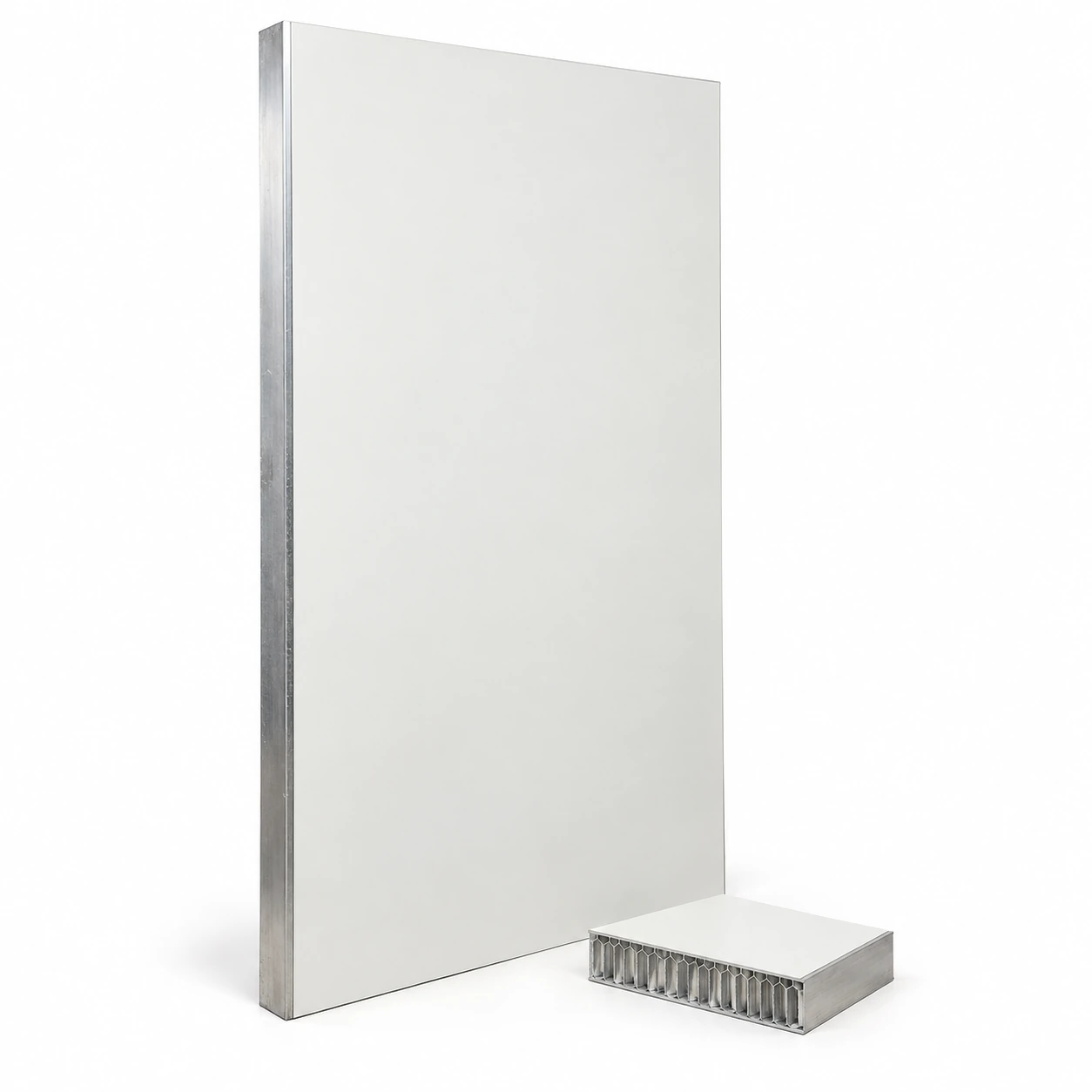
Cleanroom, Cold Room & Ceiling Panels
aluminum cleanroom wall panels
| Module width × height (mm) | 1200 × 3000; cut sizes coordinated to the wall layout |
|---|---|
| Overall thickness options | 50, 80 or 100 mm, matched to the selected core and frame |
| Exposed facing | Coated aluminum sheet; finish and sheet thickness specified separately |
| Core options | Aluminum honeycomb or an insulated core such as rock wool, according to the assembly |
| Edge frame | Extruded aluminum frame with closed terminations |
| Joining arrangement | Matched profiles or tongue connectors with a compatible sealed joint |
| Openings and fixing points | Framed service cut-outs and specified reinforcement for attached items |
| Finish selection | Smooth coated surface selected for cleaning agents, impact and repair requirements |
Aluminum face skins, an aluminum frame and an aluminum honeycomb core are separate selections. Overall panel thickness is not the facing-sheet thickness.
Aluminum-facing finishes, panel dimensions, cores and fixing details can be customized to suit your cleanroom layout and service conditions.
Aluminum cleanroom wall panels may use aluminum in the exposed skins, the perimeter frame or the honeycomb core. Those are different construction choices. Defining each layer avoids ordering a steel-faced panel when an aluminum surface is required, or assuming that an aluminum-framed system also contains a metal honeycomb core.
Specify where the aluminum is used
Aluminum faces
These form the exposed surfaces. Their coating, thickness and support affect resistance to everyday handling and cleaning. A coloured finish can hide the substrate, so the face material should be stated explicitly on the supply schedule.
Aluminum frames
Extruded edge sections locate the panel and receive connections. They may surround aluminum, steel or laminate faces. Frame geometry determines how doors, corners and replacement panels connect; it does not identify the surface material.
Aluminum honeycomb
This is an internal cellular core bonded between the skins. It can support a relatively light panel assembly, but its performance depends on the complete construction. Honeycomb alone does not establish fire resistance, a usable span or an allowable fixing load.
Choose the construction for the work around the wall
Weight can matter when panels pass through an existing building or when a wall section must be removed for equipment changes. Compare the mass of the finished assembly, including its core and frame, rather than assuming every aluminum-labelled panel will be lighter than every steel-faced alternative.
In a trolley route, the vulnerable area may be the face at handle height or the edge beside a doorway. A local protective rail, a reinforced opening or a different surface finish can address that exposure more directly than changing the entire wall. These additions need a defined support and a cleanable connection.
The finish meets the cleaning process
Coated aluminum should be assessed with the cleaning chemistry, concentration, temperature and contact time used on site. The performance of an intact finish does not automatically describe a scratched face, an exposed cut edge or the joint sealant beside it.
Close field-cut edges using the selected system's detail and remove cutting debris before sealing. Where aluminum meets other metals, select the connection materials and any isolation detail for the expected moisture and cleaning conditions.
Fixings need more than a thin skin
Wall-mounted shelves, dispensers and equipment brackets can concentrate load in a small area. A thin face is not a substitute for reinforcement. Fixing locations should reach a specified insert, frame member or independent support suited to the attachment.
Service penetrations also need an edge treatment and a seal. Planning them before panel manufacture helps keep the core enclosed and makes the finished connection easier to maintain.
Allow a damaged panel to be replaced
The route to replacement depends on the joining system. Some panels install in sequence; others use profiles that permit an individual section to be released. Discuss access from both sides, the ceiling connection and any services passing through the panel before selecting the frame.
Keep a record of the coating reference and panel build-up so a future purchase matches more than the visible colour. The existing Honeycomb Cleanroom Panel page provides another core-based option, while joining profiles address the connections. shengtongjh can coordinate these components in the project supply enquiry.
Aluminum-facing finishes, panel dimensions, cores and fixing details can be customized to suit your cleanroom layout and service conditions.