Cleanroom Wall & Ceiling Systems
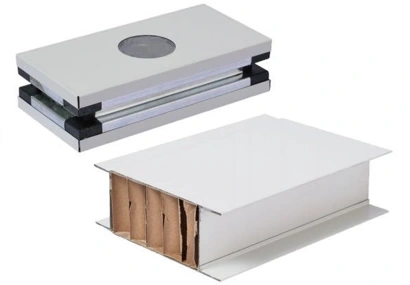
Honeycomb Cleanroom Panel
| Specification | Paper honeycomb | Aluminium honeycomb |
|---|---|---|
| Brand | shengtongJH | |
| Core options | Paper honeycomb | Aluminium honeycomb |
| Suitable selection focus | Dry internal partitioning and protected edges | Metal core construction and application-specific cleaning exposure |
| Panel thickness (mm) | 50 / 75 / 100 | |
| Module width (mm) | 980 / 1180; project-cut infill widths | |
| Panel length (mm) | 2400 / 3000 / 4000; cut to room layout | |
| Metal facing thickness (mm) | 0.4–0.8 | |
| Facing options | Prepainted steel or stainless steel | |
| Connections | Sealed tongue-and-groove or framed joints | |
| Customization | Panel size, openings, facing and junction details to suit the application | |
Dimensions and configurations can be customized for your application.
Select paper or aluminium honeycomb around the moisture exposure, fixing requirements and use of the finished partition.
Paper and aluminium are distinct core options
Paper honeycomb
The cellular paper core separates and supports the panel faces with relatively little material. It suits enclosed interior panel construction where edges remain protected. Moisture entry through damaged joints or unsealed penetrations is especially important to prevent.
Aluminium honeycomb
A metallic honeycomb core offers a different material route for the same cellular construction principle. It can be considered where a paper core is unsuitable for the intended environment. The metal core does not remove the need to assess adhesives, facings, seals and the cleaning chemistry.
Use the sandwich structure correctly
The two faces work with the cellular core; a local cut or point load can interrupt that relationship. Equipment brackets, hinges and closers need suitable reinforcement. Do not assume a fixing will hold simply because the panel feels rigid when handled.
At large openings, provide a perimeter frame that supports the inserted window or transfer equipment. Close the exposed cells and make the metal-to-frame junction accessible for sealing. Route services through planned positions to avoid a patchwork of small, difficult-to-clean penetrations.
Compare the complete finished panel
The useful comparison includes surface finish, edge profile, core choice, facing thickness and connection method. Two panels with similar external dimensions can behave differently if their internal construction or bonding differs. A core material name alone is not a fire or ceiling-load classification.
For routine operation, inspect impact-prone areas and repair damaged edge seals before cleaning liquid reaches the interior. Keep replacement finishes and joint details consistent so that later alterations do not introduce narrow ledges or exposed cells.
Paper and aluminium core configurations, panel sizes, surface finishes and reinforced openings can be customized for the room's use and installation conditions.