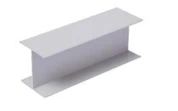
I-section connector
Cleanroom Aluminium Profiles
Cleanroom Panel Joining Profiles
| Specification | Configuration options |
|---|---|
| Brand | shengtongJH |
| Section options | I-section connector; central joining section; U-channel |
| Panel thickness options (mm) | 50 / 75 / 100 |
| Connection details | Profile slot and engagement matched to panel edge |
| Seal options | Compatible sealant or gasketed joint |
| Material options | 6063 aluminium; matching polymer connectors where required |
| Surface finish | Anodized or powder coated |
| Supply length (mm) | 3000; cut lengths to installation layout |
| Customization | Section, finish, cut length and connections to suit the installation |
Dimensions and configurations can be customized for your application.
Align panel edges and close their exposed ends with compatible joining sections and base channels.
Make adjacent panels behave as one boundary
A joining profile aligns adjoining edges and provides a defined connection between panels. An I-section or central connector fits between compatible edges; a U-channel closes or locates a panel end. These parts perform different jobs and should not be substituted merely because their outside dimensions appear similar.
The panel thickness is only the first selection dimension. Check the folded metal edge, frame depth and required engagement as well. A connection that is too tight may damage the facing during assembly; one that is loose may allow movement and leave an inconsistent sealing gap.
Start from a level base
A straight, accurately positioned channel makes it easier to keep the wall vertical and align the following openings. Where the floor varies, resolve that variation with the intended base detail rather than forcing the panel run to follow every surface irregularity.
Fixings need an adequate substrate and should not leave a water or air path through the finished boundary. Coordinate the floor finish with the channel so cleaning liquid cannot sit in an open track. At panel ends, close the core and continue the room-side seal.
At corners and intersections
A straight joining section does not automatically solve a T-junction or a change in wall direction. Match it with the appropriate corner or trim arrangement. Keep the cleaning face continuous and avoid stacking several uncoordinated profiles into a deep ledge.
During later alterations
Record the section used and retain the panel connection detail. Replacement panels from a different system may need an adapted joint even at the same nominal thickness. Planned removable sections make equipment access easier without damaging neighbouring edges.
Joining profiles, channel dimensions, cut lengths and finishes can be customized to the selected panel system and installation sequence.