Cleanroom Trolleys & Storage Racks
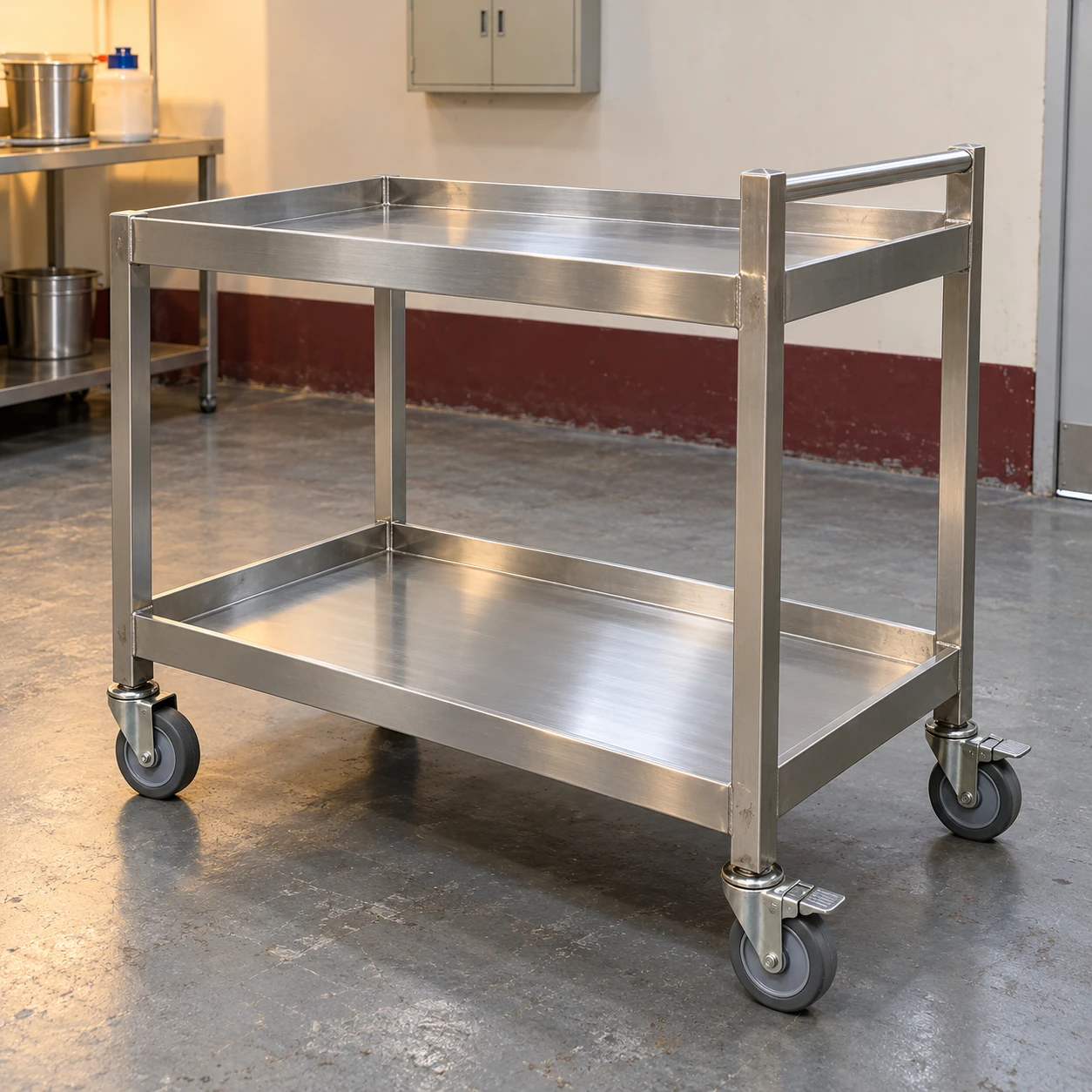
stainless steel cleanroom carts
| Cart L × W × H | 700 × 500 × 950 mm; 800 × 600 × 950 mm |
|---|---|
| Shelf levels | Two or three tiers; solid trays, perforated decks or wire shelves according to the task |
| Metal grade | 304 or 316 stainless components, with the grade identified for each part of the assembly |
| Frame and joints | Welded construction or adjustable shelf-and-post construction |
| Surface finish | Satin or electropolished components where specified; accessible joints and finished edges |
| Mobility | Manual push handle; tread, bearing, fork and brake options selected for cleaning and travel conditions |
| Load and process limits | Whole-cart and shelf loading, chemical exposure and any heated cleaning cycle specified separately |
L is the longer horizontal axis and W is the shorter axis. Cart dimensions do not represent clear tray area. Final drawings identify usable shelves, handle projection and selected caster height; material and finish options must form a compatible assembly.
Stainless steel carts can be customized in size, tray layout, edge design, material grade and caster configuration for the application.
Stainless steel cleanroom carts combine a rigid carrying structure with surfaces that can be selected for repeated cleaning and handling. The useful specification covers shelves, frame, joints and casters together, including the less visible areas beneath the load.
Follow the structure from tray to floor
A polished top shelf is only one part of a stainless cart. The support beneath it, the frame connections and the caster assembly determine how the load is carried and how the trolley can be cleaned. Review these areas together when comparing a basic utility trolley with a cart intended for more demanding controlled handling.
The carrying surface
A solid tray supports small containers and catches minor drips on its surface. Wire or perforated construction changes both support and cleaning access. Raised edges reduce the chance of loose items sliding off, while the clear space between those edges determines what fits.
The load path
Tray thickness, underside stiffeners, joints and frame members work together. A heavy item with narrow feet may require local support even when its total weight seems modest. Select the shelf around the actual contact points.
The floor interface
Wheel treads, bearings, forks and brakes are part of the working assembly. Their materials and access for cleaning deserve the same attention as the shelf, especially when the cart travels through wet or frequently washed areas.
Welded frames reduce adjustment joints
A welded frame gives a fixed relationship between shelves and supports. It can suit repeated handling of a stable container size, with fewer adjustable connections to inspect. The benefit depends on the execution: unfinished welds, overlapping seams and inaccessible pockets can still make a welded cart difficult to clean.
Look at the underside of folded trays and the ends of tubular members. The structure should avoid unintended traps and sharp edges. A smooth visible face does not prove that a concealed joint has been finished to the same standard.
Adjustable shelves offer flexibility
Shelf-and-post construction can accommodate changing container heights and allow components to be replaced individually. Its collars, grooves and support interfaces introduce additional cleaning points. Check whether those joints can be reached in place or need disassembly.
The appropriate choice depends on how often the load changes and how the cart is cleaned. Fixed construction can simplify a consistent task; adjustable construction can be valuable where shelf positions genuinely need to change.
Specify the grade by component
A cart advertised with a stainless grade may use that grade for its shelves while using another grade for the posts or hardware. If a particular material is required, identify the affected components in the purchase specification. Include the frame, tray corners, handle and caster metalwork where relevant, rather than relying on a single description of the top surface.
The choice between 304 and 316 should follow the exposure conditions and documented material compatibility. A higher grade does not make an assembly immune to unsuitable chemicals, deposits or poor cleaning practice. Define the actual cleaning agent and operating conditions before treating a material upgrade as the answer.
Surface treatment is a separate decision. Electropolishing can be specified for appropriate components, but it does not remove the need for sound fabrication and accessible joints. A bright finish is not evidence of a verified roughness value or a particular cleanroom classification. Where finish measurements or material certificates are required, identify the evidence needed for the supplied configuration.
A stainless frame does not make every wheel washable
A wash process reaches bearings, tread materials and brake mechanisms as well as the metal frame. Select components for the actual chemical, temperature and exposure cycle. A caster that works well for dry transport may need a different bearing or seal arrangement for repeated washing. Likewise, a cart described as washable is not automatically suitable for an autoclave.
Allow access beneath the lower shelf and around the wheels for cleaning and drying. After cleaning, inspect for trapped liquid, loose fittings and damaged tread. If a brake becomes difficult to operate, replacing it with an arbitrary caster may change the cart's height or handling; restore a compatible assembly.
Choose the tray arrangement for the handover
A raised edge helps retain small items, but it can obstruct sliding a large container onto a receiving bench. Decide whether the task uses lifting, a removable tray or a purpose-designed transfer interface. An open side should not be chosen casually if it permits containers to move during travel. Assess retention and access together.
For a straightforward two-level arrangement, the existing Two-Tier Stainless Steel Trolley provides another product route. For any selected cart, record the container footprint, loading pattern, cleaning conditions and required component documentation. Those details give the quotation a practical basis without assigning an unsupported capacity or hygiene claim to every stainless configuration.
Stainless steel carts can be customized in size, tray layout, edge design, material grade and caster configuration for the application.