Cleanroom Trolleys & Storage Racks
plastic cleanroom carts
| Cart W × L × H | 516 × 876 × 997 mm; 668 × 1029 × 997 mm |
|---|---|
| Nominal shelf modules | 457 × 762 mm or 610 × 914 mm; two or three levels |
| Shelf surfaces | Removable solid mats or open-grid mats on a supporting shelf frame |
| Construction | Engineered-polymer shelves and posts with stainless handle and corner components as required |
| Caster arrangement | Polyurethane wheel options; swivel and braking combinations matched to the assembly |
| Cleaning conditions | Resin, cleaner concentration, contact time and temperature assessed together |
| Load and ESD | Whole-cart and shelf loads specified; dissipative materials and electrical performance only where separately selected and verified |
W is the shorter horizontal axis and L is the longer axis. Dimensions are rounded from inch-based configurations. Shelf modules are nominal and do not equal the outer footprint or unobstructed carrying area; final deck, handle and caster selections determine the assembly.
Polymer shelf layouts, dimensions, handles and caster options can be customized to the containers, cleaning method and working environment.
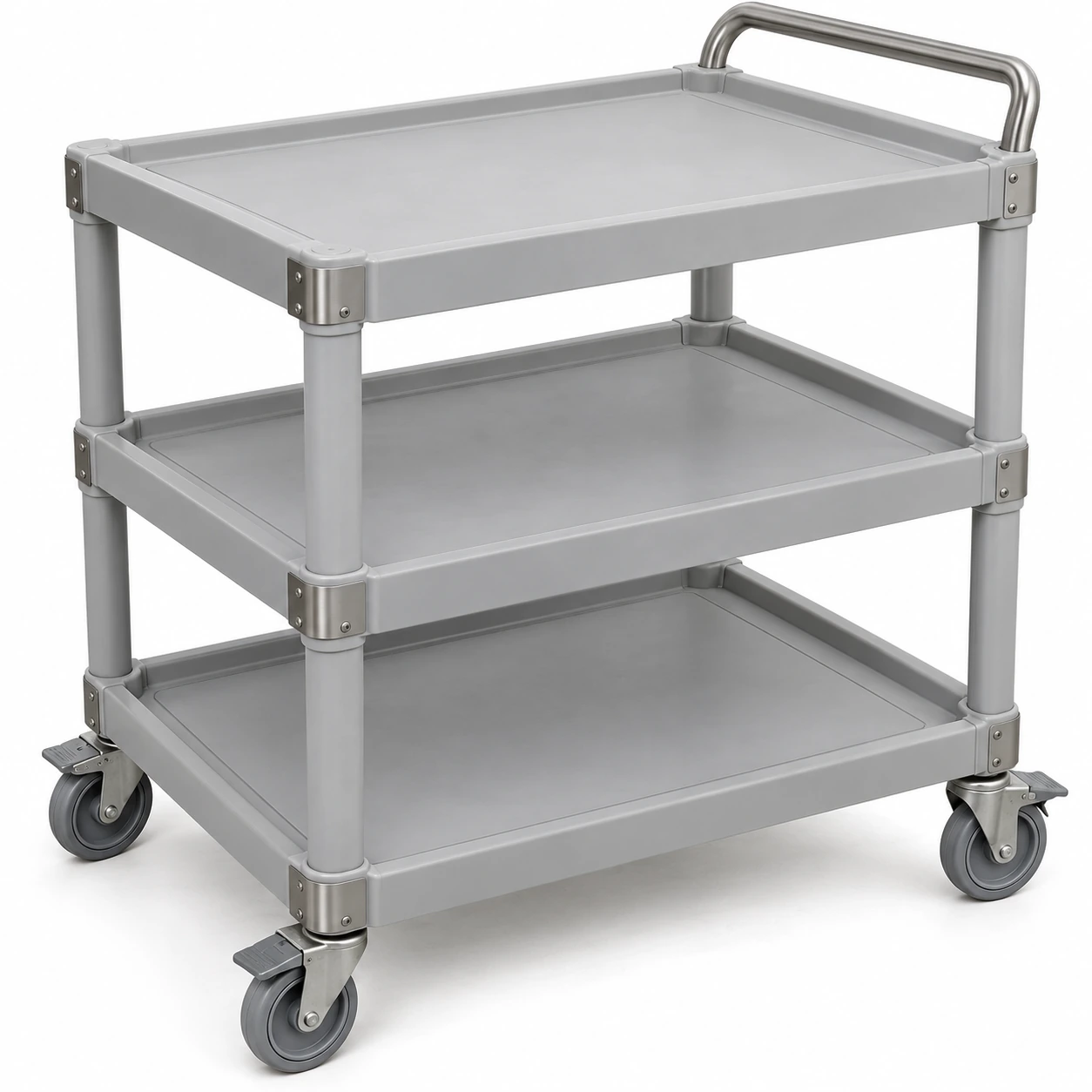
Plastic cleanroom carts use polymer carrying surfaces to support organized movement of closed containers, laboratory supplies and process materials. They can include stainless handles, reinforcement and caster hardware, so suitability depends on the complete construction rather than the word plastic alone.
What is actually made from plastic?
A polymer cart may combine moulded shelf mats, a reinforced shelf perimeter, polymer posts, metal corners and a stainless push handle. Another design may use plastic trays on an entirely metal frame. Both can be described as plastic carts, but their joints, exposed materials and replacement parts are different.
Identify the resin and structural components for the selected assembly. A smooth carrying surface can be useful for closed bottles, packaged instruments and small containers, but smoothness alone does not establish particle performance, chemical resistance or suitability for a particular controlled area.
Look below the deck
Removable mats can make cleaning easier because both sides can be reached. Their supporting rails and corner seats remain part of the cart and need access as well. A deck that looks continuous from above may have ribs and recesses underneath; include those features when assessing the cleaning procedure.
Check how the mat is released and refitted. It should sit securely when loaded, without improvised tape or packing pieces. If a section is damaged, a separately replaceable mat can avoid replacing the complete trolley, provided the correct part remains identifiable.
Match the cleaning cycle to the assembly
Chemical compatibility depends on the particular polymer, concentration, contact time and temperature. A brief wipe and a heated immersion cycle are different exposures. The same check applies to wheel treads, seals, coatings and any adhesive components. A statement that a shelf resists one cleaner does not establish compatibility of the whole cart with every disinfectant or wash process.
- Remove the load and accessible mats. Keep dirty parts away from the surface where cleaned parts will be placed.
- Reach the interfaces. Clean mat undersides, support rails, handles and caster forks using the approved method, not only the visible top surface.
- Complete the required rinse or drying step. Follow the cleaning procedure and component instructions so trapped liquid is not carried back into use.
- Check the refitted cart. Confirm the mats are seated, the frame is secure and the wheels and brakes work before reloading.
Heat resistance must be established separately. A washable polymer part is not automatically suitable for steam sterilization. Specify the complete time and temperature cycle if elevated-temperature treatment is part of the application, including the casters and structural joints.
Solid mats for small items
Solid surfaces support containers with small bases and prevent loose items from dropping through the shelf. Shallow edges can help retain a tray, but they are not necessarily a sealed spill sump. Where liquid containment matters, use an appropriate container or removable tray rather than assuming the shelf joints are watertight.
A solid lower deck can also separate the load from direct openings below. Its upper face still collects residue and needs cleaning; adding more barriers does not remove that maintenance task.
Open grids for access and visibility
Open mats allow the operator to see through the shelf and can be useful for stable closed bins. They have more individual edges and intersections to clean. Check the smallest container feet against the grid spacing before selecting this construction.
Grid shelves do not create controlled airflow or provide filtration. A process that exposes sensitive material during transport needs a separate protection strategy, irrespective of whether its cart has open or solid decks.
Ordinary polymer is not an ESD specification
Movement and contact can generate electrostatic charge. An insulating shelf does not become dissipative simply because the cart has a metal handle or a conductive wheel. For exposed sensitive electronics, specify the required material behaviour and evaluate the complete cart within the facility's ESD control programme, including its containers and floor interface.
Colour is not evidence of electrical performance. A grey or black shelf may use an ordinary resin or a special formulation; the appearance does not distinguish them reliably. Select and verify the relevant configuration instead of adding an ESD label to a general-purpose cart.
Protect the shelf support over its service life
Concentrated loads and prolonged loading can affect polymer components differently from a brief evenly distributed load. Specify where heavy containers sit and whether the cart remains loaded during storage. Use the complete assembly rating and the approved shelf support arrangement; do not infer a cart capacity from the strength of one component.
During maintenance, look for cracks, damaged locating features, distortion and loose joints. A sagging or poorly seated mat changes how a container is supported. Keep the intended replacement material and part geometry on record. Where the cleaning or load conditions favour a metal structure, compare stainless steel cleanroom carts against the same task requirements rather than treating either material as universally superior.
Polymer shelf layouts, dimensions, handles and caster options can be customized to the containers, cleaning method and working environment.