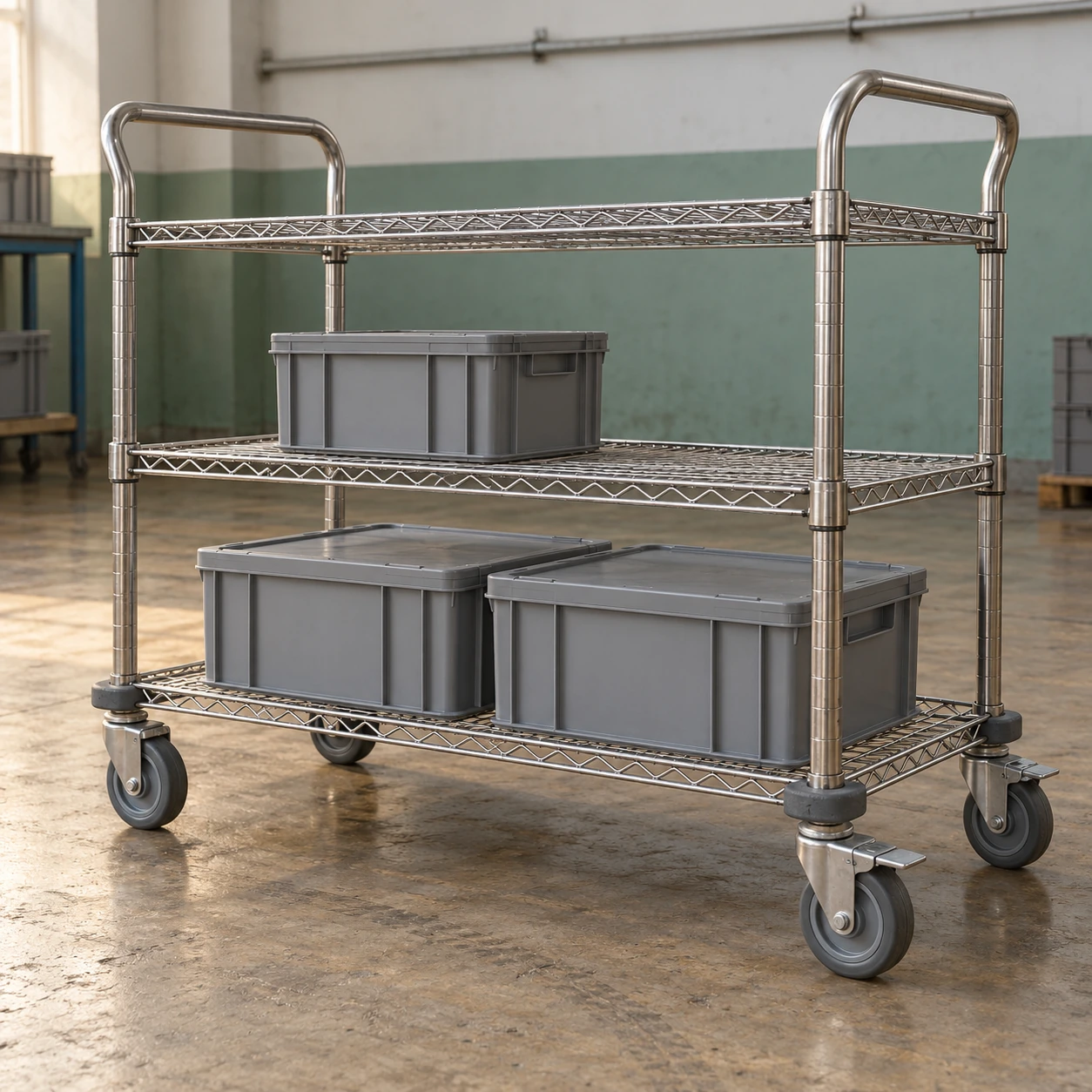
Cleanroom Trolleys & Storage Racks
industrial cleanroom carts
| Nominal cart W × D × H | 610 × 914 × 1016 mm; 610 × 1219 × 1016 mm; 610 × 1524 × 1016 mm |
|---|---|
| Levels | Two or three shelves; spacing selected around the loaded containers |
| Shelf structure | Stainless wire shelves; solid decks, baskets or retaining accessories according to the load |
| Handling | Manual push handles, corner bumpers and accessible parking brakes |
| Casters | Wheel diameter, tread, bearings and swivel or directional arrangement matched to the floor and route |
| Working load | Moving-load rating, per-shelf load and concentrated-load support specified for the complete assembly |
| Service options | Replaceable caster assemblies and identifiable shelf or frame components |
W is the shorter horizontal axis and D is the longer axis. Nominal sizes are rounded from inch-based configurations; the final drawing must identify handle, bumper and caster projection as well as clear shelf space.
Industrial cart dimensions, shelf supports, handles and caster arrangements can be customized for the load, travel route and cleaning procedure.
Industrial cleanroom carts serve repeated production transfers, from kitted parts and closed process containers to tooling and packaged assemblies. Selection should address the complete working cycle: loading, starting, turning, parking, unloading and cleaning before the next trip.
The route sets the working conditions
A production cart may make the same trip many times during a shift. A door threshold, floor joint or tight corner that seems minor during an empty demonstration can become the point where a loaded cart is difficult to control. Map the route from the loading position to the actual parking position, including door operation and the space needed for a person behind the handle.
The most restrictive point is not always the narrowest doorway. A long cart needs space to turn after passing through it. A handle or bumper can catch on a bench before the shelf reaches its destination. Where the load hides the forward view, changing the load arrangement or using a different handling method is more useful than simply fitting a stronger frame.
Read the load specification as a set of conditions
A shelf rating, a caster rating and a complete moving-cart rating describe different things. They should not be substituted for one another or added together to create a larger claimed capacity. The approved loading arrangement must account for how the frame, shelf connections and wheels share the load in use.
| Load pattern | What changes | Useful design response |
|---|---|---|
| Several closed bins spread over a shelf | Support is distributed, but containers can move during turns. | Match shelf area to the bins and use suitable retaining edges or dividers. |
| A heavy instrument standing on small feet | Local forces may be much higher than the average load over the shelf. | Check the support beneath each foot and whether a reinforced solid platform is required. |
| Dense material placed on an upper shelf | The loaded centre of gravity rises and handling becomes less forgiving. | Keep dense items low where the handling procedure permits and assess stability during turns. |
| Repeated movement over floor joints | The load and frame experience impacts as well as steady weight. | Review the route, wheel construction and complete assembly rating together. |
For a bulky single load that does not benefit from stacked shelves, a Stainless Steel Platform Trolley may provide a more appropriate loading surface. A multi-level cart is most useful when its shelf arrangement supports the actual picking and replenishment sequence.
Starting and steering
The effort needed to start a cart can differ substantially from the effort needed to keep it moving. Wheel diameter, tread, bearings, floor condition and total moving mass all contribute. Larger wheels can help with some floor irregularities, but they also affect deck height and the space beneath the cart. Select them as part of the assembly.
All-swivel layouts offer manoeuvrability in confined spaces. Directional or fixed-wheel arrangements can improve tracking on longer straight routes, while changing how the cart turns and parks. Compare the alternatives using the intended load and travel path; a free-moving empty cart is not enough evidence.
Stopping and parking
Provide a level parking location and brakes the operator can reach without stepping beneath the load. A wheel brake and a total-lock caster may restrain different movements. Identify which function is needed when the cart is loaded or unloaded.
Do not treat ordinary caster brakes as a solution for uncontrolled movement on a slope. Where ramps, steep transitions or difficult manual handling are unavoidable, assess a different route or an appropriate powered handling method. Corner bumpers can reduce contact damage, but they do not compensate for insufficient clearance.
Keep the cart serviceable between shifts
Thread, film and other debris around a wheel can increase effort before the cart shows an obvious fault. Bent forks, loose fasteners, damaged shelf supports and worn tread also deserve attention. An industrial cart should have accessible inspection points and replacement parts that can be identified without guessing from wheel appearance.
Specify the replacement caster mounting, overall height, tread and load conditions. A component that physically fits may still alter handling or introduce an unsuitable lubricant, seal or metal finish into the cleaning process. Repairs should restore the approved configuration and allow the cart to be cleaned before returning to production.
Buy for the busiest trip
Describe a realistic maximum trip: the number of containers, their individual masses, where they sit, how often the journey repeats and where the operator turns or stops. Include the empty-cart mass when assessing handling effort. This makes the choice between a longer cart, an extra shelf and more frequent smaller deliveries a practical production decision rather than a comparison of headline capacity alone.
Industrial cart dimensions, shelf supports, handles and caster arrangements can be customized for the load, travel route and cleaning procedure.