Cleanroom Tables, Benches & Stools
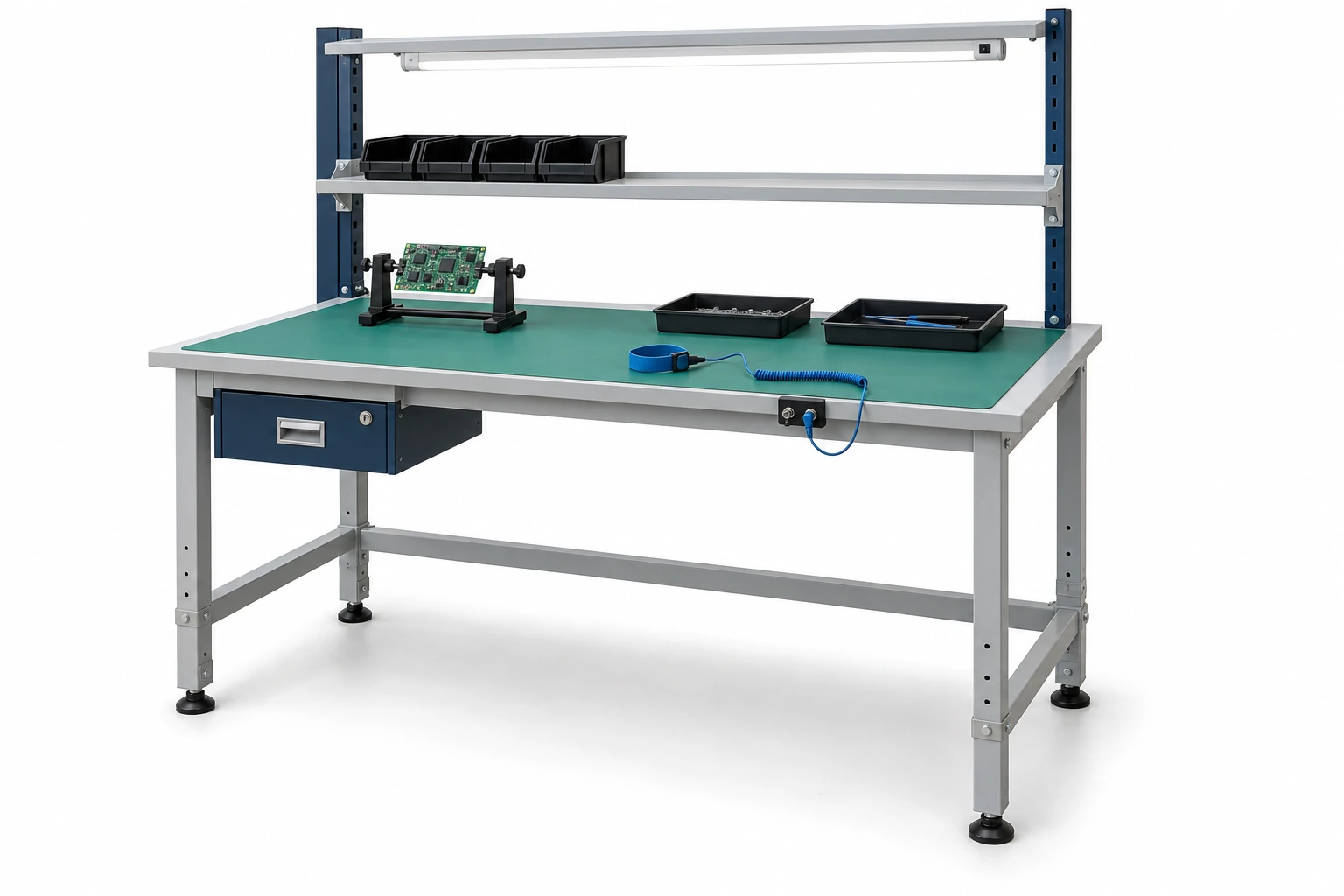
ESD Workbenches
| Worktop W × D (mm) | 1200 × 700; 1500 × 700; 1800 × 700; 1500 × 900; 1800 × 900 |
|---|---|
| Manual working-height option (mm) | 650–900, floor to worktop; adjustment mechanism selected for the task |
| Work surface | 25 mm ESD laminate top, or a supported dissipative mat system selected for the process |
| Frame and support | Steel frame with leveling feet; bolted accessory uprights; castor option with separately specified load rating |
| Grounding interfaces | Identified common point, worktop connection and personnel connection; compatible wrist strap and monitoring options |
| Above-bench fittings | Adjustable shelves, component-bin rails, task light and tool supports |
| Storage and services | Drawer module, instrument support, cable routing and power rail options |
| Process additions | Ionization, magnification or fume-extraction provision selected for the actual operation |
Worktop dimensions describe the usable bench surface. Uprights and accessories determine the complete station envelope; load ratings and ESD acceptance limits are specified for the selected configuration.
ESD Workbenches can be customized to suit the components, operating posture, equipment layout and electrostatic-control requirements of the application.
ESD workbenches combine a stable working platform with a defined route for controlling static charge during electronics handling. The worktop, operator connection, fixtures and component storage need to work together. A suitable layout also keeps tools within reach and cables clear, helping the operator maintain the intended ESD controls through assembly, testing and repair.
Keep protection continuous through the handling task
Receive and unpack
Set aside a clear area for incoming containers and protective packaging. Open sensitive assemblies within the designated ESD work area, then place them on the intended working surface or compatible fixture. A shielding bag remains packaging; its outside is not a substitute for the bench surface.
Assemble and inspect
Keep the product and frequently used tools in the operator's primary reach area. Position bins above or beside that area so a board can remain supported while parts are selected. Give test leads and wrist cords enough movement without letting them cross the component-handling path.
Transfer and store
Provide a defined outgoing position and suitable static shielding packaging for the next transfer. Keep accepted, unfinished and rejected assemblies identifiable so finished items do not become mixed with incoming material on the worktop.
Build a controlled path from the surface to ground
A dissipative worktop lets charge drain through its intended connection instead of leaving a conductive object electrically isolated. The connection needs to remain effective through the surface, grounding hardware and the facility's grounding arrangement. Specifying a green mat or an ESD label alone does not define that complete path.
The operator needs a compatible personnel-grounding method as well. At seated electronics stations, an ESD wrist strap normally connects to an identified workstation point; a compatible monitor can help detect interruptions during use. Select the connectors and monitoring system together. Workstation ESD connections and the protective earthing of powered equipment must be coordinated, with electrical installation carried out by qualified personnel.
Insulating process items need separate attention
Some plastic fixtures, films and housings cannot be discharged simply by placing them on a grounded bench. Remove unnecessary insulators from the immediate handling area. Where an insulating item is essential, assess whether ionization is needed and position the unit so its effective coverage reaches the actual product. A shelf or tall instrument can obstruct that coverage; an ionizer supplements the grounding arrangement.
Match reach and stability to the work
A deeper bench creates space for instruments but can move small components beyond comfortable reach. Use the front area for frequent handling and reserve rear shelves for less frequent access. Set the working height for the fixture as well as the operator: a tall jig raises the hand position even when the tabletop height stays the same.
Drawers and lower shelves should leave room for knees, chair movement and foot support. For shared stations or regular posture changes, a hand-crank or electric frame may be more practical than an adjustment that requires tools. Confirm its working range and moving-load rating for the complete configuration.
Check where the load is carried
A total bench capacity does not describe every loading condition. A heavy test instrument on a small footprint, a monitor on an extended arm and a shelf of components each load different parts of the structure. Specify their positions and individual weights so the worktop, uprights and supports can be selected together.
Castors change the support arrangement and may change the permissible load. For precision inspection, consider vibration and stability as well as mobility. Task lights, magnifiers and cables must move with the station without pulling on grounding connections or obstructing the work.
Keep the surface effective after installation
Select a laminate or mat for both its electrical properties and its exposure to tools, soldering operations and cleaning agents. An ESD resistance specification does not establish resistance to heat or solvents. Avoid covering the handling zone with ordinary tape, labels or insulating pads that interrupt contact with the intended surface.
Clean according to the surface supplier's instructions, using products that do not leave an insulating film. Inspect worn mats, loose snaps and strained cords. Record the agreed resistance and grounding checks at installation, then repeat the relevant checks after relocation, surface replacement or changes to the workstation layout. A continuous monitor covers its specified circuits; it does not assess every fixture or material placed on the bench.
For a coordinated quotation, provide the assembly dimensions, seated or standing task, instrument loads, cleaning method and required storage. Include the facility's ESD-control plan and verification criteria. shengtongjh can coordinate the bench and accessory selection around these requirements, including sites working to IEC 61340-5-1 or ANSI/ESD S20.20. Request a workstation configuration.
ESD Workbenches can be customized to suit the components, operating posture, equipment layout and electrostatic-control requirements of the application.