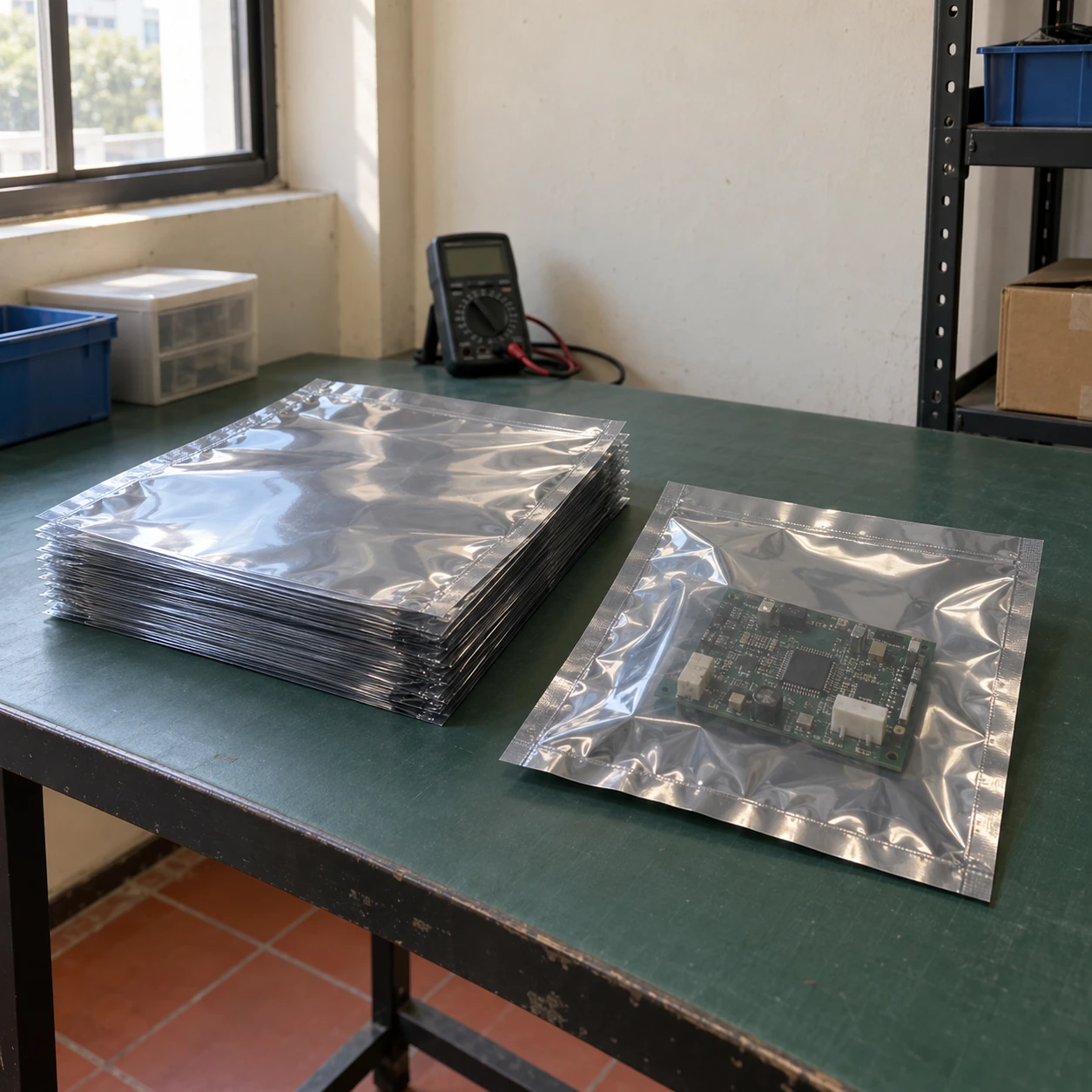
Static Shielding Bags
esd static shielding bags
| Packaging construction | Open-top or zipper metal-in shielding laminate |
|---|---|
| Nominal sizes, W × L | 152.4 × 203.2; 203.2 × 304.8; 254 × 304.8 mm |
| Nominal film choices | Approximately 0.071 or 0.081 mm, according to the selected material |
| Discharge shielding evidence | Applicable ANSI/ESD STM11.31 method and agreed acceptance limit |
| Surface-property evidence | Inside and outside surfaces evaluated with the applicable test method and conditioning |
| Acceptance identity | Bag specification revision, material identity, dimensions, closure and lot reference |
Standards and test methods identify qualification requirements; they are not a claim that every offered configuration is certified. Approve documentation for the specific supplied construction.
ESD static shielding bags are part of a controlled packaging system for sensitive electronic assemblies. A useful purchasing specification links the bag construction to qualification evidence, incoming acceptance and the way the package will be handled after delivery.
Write acceptance criteria before comparing quotations
The term ESD bag covers products with different protective functions. Begin with the assembly and its movement: what touches the part, whether it leaves an ESD protected area, and whether moisture or mechanical damage is also a concern. ANSI/ESD S541 and IEC 61340-5-3 address packaging properties; the selected requirements should fit the site's ESD control program.
Keep the evidence specific. A report for another film family, a different thickness or a material before conversion may not establish the behavior of the finished bag being ordered. Identify the supplied construction and check how the documents apply to it.
Read the measurements as separate answers
Surface properties
Inside and outside resistance results describe the surfaces tested under stated conditions. They do not replace a measurement of discharge shielding through the package.
Shielding performance
A shielding test addresses energy reaching the inside under a defined test arrangement. Compare the method, conditioning, sample construction and acceptance limit together.
Physical integrity
Dimensions, seams and closure determine whether the bag can actually enclose the part throughout handling. Electrical data cannot make a torn or badly fitting package suitable.
A practical receiving and release sequence
- Identify the delivery. Match the product and lot information to the purchase order and approved specification.
- Check the supplied form. Confirm the intended size designation, closure and markings. Keep the distinction between flat dimensions and usable packing space.
- Inspect the packaging condition. Segregate bags with damaged seals, punctures or compromised closure. A quick appearance check is useful but does not prove electrical performance.
- Apply the site's verification plan. Use the agreed sampling and test methods, with suitable equipment and trained personnel, for the properties that require ongoing verification.
Record discrepancies before mixing new stock into an existing bin. Retaining lot identity makes a targeted hold or replacement possible if a later problem appears.
Keep the protection during use
Open the bag at a suitable protected workstation. Do not turn it into a permanent bench covering or assume it makes an ordinary table safe for exposed assemblies. Close the package before it returns to general stores or transport.
Review changes deliberately
A change in laminate, surface treatment, zipper construction or packing route deserves review. An unchanged size label is not enough to establish equivalence. For repeat supply, use the order and traceability details to keep the approved package identifiable.
Dimensions, closure, labeling and the required documentation package can be customized to fit the site's ESD packaging specification.