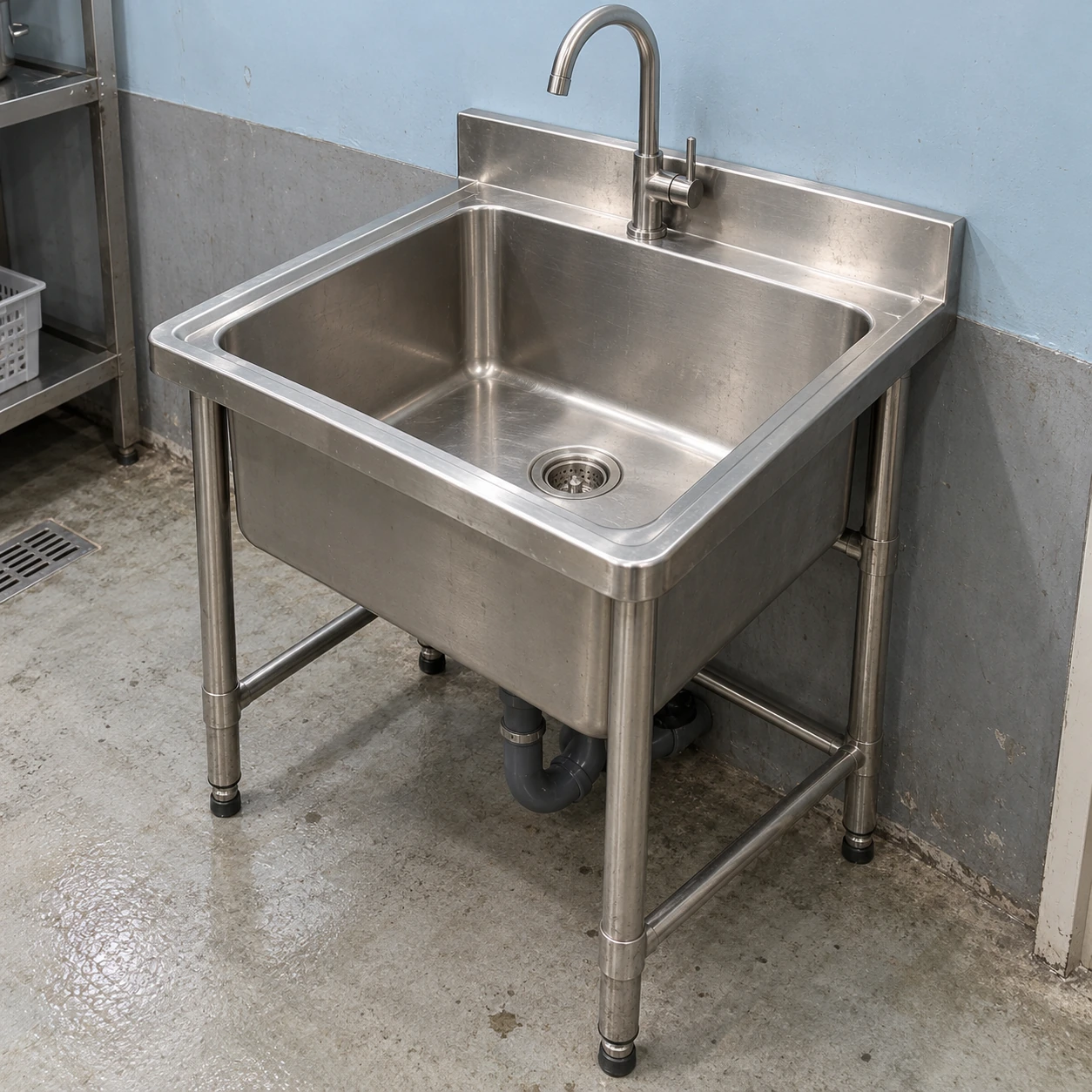
Cleanroom Sinks & Wash Stations
deep stainless steel sinks
| Freestanding unit W × D × H (mm) | 565 × 775 × 1119; 718 × 775 × 1119 |
|---|---|
| Corresponding bowl W × D × vertical depth (mm) | 457 × 610 × 356; 610 × 610 × 356 |
| Working rim height (mm) | 890 |
| Material and finish | 304 stainless steel; 2.0 mm nominal sheet, satin finish |
| Bowl and rear edge | Single compartment, rounded front/back transitions, rolled rim and splashback |
| Support | Stainless tubular legs with adjustable feet |
| Drainage | Basket waste; accessible trap and waste connection selected for site plumbing |
The two bowl sizes correspond to the two unit sizes. Overall height includes the rear splashback; rim height describes the standing work level. Vertical bowl depth is not the permitted fill level, and D describes front-to-back space. Dimensions are rounded millimetres.
Deep stainless steel sinks can be customized for container height, immersion needs, operator access, supporting frames and the available waste connection.
Deep stainless steel sinks give tall containers and utensils more vertical washing space while keeping the station footprint manageable. The deeper bowl can support soaking and contain normal washing splashes, but it also moves the bottom farther from the operator. Match bowl depth to the actual item, the intended water level and the way the load will be lifted out.
Use vertical space where the task needs it
A deeper bowl allows more of a tall utensil or container to sit below the rim. It can make soaking easier and keep normal washing activity farther from the upper edge. It does not compensate for an opening that is too narrow: a wide pot still needs sufficient horizontal clearance, including room around its handles.
The value of the extra depth changes with the work. Occasional washing of large vessels may benefit from it, while repeated handling of small items at the bottom can involve unnecessary bending. Consider what the operator must touch, how often the task repeats and whether the item can remain supported at a convenient level.
Keep three vertical dimensions separate
Bowl depth
This is the vertical distance inside the bowl, measured according to its drawing. A sloped bottom and rounded transitions mean that not every point has the same clear depth. An item also occupies space below its rim, especially when its base is irregular.
Working water level
The intended fill must leave room for the item, displacement and ordinary handling movement. Filling close to the top before lowering a large container can cause overflow. A standpipe or overflow fitting has its own arrangement; the quoted bowl depth is not a fill instruction.
Standing work level
The rim height determines the starting reach, while the bowl bottom sits farther below it. Raising the whole sink does not automatically make a very deep bowl comfortable because the front edge may then be too high for the operator's arms.
Reduce the need to reach into the bottom
A suitable removable basket or supported grid can keep small components within reach. It must fit securely, carry the intended load and remain removable for cleaning. Account for the space it occupies when considering immersion; an improvised support can reduce useful depth or concentrate load at a few points.
Place the tap controls where they can be used without reaching across the wet load. The spout should admit the tallest item and direct water into a useful working area. A spray fitting can extend access, provided its hose, mounting and water connection suit the intended service.
Plan the lift out while the load is wet
Containers become harder to handle when they retain water, and a deep bowl places the starting grip lower. Give large items a supported draining position beside the sink and use an appropriate handling method for their wet mass. A drainboard or adjacent stand is more useful than an unsupported gap between the sink and trolley.
For mixed tasks, a High-Low Stainless Steel Sink offers a different arrangement to consider. Select the working positions around the people and items using them rather than assuming one deep basin will suit every operation.
Reserve space beneath the deeper bowl
Increasing vertical depth lowers the waste outlet and reduces the available space for the trap and connection to the wall or floor. A replacement sink can therefore fit the same floor footprint while failing to align with existing drainage. Compare the outlet elevation and service envelope before committing to the bowl.
Leave access to seals, strainers and connections. A lower shelf must not force the trap into an awkward position or prevent its removal. The complete support frame also needs to carry the intended water and item load without relying on the plumbing to restrain movement.
Drain the sink before reaching into a concealed load, remove collected debris and clean the bowl transitions and waste fitting. Use a cleaning method compatible with the steel, seals and any added support basket. Deep storage of soaking liquid requires a process suitable for the items and chemistry; the sink itself does not establish that process.
For a quotation, send the container footprint and height, its wet handling mass, the required immersion level, the existing waste elevation and the normal operator position. shengtongjh can coordinate a deep bowl with the surrounding work level and drainage arrangement. Request a deep sink configuration.
Deep stainless steel sinks can be customized for container height, immersion needs, operator access, supporting frames and the available waste connection.