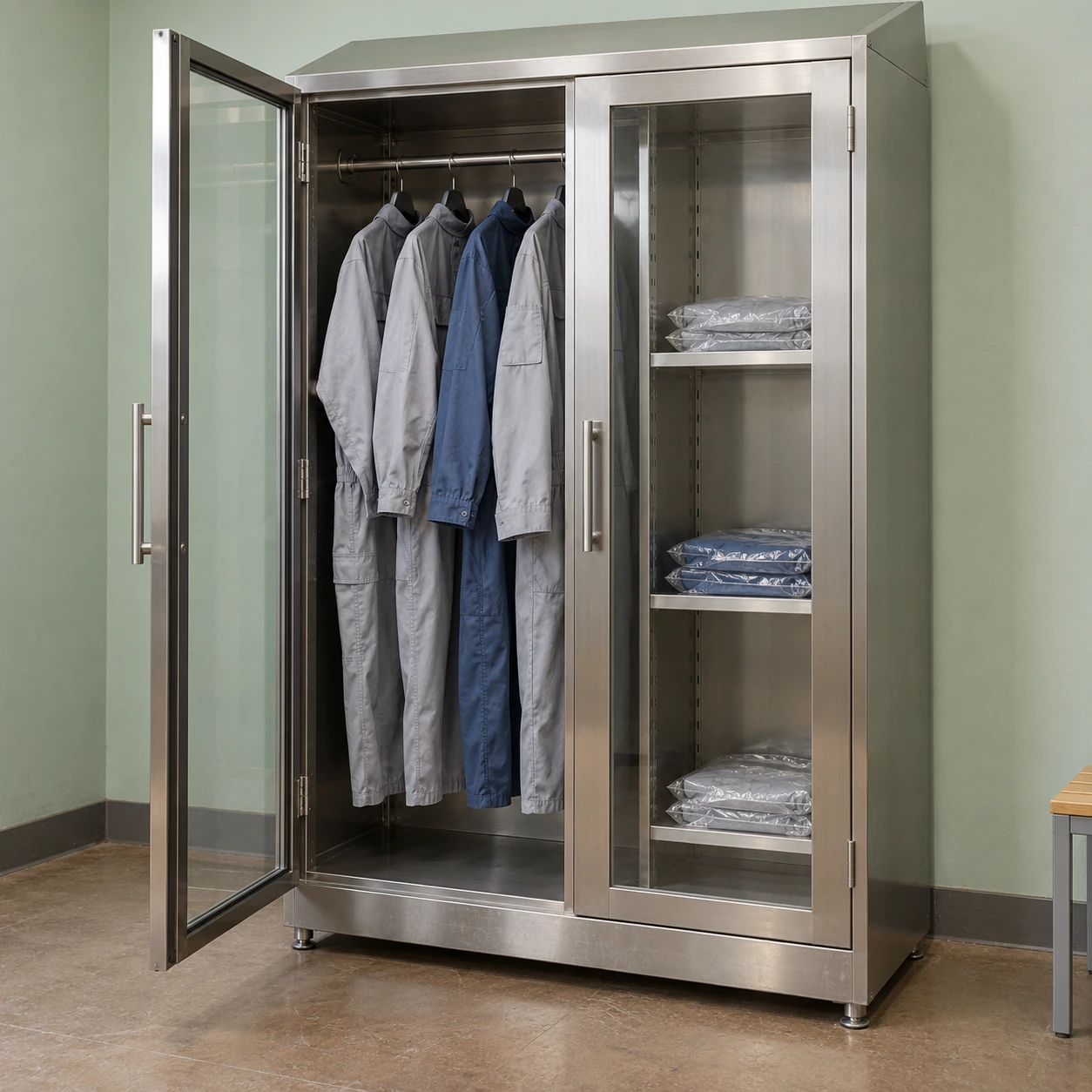
Cleanroom Lockers & Garment Cabinets
Garment Storage Cabinets
| Unpowered cabinet exterior W × D × H (mm) | 914 × 457 × 1981; 914 × 610 × 1981 |
|---|---|
| Filtered cabinet exterior W × D × H (mm) | 1340 × 740 × 2240; 1950 × 740 × 2240 |
| Corresponding filtered storage space W × D × H (mm) | 1240 × 645 × 1790; 1850 × 645 × 1790 |
| Cabinet material | 304 stainless steel or powder-coated steel |
| Storage arrangement | Hanger rail, adjustable shelves or divided hanging / shelf sections |
| Enclosure and access | Solid or viewing-panel doors; lockable access and sloped-top options |
| Filtered configuration | Top-mounted prefilter, fan and final filter; airflow path and filter-condition indication selected together |
Dimensions describe separate cabinet configurations; filtered interior sizes correspond to the exterior sizes in the same order. Unpowered dimensions are rounded to the nearest millimetre. Door swing, service access and garment clearance require additional space.
Garment Storage Cabinets can be customized for the garment type, storage quantity, room layout, cleaning method and required airflow arrangement.
Garment Storage Cabinets organize workwear between receipt and issue, keeping hanging garments or folded packs away from open benches and busy changing areas. An enclosed cabinet suits routine uniform storage; a filtered cabinet adds controlled airflow where the garment-handling process requires it. Select the storage arrangement for the clothing, packaging and daily issue pattern in manufacturing, laboratories, food-production support areas and controlled facilities.
Start with the clothing inside the cabinet
Long coveralls need free hanging length; jackets need enough shoulder depth to close the door without compressing their sleeves. Position the rail so the longest garment stays clear of the base and is easy to remove. A rail that accepts many empty hangers can still be too crowded once the garments are loaded.
Leave room to identify and lift out one item without dragging it across its neighbours. For mixed workwear, a divider can separate a hanging bay from folded stock. Keep hoods and accessories in designated compartments so they remain accessible without reaching through the main clothing supply.
Use shelves for packs that should stay closed
Individually packed clothing can remain packaged on shelves until the approved point of use. Match shelf depth to the actual pack and arrange sizes so the label can be read without lifting several other items. Very deep stacks make stock checks harder and encourage repeated handling.
Adjustable shelves allow the layout to change with garment size or seasonal demand. Shelf supports must remain secure and accessible for cleaning. Specify the load of the filled packs and their distribution; an overall cabinet capacity does not establish the capacity of each shelf or hanger rail.
Choose the storage environment deliberately
A nonpowered enclosed cabinet provides organized storage and limits direct exposure while its doors are closed. It is useful for dry, ready-to-issue uniforms and packaged garments where the room and handling procedure provide the required conditions. Door seals, viewing panels and internal divisions should suit that procedure rather than simply adding complexity.
Filtered storage is a complete airflow arrangement
In a filtered cabinet, a fan draws air through a prefilter and final filter before supplying the storage zone. Garment spacing, shelves and the discharge route affect how that air reaches the stored clothing. Dense bundles can block the path, so a fan added to an ordinary cupboard does not by itself establish effective filtered storage.
Specify the intended loading and door-use pattern with the airflow arrangement. Filter-condition indication helps plan maintenance, while the selected cabinet still needs the agreed checks in its installed condition. A Filtered Cleanroom Garment Cabinet is the more focused option when this function is central to the process.
Storage preserves the condition of properly prepared clothing; it does not wash, dry or sterilize garments. Keep required packaging intact and follow the garment process for release, use and return. A stainless steel enclosure or a filter designation alone does not establish a sterile storage environment.
Give clean stock a clear route through the changing area
- Receive and replenish. Provide a convenient replenishment position so incoming stock can be checked and placed without resting it on the floor. Allocate visible shelf or rail positions by size and garment type, and refill before the busiest changeover period.
- Select and issue. Put frequently used items within comfortable reach. Viewing panels help staff locate clothing before opening the cabinet. Door movement and the person selecting garments both occupy floor space; keep that activity clear of the main passage.
- Return separately. Give used clothing its own collection position and identified return container. Returning it to the clean-stock compartment disrupts the issue sequence and mixes garment conditions. Personal belongings also need a separate allocation, such as a Stainless Steel Cleanroom Locker.
Make the enclosure easy to live with
Choose the metal finish and door-panel material around the actual cleaning agents and contact time. Stainless steel simplifies many cleaning routines but still needs compatible products; coated steel needs attention at chips, hinges and exposed edges. Transparent panels improve visibility, although scratching or chemical damage can eventually make the contents harder to see.
Cleanability depends on access as well as material. Removable shelves, reachable corners and a base that can be cleaned around reduce awkward work. A sloped top discourages overhead storage but still needs access for wiping. Locate the cabinet so its doors open fully without striking a wall or blocking adjacent lockers.
For powered configurations, reserve the specified space for air intake and filter replacement. Check the installation route against the full cabinet envelope, including the upper fan section, before delivery. Level and secure the cabinet according to its installation requirements, then confirm that loaded doors, shelves and rails operate correctly.
For a coordinated quotation, send the longest garment on its hanger, folded-pack dimensions, quantities issued per shift, room layout and cleaning method. Include any required filtration and storage-condition checks. shengtongjh can coordinate the enclosure, internal arrangement and access options around these details. Request a garment storage configuration.
Garment Storage Cabinets can be customized for the garment type, storage quantity, room layout, cleaning method and required airflow arrangement.