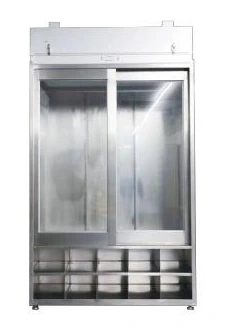
Cleanroom Lockers & Garment Cabinets
Filtered Cleanroom Garment Cabinet
| Specification | Configuration options |
|---|---|
| Brand | shengtongJH |
| External size, W × D × H (mm) | 1000 × 700 × 2300 / 1500 × 700 × 2300 / 2000 × 700 × 2300 |
| Cabinet material | 304 stainless steel |
| Air treatment | Fan-assisted HEPA-filtered supply; filter grade selected for the application |
| Storage | Hanging rail with lower shelf or footwear compartment |
| Doors | Glazed hinged or sliding doors |
| Controls | Fan control and lighting; filter-service indication optional |
| Power supply | 220–240 V, 50/60 Hz configuration |
| Customization | Hanging capacity, shelf arrangement, doors and filtration package |
Dimensions and configurations can be customized for your application.
Keep clean garments organized in an enclosed, filtered storage space between handling stages.
Protect the storage interval
Clean garments can collect particles again while waiting to be worn. A filtered garment cabinet places hanging storage inside an enclosure supplied with filtered air, reducing direct exposure to the surrounding room during that interval. It is useful where reusable garments are staged for a defined gowning routine and ordinary open hooks leave them exposed to passing traffic.
The cabinet complements garment processing; it does not replace laundering, validated sterilization where required, or control of how long a garment may be reused. Only garments that meet the site's handling procedure should be placed into the clean storage space.
Leave air space between garments
Closely packed clothing can restrict air movement and make retrieval difficult. Choose the rail length around the garment type and practical hanger spacing. Long suits need enough drop to avoid touching shelves or footwear, and the lower compartment should not become an overflow location for used clothing.
Keep the return or discharge path clear. Bags placed against an opening can change the circulation inside the cabinet even while the fan continues to run. Closed doors also matter: frequent opening exposes the storage zone to room air and changes the intended operating condition.
Plan filter service before positioning the cabinet
Confirm how the filter and fan are accessed, and leave adequate clearance for removal. A cabinet fitted tightly below a ceiling may be difficult to service if its upper panel is the only access route. Controls should remain visible and reachable without handling garments unnecessarily.
Establish a cleaning routine for rails, shelves, glazing and door tracks. Inspect the airflow arrangement after installation and filter changes, using acceptance criteria appropriate to the garments and room. Filtration does not by itself establish sterility. Cabinet size, hanging arrangement and the air-treatment package can be customized for your garment handling process.