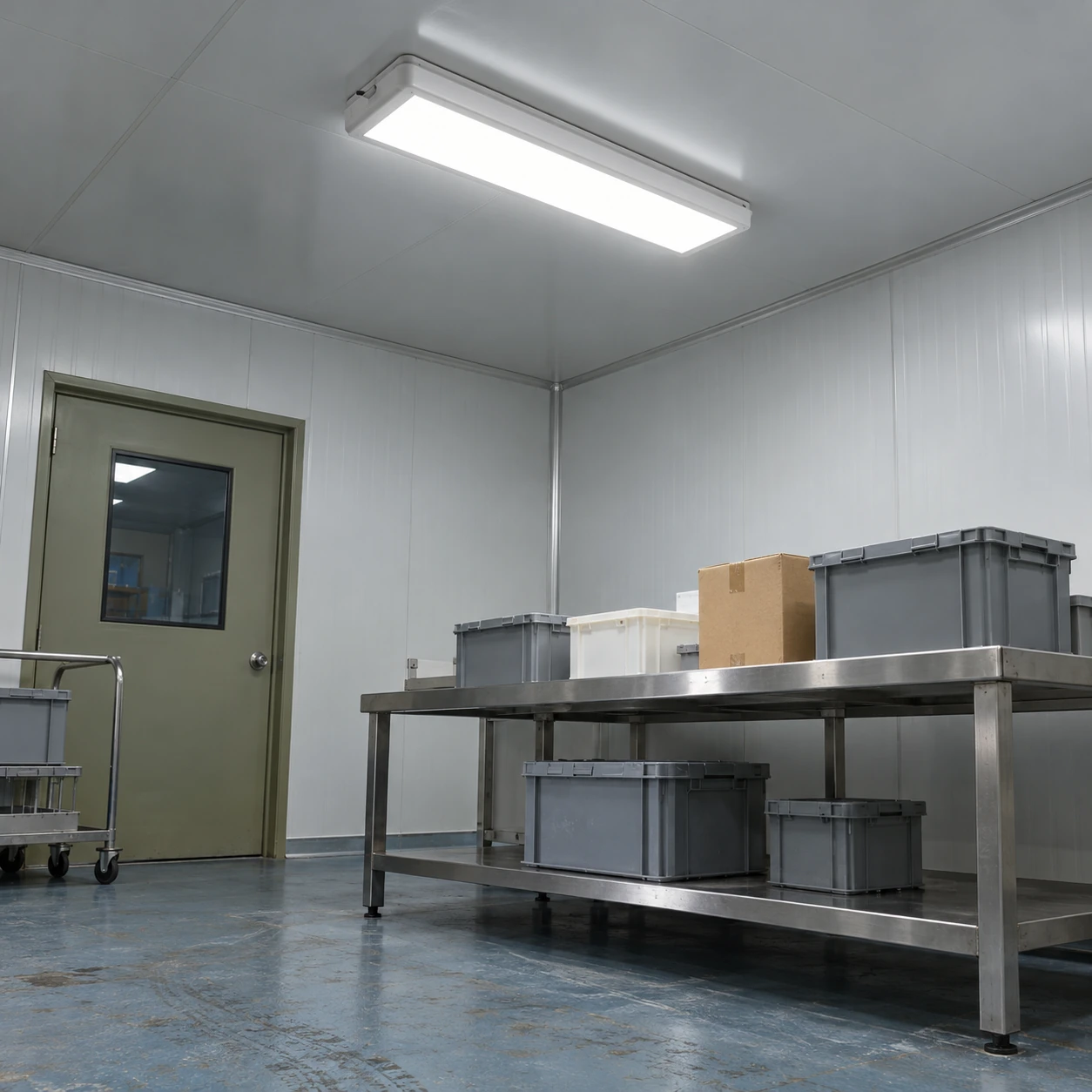
Cleanroom Lighting
iso class 8 cleanroom lighting
| Ceiling formats | 600 × 600 or 300 × 1200 mm (nominal W × L) |
|---|---|
| White-light selection | 4000 K; colour rendering above 80 or a task-specific alternative |
| Supply arrangement | 220–240 V AC, 50–60 Hz with matched control gear |
| Mounting | Sealed recessed assembly or cleanable surface-mounted fixture |
| Protection and materials | Enclosure rating, diffuser, gasket and finish selected for the actual cleaning environment |
| Assessment inputs | Visual task, ceiling construction, cleaning procedure, service access and room operating state |
ISO Class 8 is not a fixture performance rating. Nominal module dimensions do not define the housing or cutout, and the selected luminaire needs its own applicable product documentation.
Fixture format, optics, mounting and controls can be customized for the visual task and the room's operating and cleaning conditions.
Lighting for an ISO Class 8 cleanroom should support both the visual work and the room's contamination-control arrangements. The class identifies an air-cleanliness requirement; it does not by itself select the luminaire, define its ingress protection or set the required illuminance.
Choose the light for the activity inside the room
An ISO Class 8 room may contain packing, assembly or inspection operations with different visual demands. Reading print, judging colour and identifying a surface defect require different attention to light distribution and optical quality. Establish those tasks before choosing the output and spacing of fixtures.
There is no single lamp wattage or universal lux figure that follows from the class name. The room height, equipment shadows, task plane and viewing direction all influence the result. A lighting calculation and the applicable workplace criteria provide a more useful basis than matching a catalogue's cleanroom-class wording.
Protect the ceiling interface
Fixture openings, cable entries and removable covers are part of the room boundary. Select the supports and perimeter detail with the ceiling construction so the installer can form a consistent joint. A room-side seal does not compensate for an unsuitable opening or unsupported housing.
Retain access to filters and other services instead of using every available bay for lighting. The fixture position should work with the room arrangement rather than forcing a change to an established airflow or maintenance route.
Use the actual cleaning routine
A room cleaned by controlled wiping has different exposure conditions from one subject to frequent wet cleaning. State the cleaning agents, contact conditions and method so the face material, finish and gasket can be assessed together.
An IP rating does not establish chemical resistance or certify an ISO room class. Review the selected luminaire's evidence for the protection required, and keep the permitted cleaning procedure with the operating records.
Treat a lighting change as a room change
Replacing a damaged fitting or cutting a new ceiling opening can disturb the room. Plan the work area, handling of removed parts, cleaning and the checks required before returning to the intended operation. The appropriate extent depends on the change and the site's established procedures.
If particle measurements are part of that assessment, use the defined sampling procedure and suitable airborne particle counters. A fixture described as suitable for clean environments does not demonstrate that the completed room passes classification.
For selection, provide the room activity, ceiling type, visual requirements and maintenance route alongside the target cleanliness class. These details turn a broad class description into a practical lighting specification.
Fixture format, optics, mounting and controls can be customized for the visual task and the room's operating and cleaning conditions.