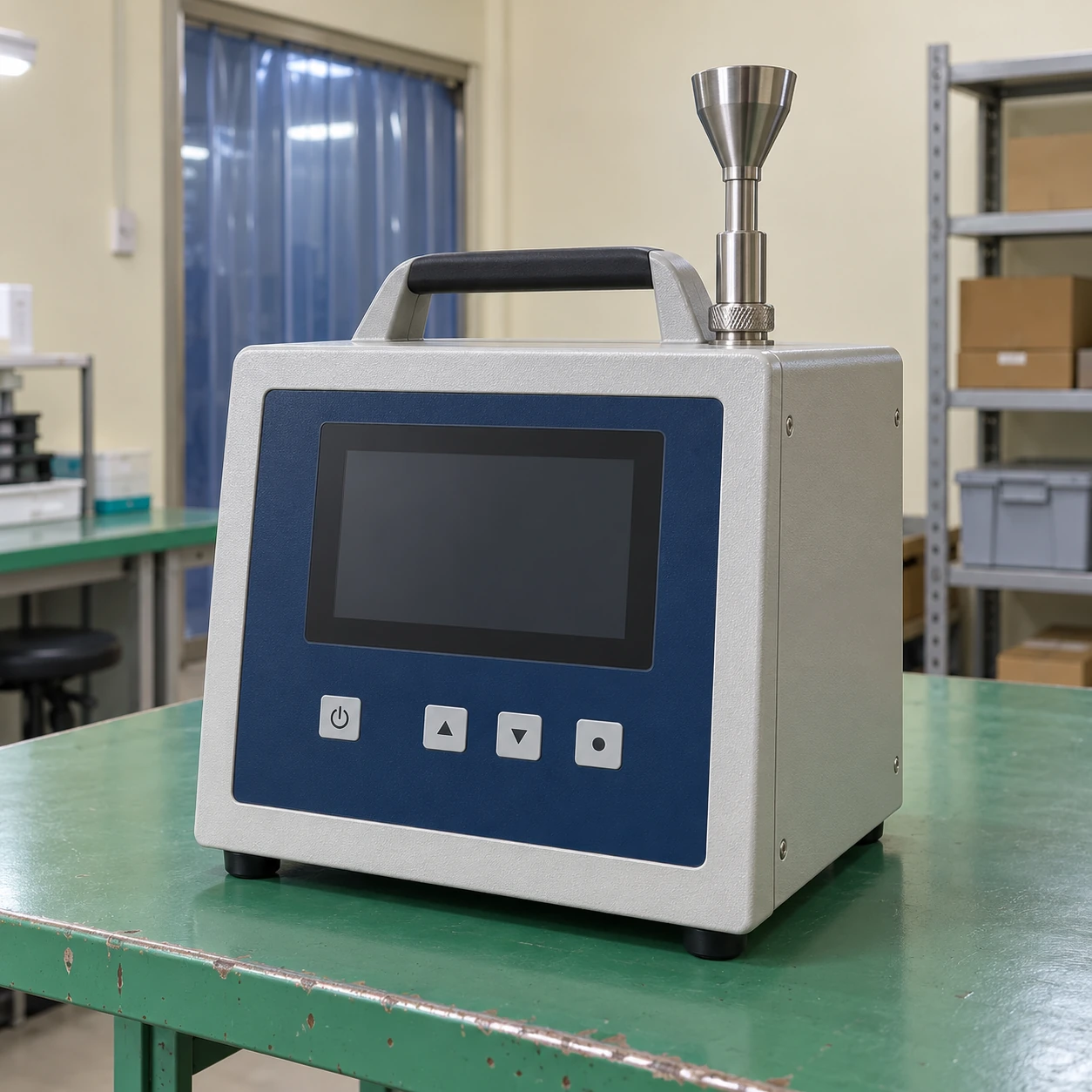
Airborne Particle Counters
Airborne Particle Counters
| Measurement principle | Optical light scattering; particle counts and number concentration by size channel |
|---|---|
| Handheld configuration | 2.83 L/min; 239 × 117 × 124 mm (H × W × D) |
| Portable configuration | 28.3 L/min; 324 × 158 × 226 mm (L × W × H) |
| Particle-size channels | 0.3 / 0.5 / 1.0 / 3.0 / 5.0 / 10.0 µm; six simultaneous channels |
| Power and data options | Rechargeable battery with external power supply; USB export and Ethernet, according to instrument configuration |
| Sampling accessories | Flow-matched inlet probe, zero-count filter and approved sample tubing; optional temperature/RH probe |
Dimensions are rounded external dimensions; the handheld dimensions include its handle and exclude the inlet. Allow space for probes and tubing. Flow, channels, accessories and calibration documentation must match the selected instrument.
Instrument configuration, sampling accessories, data outputs and monitoring arrangements can be customized to suit the process and measurement requirements.
Airborne particle counters sample a known volume of air and report particle numbers by size. They help investigate contamination changes around sensitive assembly, packaging, laboratories and clean zones. Selecting the sampling arrangement and records is as important as selecting the instrument itself.
Follow a change in particles back to the process
Counts that rise during material transfer, packaging or operator movement can reveal when a controlled area is being disturbed. Repeatable measurements help compare operating states and investigate the timing of those changes. They do not identify the particle material or prove a particular cause without further investigation.
A conventional optical counter measures light scattered by individual particles. It does not determine whether a particle is a living microorganism, and it does not replace microbial air sampling. It also reports a different quantity from an instrument primarily intended to measure dust mass concentration.
Read the channel definition before comparing results
Cumulative counts
A channel includes particles equal to or larger than its threshold. Higher-size channels are already included in lower-threshold cumulative results, so adding the channels together double-counts particles.
Differential counts
A channel describes particles within a size interval. The interval boundaries matter when comparing instruments or exported files. A differential result cannot be compared directly with a cumulative limit.
Raw counts also depend on the air volume sampled. Compare matching size definitions and concentration units, while retaining the original sample volume and duration. A small raw count from a short sample is not automatically evidence of a cleaner location.
Choose the format around the sampling task
A handheld counter is convenient for moving between workstations and investigating a local change. A portable unit with a higher sampling flow collects the same required volume faster, which can matter during a multi-location survey.
For continuous monitoring at fixed points, select a remote instrument together with its pump arrangement, communications, alarm handling and data system. Higher flow by itself does not establish better size sensitivity, a lower false-count rate or a particular cleanroom class.
The inlet is part of the measurement
Place the sampling point where it answers the process question. A reading at a room return grille may not describe the exposed product zone. At a clean bench, probe position and nearby movement can affect what is sampled.
Use a probe matched to the flow and orient it for the airflow being assessed. Keep sampling tubing within the instrument manufacturer's limits; unnecessarily long routes and bends can lose particles before they reach the sensor. Preserve the same inlet arrangement when trending results.
Keep enough context to use the data later
- Before sampling: identify the location, operating state, required volume and the applicable measurement procedure. Keep the inlet away from unintended obstructions.
- During sampling: retain flow and instrument-status flags alongside the counts. A flow interruption or instrument fault should not be interpreted as a valid low-particle result.
- After sampling: save the time, location, size thresholds, count mode, volume and concentration units. Record unusual activities so a later reviewer can interpret a spike.
Cleanroom classification under ISO 14644-1 is a defined assessment at designated locations, not a label established by one convenient reading. Send the target particle sizes, sampling task and reporting requirements so the instrument, accessories and documentation can be selected together.
Instrument configuration, sampling accessories, data outputs and monitoring arrangements can be customized to suit the process and measurement requirements.