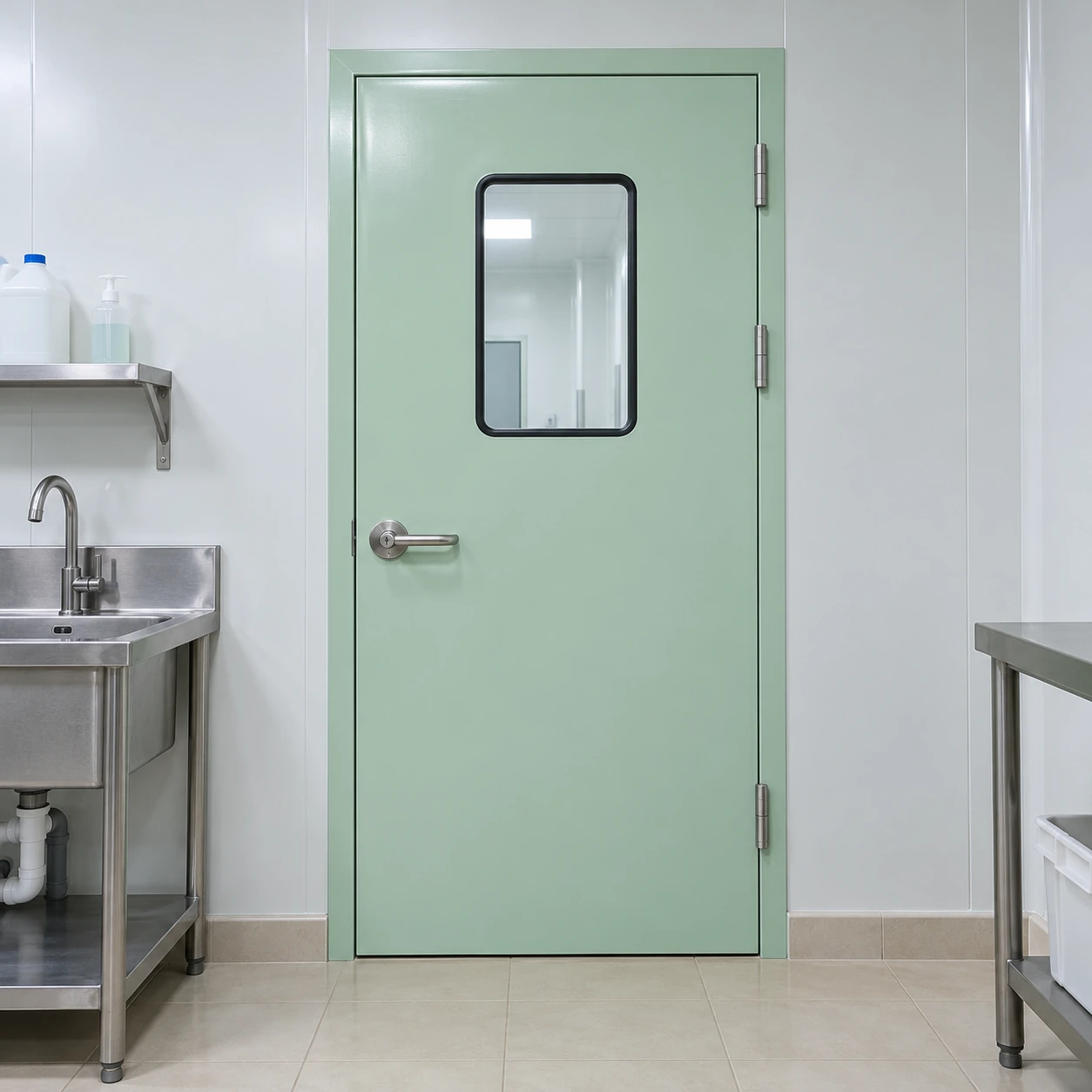
Cleanroom Doors / Windows
frp cleanroom doors
| Material | Fibre-reinforced polymer leaf; GRP is the glass-fibre variant |
|---|---|
| Clear openings, W × H (mm) | Single: 895 × 2100; double: 1818 × 2100 |
| Construction | Encapsulated insulating core with sealed perimeter |
| Frame options | Compatible aluminium, stainless steel or GRP construction |
| Glazing and operation | Flush vision panel; single-action swing and closer options |
| Service details | Chemical-compatible seals, reinforced hardware fixing zones and repair system |
Clear-opening sizes exclude the frame and wall installation allowance. Resin, core and fittings are selected as one assembly; fire performance requires a separately evidenced fire-rated doorset.
Resin finish, frame, glazing and hardware can be configured for the application and cleaning regime.
FRP cleanroom doors use a fibre-reinforced polymer construction. GRP is the common glass-fibre variant. The resin surface, encapsulated core and reinforced fixing zones work together to form a cleanable leaf for suitable industrial environments.
The sealed skin is part of the construction
A moulded or encapsulated leaf can provide a continuous exposed surface around the core. Its edges and hardware penetrations still need to remain closed. Damage that exposes reinforcement or the internal core should not be treated as a harmless colour defect in a hygiene-sensitive location.
The exact resin, reinforcement and core should be identified for the selected assembly. FRP describes a material family, not one universal combination of stiffness, chemical resistance and fire behaviour.
Support the fittings from within
Hinges, closers and latches need reinforced attachment zones. Moving a fitting after manufacture may put its screws outside those zones and compromise the leaf. Hardware positions should therefore be agreed before production, especially for large glazing or powered operation.
The frame may be GRP, aluminium or stainless steel depending on the door system. Its connection to the leaf and wall should be selected as part of the assembly rather than chosen only to match the colour.
Match the resin surface to the cleaning duty
FRP constructions can be useful in selected wet or frequently cleaned areas, but compatibility depends on the actual chemical, concentration, contact time and temperature. The gasket, glazing seal and exposed hardware need the same review. A broad statement that the door is chemical-resistant does not answer every operating condition.
Abrasive cleaning can damage an otherwise suitable surface. The maintenance method should preserve the resin skin and keep joints accessible. Where a repair is permitted, it needs the correct materials and curing process to restore a stable, cleanable finish.
Choose the leaf arrangement for traffic
A single-action leaf closes to a defined stop and can suit a controlled personnel entrance. A double leaf provides wider access, with the active and inactive hardware selected for how frequently the full opening is used. Double-action traffic variants use different operating and sealing details and should be specified separately.
Vision glazing helps users see the opposite approach. Flush mounting reduces a ledge, while the size and location must remain compatible with the leaf construction and required reinforcement.
Keep special performance claims separate
A non-fire-rated FRP door should not be promoted as a fire door because another composite construction has passed a test. Any required fire or smoke classification must be supported for the complete offered doorset, including its frame, glazing and hardware. The same principle applies to leakage or containment performance.
Compare stainless steel doors where metal surface properties are preferred. The useful choice is the assembly that fits the cleaning process, impact exposure and repair strategy, rather than a material name alone.
Resin finish, frame, glazing and hardware can be configured for the application and cleaning regime.