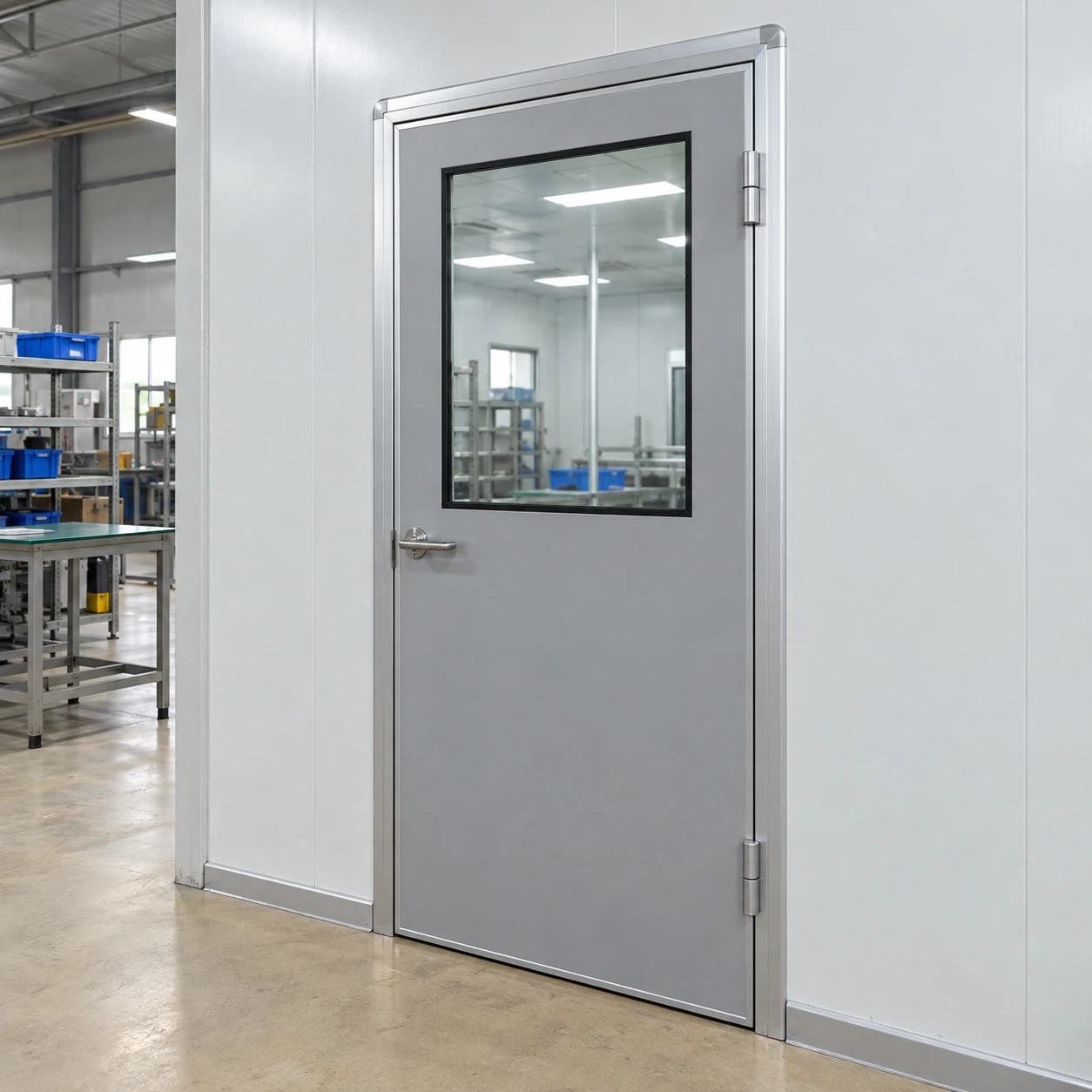
Cleanroom Doors / Windows
aluminum profile cleanroom doors
| Frame | Rounded extruded aluminium; anodized or coated finish |
|---|---|
| Nominal door sizes, W × H × T (mm) | 900 × 2100 × 42; 1828 × 2100 × 42 |
| Leaf infill | Coated metal skin or selected hygienic panel |
| Wall interface | Profile matched to panel thickness and opening reinforcement |
| Sealing | Replaceable frame gasket and bottom-seal options |
| Fittings | Flush glazing; adjustable hinges; latch, closer and interlock options |
The aluminium profile describes the frame construction, not necessarily the leaf skin. Clear passage and overall frame dimensions depend on the selected profile.
Profile finish, wall interface, leaf infill and fittings can be configured for your application.
Aluminum profile cleanroom doors use extruded sections to form the frame or leaf perimeter. The profile shapes the wall connection, seal channel and hardware attachment; it does not by itself specify what the door leaf is made from.
Read the section, not just the colour
Two silver-coloured frames may use very different cross-sections. One wraps around a panel opening, another fits into a prepared reveal, and another forms part of a proprietary wall module. The section determines how loads reach the wall and how the finished junction can be sealed.
Frame depth must suit the finished wall. A profile selected for the bare panel may fail to accommodate an added lining or tile finish. Conversely, an oversized frame throat can leave a gap that is difficult to close neatly without extra trim.
Frame, skin and core are separate choices
An aluminium frame can hold a coated-steel leaf, a stainless-faced leaf or a selected composite panel. An aluminium skin does not imply an aluminium honeycomb core. Define each layer when comparing quotations.
Use the profile to organise serviceable details
A dedicated gasket channel can keep the seal located while allowing replacement. The corner treatment matters: discontinuous or poorly joined seals can leave a gap even when the straight sections compress well. The latch position should bring the leaf into contact without requiring excessive force.
Hinges and closers need a suitable fixing zone. A decorative cover or thin wall of an extrusion should not be assumed to carry repeated loads. Hardware interfaces may require inserts or reinforcement that should be part of the doorset design.
Rounded exposed surfaces and flush glazing trims can make wiping easier, but extra cover strips can also create narrow crevices. The useful measure is whether the installed junction is accessible and sealed, rather than how many rounded profiles appear in the catalogue.
Finish and cleaner compatibility
Anodized and coated finishes behave differently under cleaning and abrasion. The actual cleaner, concentration and contact time need to be considered with the gasket and sealant. An aluminium frame should not be advertised as universally chemical-proof or suitable for every wet-process room.
At contact points with other metals, the design should also consider moisture and the chosen fasteners. A good visible face does not prevent deterioration at an exposed cut edge or hidden connection if the environment is unsuitable.
Where this construction is useful
Profile frames can provide practical interfaces for modular partitions and refurbishment work where wall thickness or trim access must be accommodated. The chosen profile still needs to match the leaf, opening loads and sealing requirement. For the more demanding cleaning and change-control considerations of production areas, see aluminium-profile doors for pharmaceutical use.
Profile finish, wall interface, leaf infill and fittings can be configured for your application.