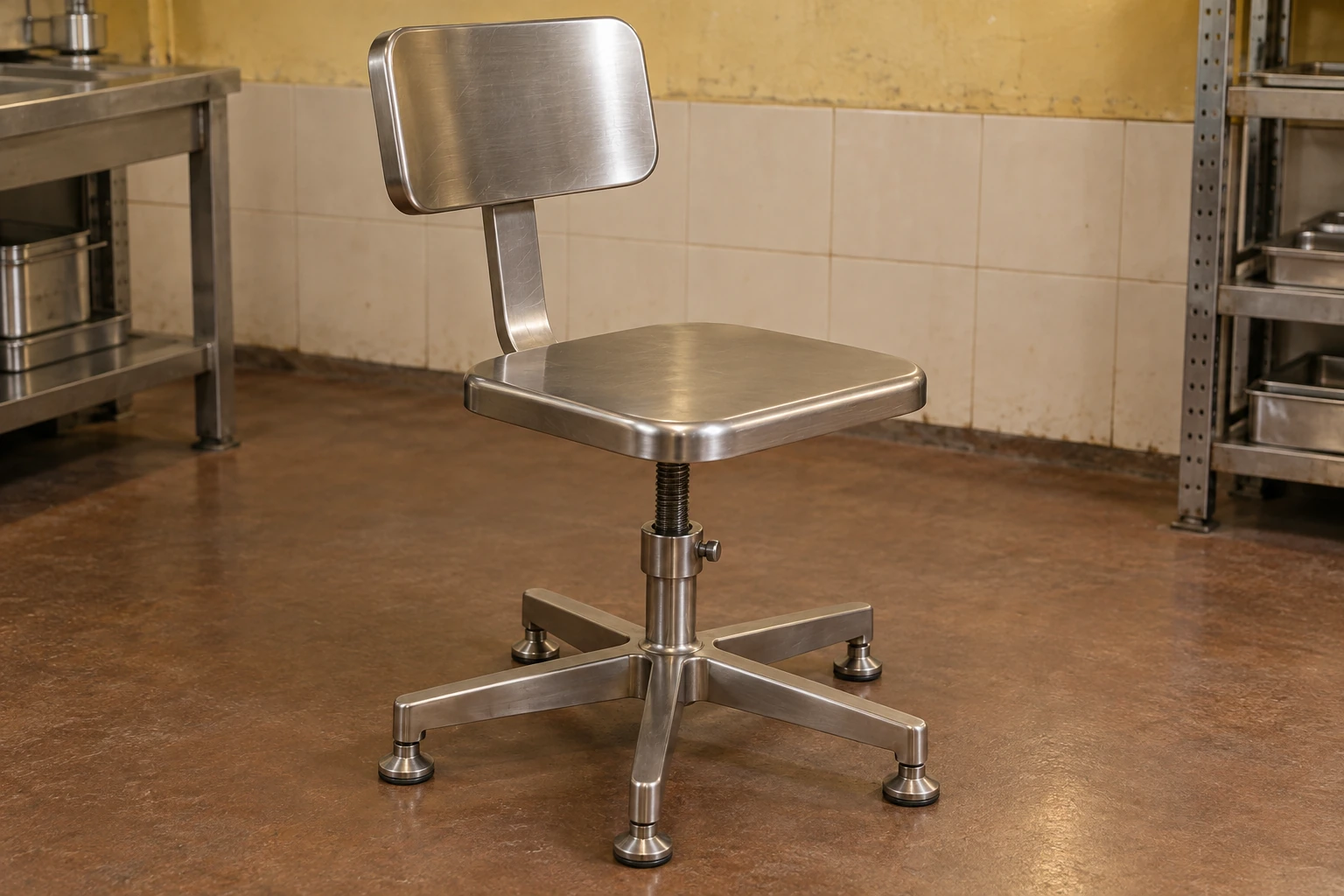
Bare-metal seating
stainless steel cleanroom chairs
| Main construction | AISI 304 stainless steel seat, backrest and frame |
|---|---|
| Rectangular seat surface (mm) | 380 × 400 |
| Round seat diameter (mm) | 330; backrest-equipped configuration |
| Seat height H (mm) | 500–600 |
| Base | Five-spoke stainless steel base |
| Floor contact | Stationary feet or castors, selected for the floor and cleaning process |
| Adjustment | Adjustable seat height and backrest; dismantlable construction where required |
H is floor-to-seat height. The rectangular and round seats are separate options; overall clearance depends on the selected base and backrest.
Seat shape, height adjustment, floor contact and cleaning-access details can be customized to suit your application.
Stainless steel cleanroom chairs place a bare metal seat and backrest in an environment where upholstery may be an unwanted maintenance item. The value lies in accessible surfaces and suitable fabrication details. The frame, adjustment mechanism and floor-contact parts still need to match the cleaning process and the operator's task.
Specify the complete construction
A stainless base does not make an all-stainless chair.
Some seating combines a metal base with an upholstered seat and plastic back shell. An all-stainless specification should identify the seat, backrest, supports, central column, base and fasteners. This makes the cleaning boundary clear and prevents a visually similar chair from being treated as an equivalent replacement.
Bare steel removes a covering that could split or expose foam. It also creates a firmer contact surface, so seat shape and edge treatment become more important during use. A rounded front edge and an appropriate seat profile help avoid an abrupt contact point; the selected chair should still be tried at the intended task.
Three details deserve a close look.
- Seat and backrest edges
- Specify smooth, finished edges and accessible attachment points. A folded return can strengthen a thin seat, but its underside also becomes part of the cleaning route. Check that the backrest support does not create an inaccessible pocket behind the contact surface.
- Joints and fasteners
- A neat external finish can hide gaps underneath. Review welds, mechanical joints and open tube ends against the required cleaning method. “Stainless steel” describes a material family; it does not describe how well the assembled chair can be drained, wiped or inspected.
- Height adjustment
- Manual adjustment and pneumatic adjustment introduce different components. Threads, lock collars, sliding interfaces and enclosed mechanisms need an agreed maintenance method. The adjustment must stay secure in service while remaining accessible for cleaning.
Match the whole chair to the cleaning cycle.
Start with the actual chemical, exposure time and method. Wiping, immersion and steam processing impose different demands. Include the underside, fasteners, adjustment assembly and floor-contact parts in the compatibility review.
All-stainless dismantlable seating is available for processes that require parts to be removed for cleaning. If steam sterilisation is required, the specified assembly and permitted cycle need explicit approval. A steel seat alone cannot establish that a gas lift, seal, wheel or lubricant can undergo the same process.
Decide where cleaned parts dry and how they return to service. A removable part helps access only when its removal and reassembly can be completed consistently, without leaving loose fasteners or trapped residue.
Choose the contact surface and the floor contact together.
A rectangular seat offers a different sitting area from a compact round seat with a backrest. Compare the shape with the operator's clothing, working duration and movement. If the task needs a padded seat, consider sealed upholstered cleanroom chairs against the same cleaning requirements.
Stationary feet reduce the need to manage rolling movement at a fixed station, but they must suit the floor finish. Castors improve repositioning and add tread, axle and brake details to the cleaning and maintenance scope. Bare metal contact with a floor should not be accepted simply because the rest of the chair is stainless steel.
For electronics handling, conductivity of the steel is not enough to establish the behaviour of the complete seating system. Any ESD requirement should be evaluated with the actual contact components and floor arrangement.
Define the chair that will be supplied.
Include seat shape, working height, backrest adjustment, floor contact and the cleaning process in the order. Add requirements for dismantling, component materials and spare parts when relevant. For an operation that does not need a backrest, the existing stainless steel stool offers a separate seating format to assess.
shengtongjh can help coordinate the seating specification with your other production furniture. The final configuration should describe the complete chair, so that later replacements retain the intended construction.
Seat shape, height adjustment, floor contact and cleaning-access details can be customized to suit your application.