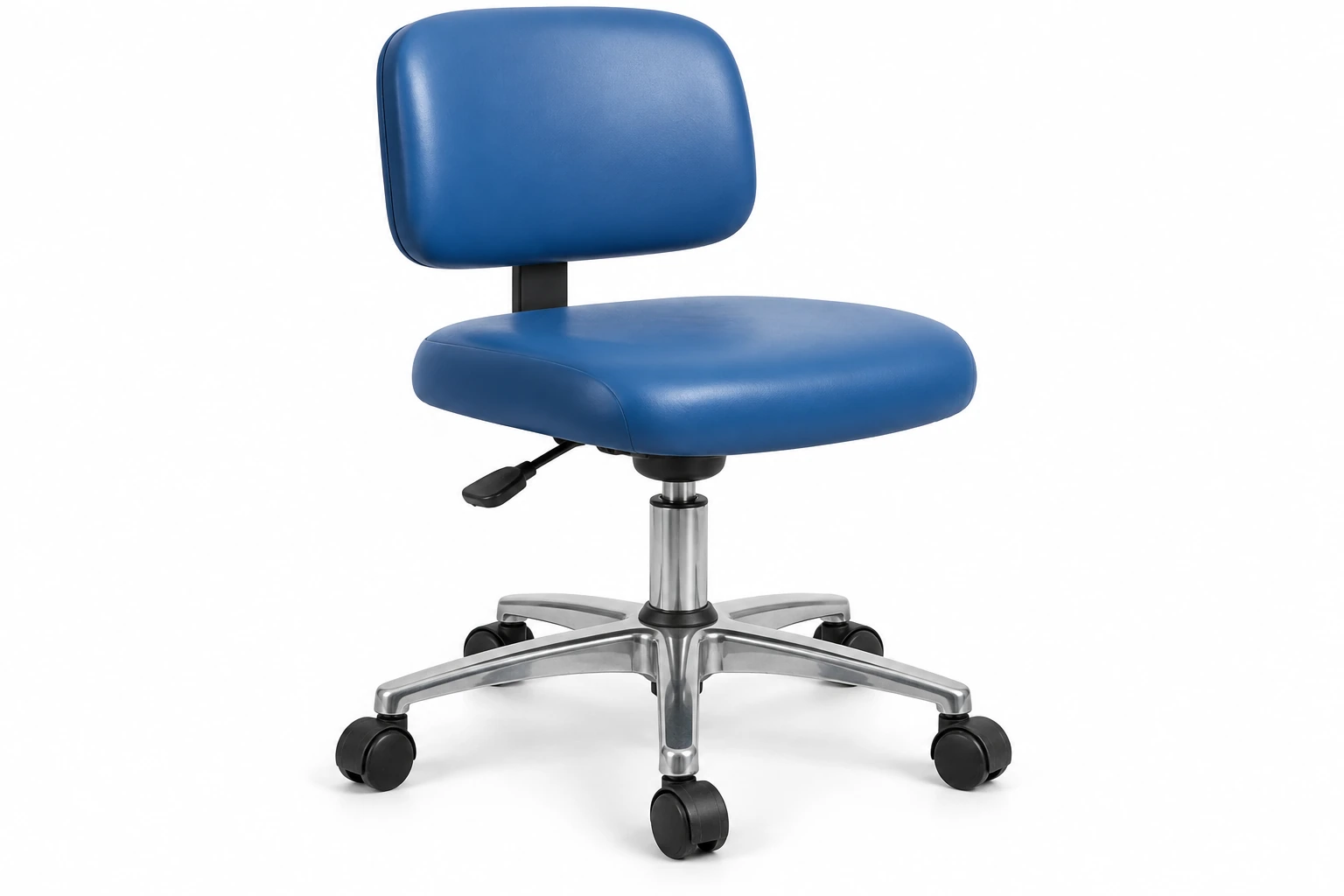
Seating for controlled work
cleanroom chairs
| Seat height H (mm) | Low: 460–630; high: 600–870 |
|---|---|
| Seat W × D (mm) | 460 × 440 |
| Seat and back | Sealed synthetic-leather upholstery; adjustable backrest |
| Base and contact | Five-spoke metal base; glides or floor-compatible castors |
| Height adjustment | Pneumatic lift; foot support for high seating |
| Armrests | Armless or adjustable-arm configurations |
| ESD selection | Dissipative construction where required; configuration-specific evidence |
H is the floor-to-seat height; W and D are seat width and depth. Height range, base and upholstery are selected as a matched configuration.
The seat height, upholstery, base and accessories can be customized to suit your workstation and operating conditions.
A cleanroom chair has to work close to exposed products while moving with its operator throughout the shift. The useful choices are the surfaces that can be cleaned, the parts that move, and the position the chair allows at the bench. Selecting these together makes seating practical for inspection, assembly, laboratory and other controlled production tasks.
Surfaces and movement
Look underneath the seat as well as at the upholstery.
A smooth top surface is only part of the construction. The underside of the seat, backrest attachment, adjustment controls and base also enter the room. Exposed foam, loose fabric edges and inaccessible recesses complicate cleaning even when the chair looks suitable from above.
Sealed upholstery and covered construction reduce exposed absorbent areas. They do not eliminate wear: repeated movement can damage the seat edge, and a hard collision with a bench can open a covering. A useful purchasing specification describes the seat enclosure and replaceable parts, rather than relying on a colour or a polished base to identify a cleanroom product.
Choose a covering against the cleaning process actually used. Record the cleaner, concentration, contact time and drying method. A broad statement such as “wipe-clean” does not establish compatibility with every disinfectant or repeated soaking.
Fit the chair to the operation.
The floor, bench and task determine which adjustments are useful.
Seated precision work
Position the operator close enough to see and handle the part without reaching over the front of the seat. A backrest is useful only if its position allows the operator to use it during the task. Test the fit with the clothing and footwear worn in the room.
Elevated benches
A higher seat changes access to the floor and the way the operator gets on and off. Include suitable foot support and select the complete base and braking arrangement for that height. A long lift fitted to an unrelated low-chair base is not a complete high-seat specification.
Shared stations
Controls need to remain reachable and recognisable with work clothing on. Establish a simple reset routine for each operator. If a wide range of users cannot fit one chair, splitting the seating specification can be more practical than adding adjustments nobody can use.
Allow movement where the work needs it.
Castors help when the operator changes position between adjacent tasks. Their tread and braking behaviour should suit the floor and the seated working position. Glides provide a different contact arrangement for a station that does not need to roll; they still need to be compatible with the floor finish.
Check the whole base envelope under the worktable. A seat can slide under the tabletop while its base catches a crossmember, drawer pedestal or nearby trolley. Include the space behind an occupied chair in the working aisle.
Keep the approved configuration in service.
Seat damage, loose backrest attachments, contaminated castors and a height adjustment that slips are useful maintenance triggers. An inspection should include the underside and moving parts, not only the surface wiped between shifts. Follow the selected chair's maintenance instructions and use compatible replacement parts.
A replacement wheel or seat covering can change more than appearance. Keep the approved part details with the furniture record, especially where electrical performance or a particular cleaning method forms part of the specification.
For a quotation, share the bench height, task, users, floor finish and cleaning method. Add any required cleanroom assessment or ESD documentation. If backrest support and compact access are competing priorities, compare chairs and stools before choosing the fleet.
The seat height, upholstery, base and accessories can be customized to suit your workstation and operating conditions.