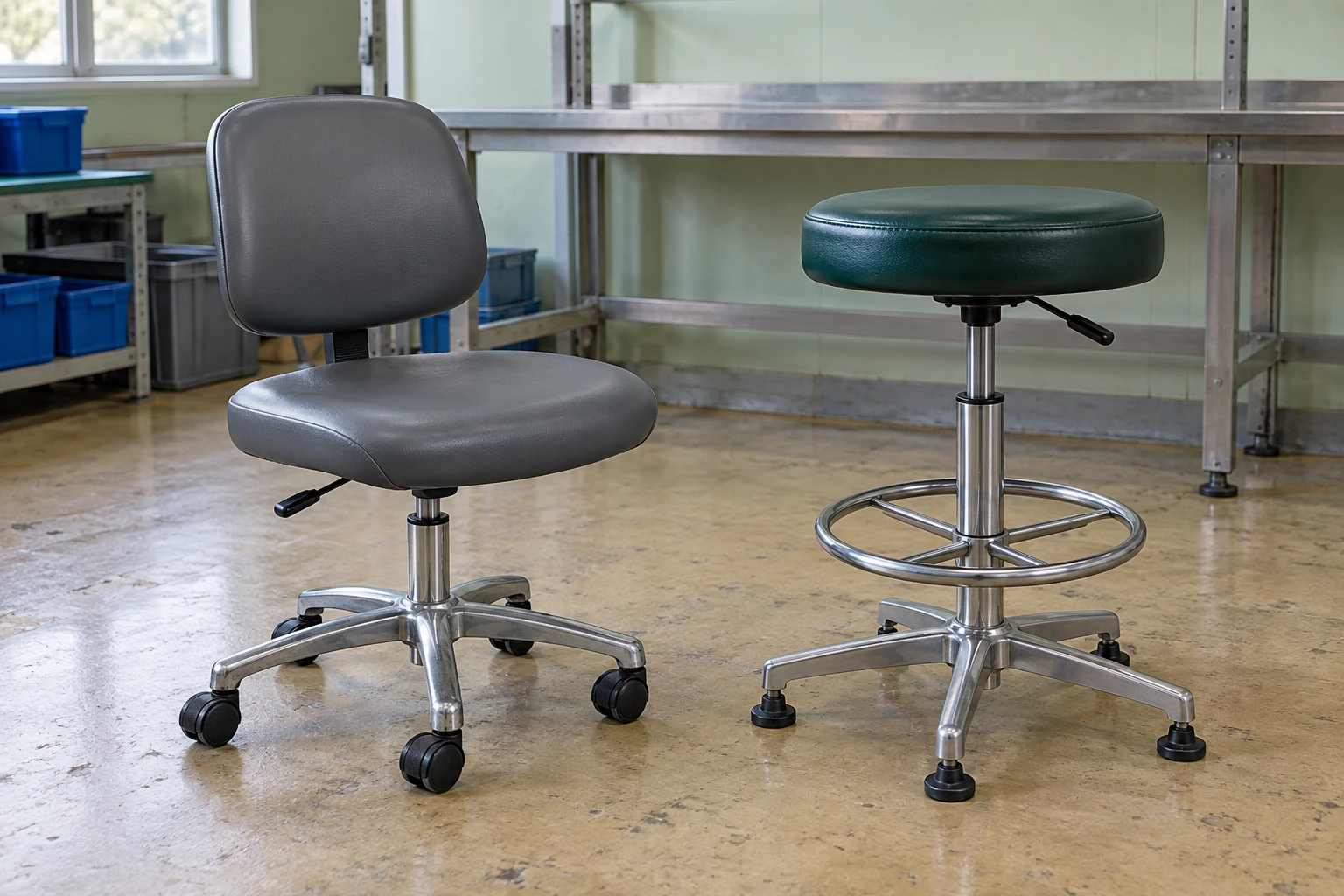
Choose seating by task
cleanroom chairs and stools
| Low chair seat H (mm) | 460–630 |
|---|---|
| High chair seat H (mm) | 600–870 |
| Low stool seat H (mm) | 460–630 |
| High stool seat H (mm) | 570–850 with footring |
| Contact surfaces | Sealed upholstered seat; backrest on chair configurations |
| Floor contact | Five-spoke base with glides or suitable castors |
| Controls | Seat-height adjustment; backrest adjustment on chair variants |
All heights are measured from the floor to the seat. Chair and stool ranges describe separate configurations, not one interchangeable lift assembly.
Chair and stool configurations can be customized for your work heights, access needs, cleaning process and operating environment.
A chair and a stool solve different seating problems. A chair brings a backrest into a fixed working position; a stool leaves more room around the operator for short tasks and changes of direction. Choosing between them starts with what the person does at the station, how long they stay there and where their feet can rest.
Start with the task, then choose the seat.
| Working situation | Useful starting point | What to resolve |
|---|---|---|
| Repeated inspection or assembly at one bench | Chair with an adjustable backrest | Can the operator reach the work while still using the backrest? |
| Brief access to several sides of a small work area | Compact stool | Is the task short enough, and is frequent repositioning practical? |
| An elevated instrument or work surface | High chair or high stool with suitable foot support | Seat access, leg clearance and base stability must work together. |
| A shared station used by different people | A defined adjustment range, or more than one seating configuration | Try the shortest and tallest users before standardising the order. |
A stool is not automatically the better choice because the room is small. Its seat may occupy less space while the five-spoke base still needs clearance. Equally, a chair with a backrest provides little practical support if the task keeps the operator leaning beyond it.
Backrest seating
Give a fixed station a usable resting position.
A chair suits work where the operator remains at the same location and can alternate between close work and a supported position. Backrest location, seat depth and access to controls matter more than the visual size of the back.
Armrests add another contact point, but they also occupy space beside and beneath the bench. Use chairs with arms where the supports can be positioned without obstructing the task. An armless chair may fit a narrow opening more readily.
Open access
Use a stool where movement is part of the job.
A backless stool leaves the upper body and surrounding work area more open. This can suit occasional instrument access, short checks or a station approached from more than one direction. It also removes the backrest as a support surface, so task duration and the opportunities to change position need attention.
A footring on a high stool gives the feet a place to rest when the floor is out of reach. Check its position relative to the seat and operator, and keep the approach clear. Do not assume a footring can be used as a climbing step unless it is designed for that purpose.
Work height is not seat height.
The useful working level may be the top of a fixture or the view into an instrument, rather than the bare tabletop. Consider that level, the operator's reach and the available knee space together. Raising the seat alone can create a new problem if feet lose support or the bench underside blocks the legs.
Try seating at the actual station with its tools, trays and foot controls in place. The test should include getting on, moving into position and leaving, not just sitting still. Select glides, castors and any braking mechanism as part of the complete seating configuration.
A cleaning routine needs to cover both designs.
The underside of a round stool is easy to miss, while a chair adds backrest joints and possibly armrest mounts. Include these locations in the cleaning access review. Move seating only along approved routes so that a convenient spare does not become a vehicle for transferring floor debris between areas.
Where bare metal seating fits the cleaning process, compare the existing stainless steel cleanroom stool. For padded seating, agree the covering and replacement policy before purchasing. Send a list of stations with task duration, work height and cleaning method to define a practical mix of chairs and stools.
Chair and stool configurations can be customized for your work heights, access needs, cleaning process and operating environment.