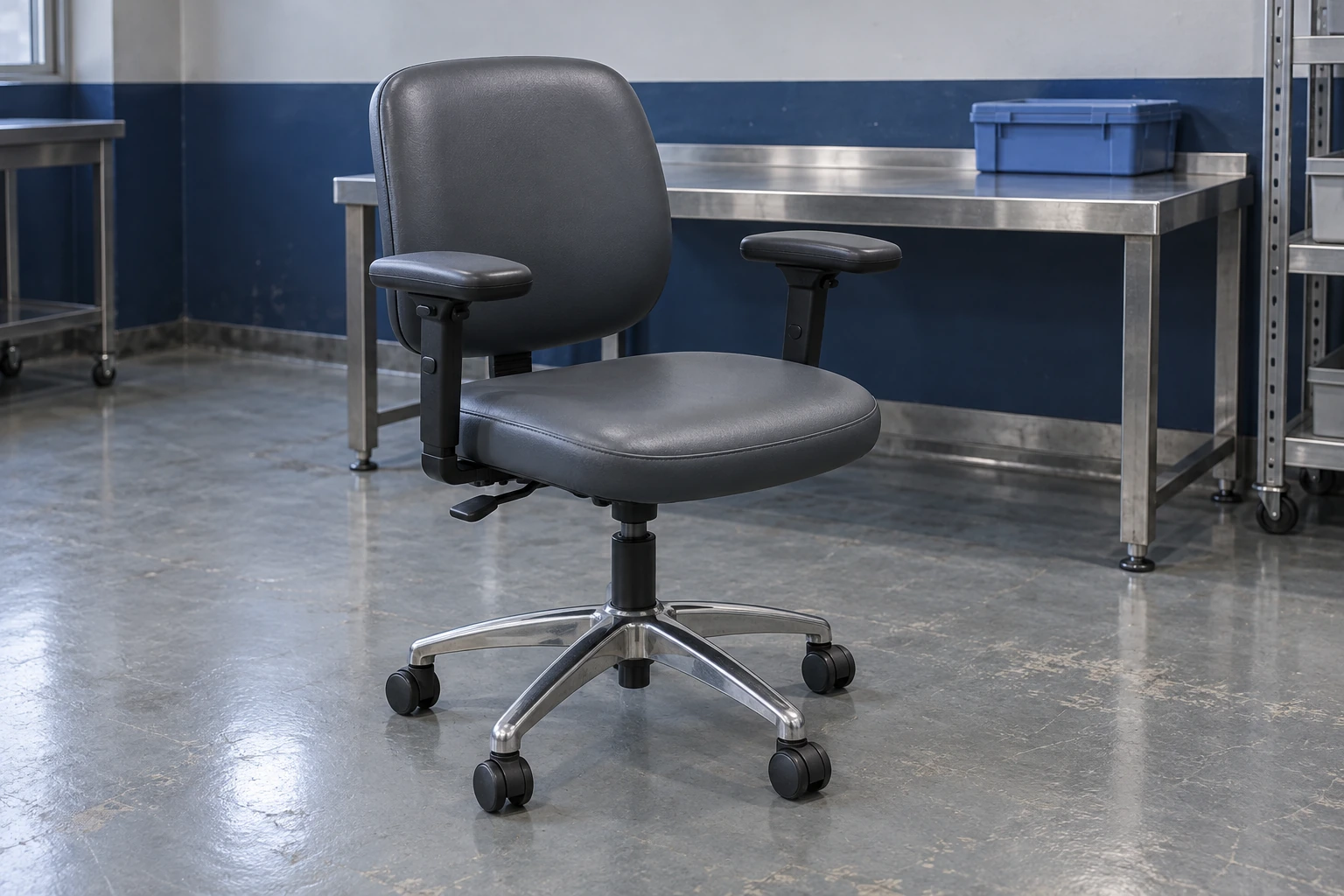
Arm support and bench access
cleanroom chairs with arms
| Seat height H (mm) | Low: 460–630; high: 600–870 |
|---|---|
| Seat W × D (mm) | 460 × 440 |
| Armrest type | Fixed or adjustable, according to chair configuration |
| Adjustment options | Height; width, pad depth and pivot on multi-adjustable arms |
| Seat and back | Sealed synthetic-leather upholstery; adjustable backrest |
| Base | Five-spoke metal base with glides or suitable castors |
| High-seat support | Foot support coordinated with seat height and base |
H is floor-to-seat height; W and D describe the seat. Armrest width and height must also fit the bench opening and operator.
The armrest arrangement, seat height, covering and base can be customized for your working position and operating conditions.
Armrests can provide a useful resting position during inspection, control or light assembly work. They can also stop a chair reaching the bench or obstruct a sideways movement. A cleanroom chair with arms should therefore be selected around the complete working position, with enough adjustment and cleaning access for the task.
Access comes first
Keep support from becoming an obstacle.
Imagine the chair moving into the station with its operator already seated. The arm pads need to pass the bench edge, while the base and knees need their own clearance below. Checking only the seat width misses the outer width of the arms and the height at which they meet the work surface.
A support that is too high may interfere with a relaxed working position. A support too far from the body may go unused. The useful setting is the one that works with the person's clothing, reach and actual task, not simply the middle of the adjustment range.
Different adjustments solve different clearance problems.
Height
Moves the support up or down relative to the seat. Test it at the intended seated working height; lowering the whole chair just to clear the arms can put the operator at the wrong level for the work.
Width
Changes the spacing between the supports. It affects both the operator's position and the overall width beside the bench. Include garment bulk when checking the available space.
Pad depth and pivot
Move or turn the contact surface for different hand positions. They can help keep the pad away from a bench edge, but the settings must remain stable during normal use.
Fixed arms
Offer a simpler arrangement where a known task and user fit the geometry. Fewer adjustments can simplify operation, but there is less scope to recover from an unsuitable height or spacing.
Try the complete work sequence.
- Set the seat first. Establish the working height and backrest position with suitable foot support. Keep the normal garment and footwear on.
- Bring the chair to the task. Check the bench edge, underside, drawer units and tools. The arms should not force the operator to sit farther away than the task permits.
- Place the supports. Adjust the pads for the intended resting position, then perform the actual hand movements. Include reaching a tray or control to the side.
- Leave and reset the station. Check that the operator can move out without catching clothing and that another user can identify and change the settings.
This sequence is especially useful before standardising several shared stations. If the arms remain in the way after adjustment, a different support geometry or an armless chair configuration may fit the work more naturally.
Armrests add surfaces to the cleaning route.
The pad top is touched frequently, but the underside, adjustment column and mounting point also need access. Look for intact smooth contact surfaces and a construction that allows the prescribed cleaning method to reach these locations.
A thick soft pad is not useful if its covering opens at the edge or reacts badly to the cleaner. Include the pad material in the compatibility review alongside the seat and backrest. Do not assume a chemical approved for the metal base is suitable for every polymer or covering.
Keep the support within its intended use.
Armrests are not automatically lifting handles or load-bearing transfer aids. Where the operator will push heavily on the supports, define that use and obtain the relevant capacity information for the chosen construction. Loose mounts or damaged pads should be addressed before the chair returns to service.
For a quotation, send the bench opening, work-surface height, task and preferred support arrangement. Include the cleaning method and any ESD requirement. For stations where open access matters more than arm support, compare the chair and stool options.
The armrest arrangement, seat height, covering and base can be customized for your working position and operating conditions.