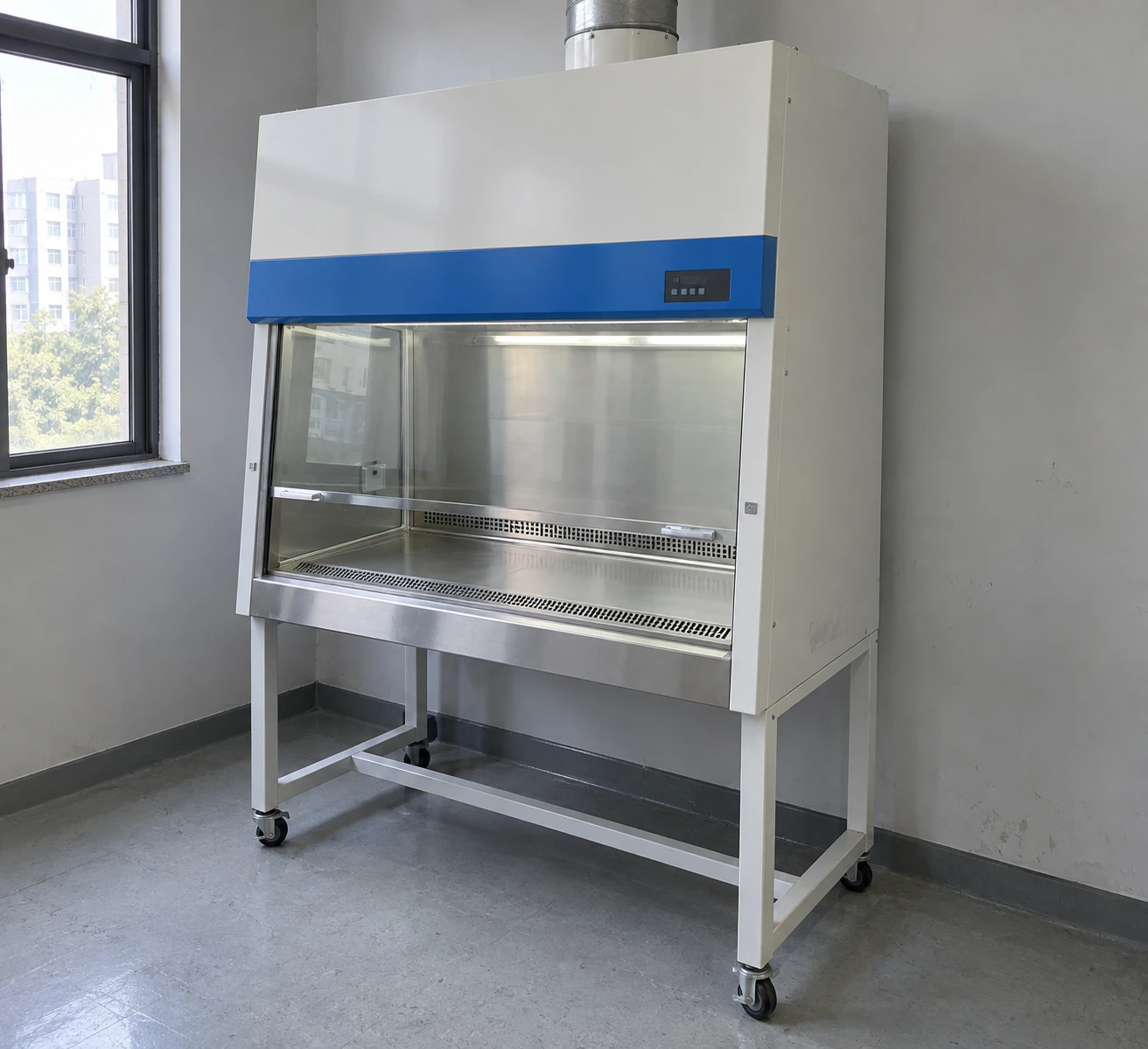
Biological Safety Cabinets
biological safety cabinet bsc
| Brand | shengtongJH |
|---|---|
| Supply focus | Front-access Class II A2 BSC and its installation accessories |
| Cabinet external W × D × H | 1080 × 845 × 2160 / 1380 × 845 × 2160 / 1680 × 845 × 2160 mm, including stand |
| Corresponding work chamber W × D × H | 920 × 620 × 650 / 1220 × 620 × 650 / 1520 × 620 × 650 mm |
| Cabinet materials | Coated steel housing; stainless steel work chamber and tray |
| Supply and exhaust filters | HEPA filter assemblies matched to the selected cabinet air system |
| Exhaust accessory | Room-discharge diffuser or compatible A2 canopy kit, as selected for the duty |
| Power supply | 220–240 V, 50 Hz option; local plug, sockets and total load specified with the cabinet |
| Stand options | Fixed or height-adjustable support; delivery sections to the accepted drawing |
| User information | Sash-position and airflow indication with audible/visual alarms |
| Service package | Operating manual, cabinet identity, filter/part references and agreed test documentation |
Cabinet dimensions exclude the room's service and operating clearances. Exhaust accessories, support height and electrical supply are coordinated with the selected configuration before supply.
The BSC, stand, service fittings, exhaust accessory and documentation package can be customized to the laboratory layout and approved application.
BSC is the abbreviation for biological safety cabinet. A successful BSC purchase connects the cabinet's protective function to the room, the people who maintain it and the documents needed for future service. This page focuses on those practical interfaces for a front-access laboratory cabinet.
Turn a cabinet order into an installation brief
The cabinet can arrive with the correct working width and still be difficult to install. A stand may not pass through an internal door, the overhead outlet may meet a low ceiling, or the proposed position may leave no route for future filter replacement. These are purchasing decisions because they affect the supplied sections and accessories.
Record the delivery route separately from the finished cabinet footprint. Include lifts, turns, door openings and the point at which the support will be assembled. Then reserve the service space required by the selected cabinet's installation instructions. These clearances should remain available after neighbouring benches are fitted.
Close the gaps between equipment and building works
Cabinet package
Identify the cabinet class, working chamber, stand, sockets and accessory connections. An included support or exhaust diffuser should be explicit in the supply schedule, rather than inferred from a product image.
Facility connection
Identify who supplies any duct, canopy, extract fan, controls and electrical connection. A Class II A2 canopy and a total-exhaust B2 connection serve different air systems; the right interface follows the chosen cabinet type and duty.
Acceptance
Agree who completes the installed tests and who receives the report. This makes the handover a defined part of the project rather than an unresolved task after the delivery crew leaves.
A running fan is not an acceptance result
A powered cabinet with a lit display shows that it has started; it does not establish its installed containment performance. Relevant assessment includes airflow, filter integrity, airflow patterns and the effect of the installation. The test method and limits must follow the actual cabinet and applicable requirements.
The Thermo Scientific A2 manual calls for qualified field testing at installation, periodic testing and retesting after specified changes such as relocation or filter replacement. An owner's maintenance plan should preserve the corresponding requirements for the cabinet actually supplied.
Keep replacement information usable
Retain the cabinet identity, electrical version, filter assembly references, gasket details and the latest accepted test report together. This helps a service provider distinguish a matching replacement part from one that merely has a similar outside size.
A filter-media efficiency number cannot confirm that a new assembly seals correctly in an existing cabinet. Replacement selection also depends on frame geometry, sealing arrangement and the cabinet's airflow requirements. The air filter category covers filter products; the BSC remains a complete tested air-containment system.
Plan access before it becomes urgent
Leave access to the intended service panels and to the top of the unit. Do not convert maintenance space into permanent storage or extend a bench across a panel that must be removed. An inaccessible cabinet can require surrounding work to be dismantled during a later repair.
Service involving a used containment cabinet also needs a facility-approved decontamination and handover plan. That responsibility should be clear before a contractor is asked to open the enclosure; it is not ordinary bench-equipment maintenance.
Compare the complete supply scope
Two quotations may cover different support stands, exhaust kits, local electrical arrangements and testing responsibilities. Compare those inclusions against the same brief before judging the price difference. Excluding a necessary interface from the equipment line can simply move its cost and delay into installation.
shengtongJH provides trading and equipment-sourcing coordination. For a new cabinet class decision, start with the biological safety cabinet selection overview; for A2 versus B2 architecture, use the Class II cabinet page. The quotation can then address a defined equipment and accessory package.
The BSC, stand, service fittings, exhaust accessory and documentation package can be customized to the laboratory layout and approved application.