Airflow Capture Hoods
Airflow Capture Hoods
| Measurement duty | Supply and return volume flow; display units m³/h, L/s or CFM |
|---|---|
| Instrument range | 42–4,250 m³/h instrument configuration; usable range and accuracy depend on the selected assembly |
| Hood sizes, W × L | 610 × 610; 305 × 1,220; 610 × 1,220; 915 × 915 mm — nominal frame formats |
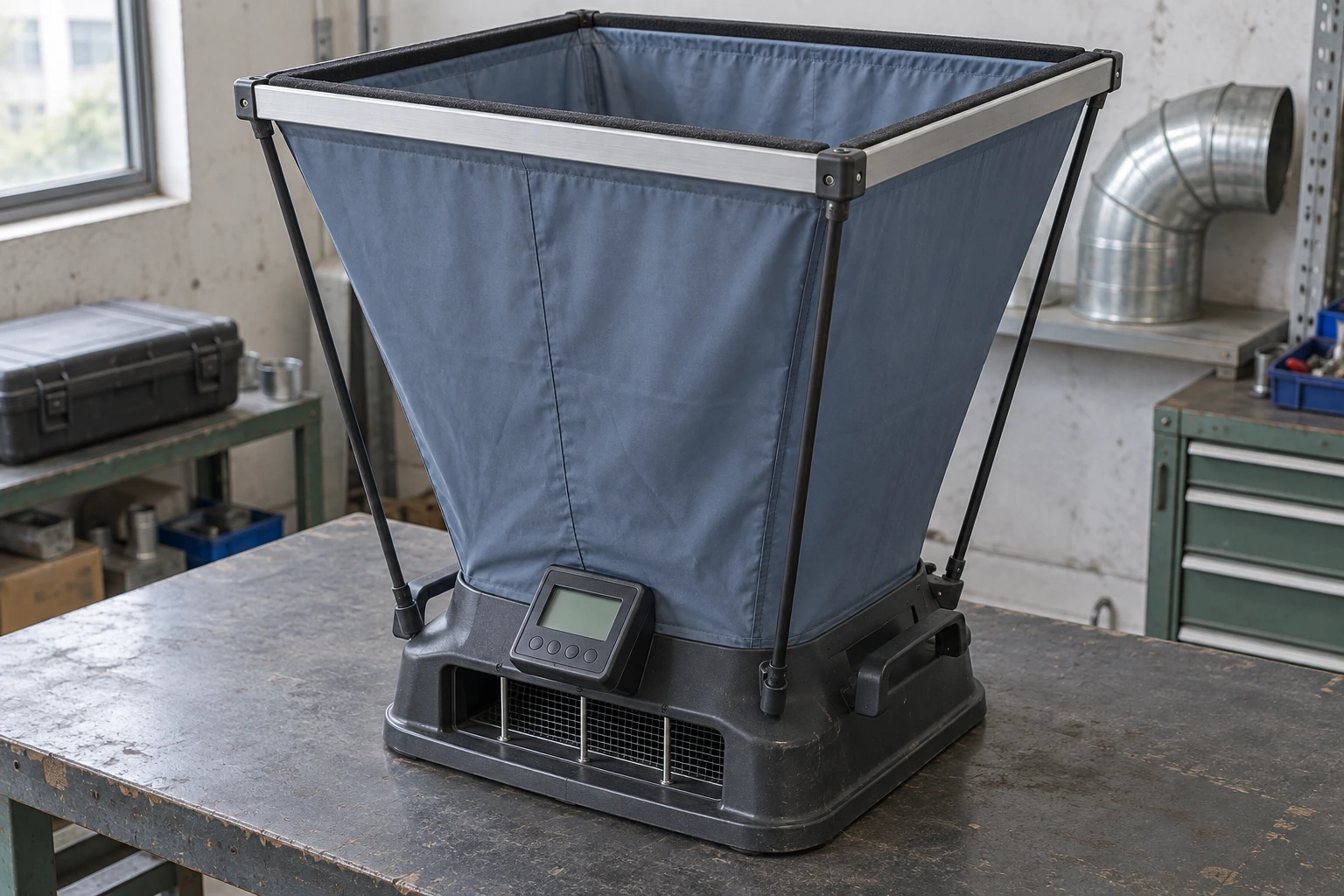
| Assembly | Collapsible fabric, gasketed frame, support rods and differential-pressure measuring base |
| Measurement options | Flow conditioner; backpressure compensation; detachable meter and data logging, according to configuration |
| Field accessories | Battery-powered meter, carrying case, interchangeable hood kits and compatible support stand |
Select the hood, base and meter as a compatible system. Nominal frame dimensions are not the clear opening or assembled height; confirm fit and the supplied instrument specification before ordering.
Airflow capture hoods measure the volume of air passing through a ventilation terminal. A fabric hood collects the flow over a diffuser or grille and channels it through a measuring base. For commissioning teams and building maintenance staff, the useful result is a repeatable terminal flow reading that can be compared with the ventilation schedule and earlier measurements.
Start with the terminal you need to measure
A supply diffuser can feel active while still delivering less air than its scheduled duty. A capture hood gives the technician a volume-flow result for that terminal. It is useful when balancing offices, laboratories and production buildings, and when investigating a ventilation change after filter replacement, duct modification or equipment relocation.
The reading answers a different question from a spot air-speed measurement. Air leaving a diffuser is rarely uniform across its face, so one velocity reading multiplied by the visible grille area can be misleading. Collecting the complete outlet flow reduces the need to estimate its effective open area. The hood still has to fit the terminal and operate within its calibrated conditions.
Fit around the whole opening
Choose the frame from the outlet shape and the available sealing surface. A nominal hood size does not identify its usable internal opening: the frame and gasket occupy space. Check the grille surround as well as the outlet itself, especially beside a wall, light fitting or exposed pipe.
A gap around the rim lets air bypass the measuring base. A twisted frame or loose fabric can make positioning inconsistent between readings. Use the matching fabric and support arrangement for each frame. A long slot outlet may need an elongated hood or a documented alternative method; measuring overlapping pieces and simply adding them can alter the flow being assessed.
Control the measurement conditions
Swirl diffusers send air into the hood at changing angles. A compatible flow conditioner helps align that flow before it reaches the sensing grid. It addresses inlet turbulence; it does not correct a leaking perimeter or make an unsuitable measuring range acceptable.
The hood itself adds resistance and can change the terminal flow. Backpressure compensation is a separate function intended to account for that disturbance. Where the instrument uses a two-reading sequence, keep the ventilation setting steady throughout. A damper adjustment or control-system change between readings undermines the correction.
Make the readings useful for balancing
Identify each terminal on the ventilation drawing before taking readings. Record its target flow, supply or return duty, current operating mode and the hood used. Keep units and actual-air versus standard-air settings consistent with the project measurement procedure. Otherwise, an apparent change between visits may come from the reporting setup rather than the ventilation system.
- Establish a stable starting condition. Bring the air-handling system to the intended test setting and allow the indication to settle before saving a result.
- Investigate a low reading before increasing the fan. Check the seal and measurement mode, then examine the terminal, branch restriction and control position.
- Revisit connected outlets after adjustment. Changing one branch can redistribute flow elsewhere. Compare the final set of readings with the schedule, not just the last outlet adjusted.
Air volume control dampers provide the adjustment point in many duct systems. Where a hood result is disputed or the outlet cannot be captured properly, an appropriate duct traverse can provide an independent comparison. Its access location and method need to suit the duct geometry.
Handling, calibration and the limits of the result
Overhead work makes balance, handle position and display visibility practical selection criteria. A support stand can help maintain a seal, but check its compatibility with the intended measurement mode: some arrangements prevent operation of a backpressure flap. Include the required access height and nearby obstructions in the equipment selection.
Inspect fabric seams, gasket contact and sensing ports before a survey. Keep the pressure grid free from deposits without bending it, and clean components using the instrument instructions. Arrange calibration for the complete measurement assembly, including the base and fabrics used. Set the interval through the instrument guidance and your quality procedure.
A ventilation flow reading alone does not establish room cleanliness, air-distribution effectiveness or containment. Those questions need their own measurements and assessment. For airborne contamination monitoring, see Airborne Particle Counters. For a capture-hood quotation, send the outlet dimensions, expected flow range, ceiling access, reporting requirements and calibration-document needs so the measuring package can be matched to the work.
Hood format, field accessories and the measurement package can be customized to the ventilation outlets and working conditions of your application.